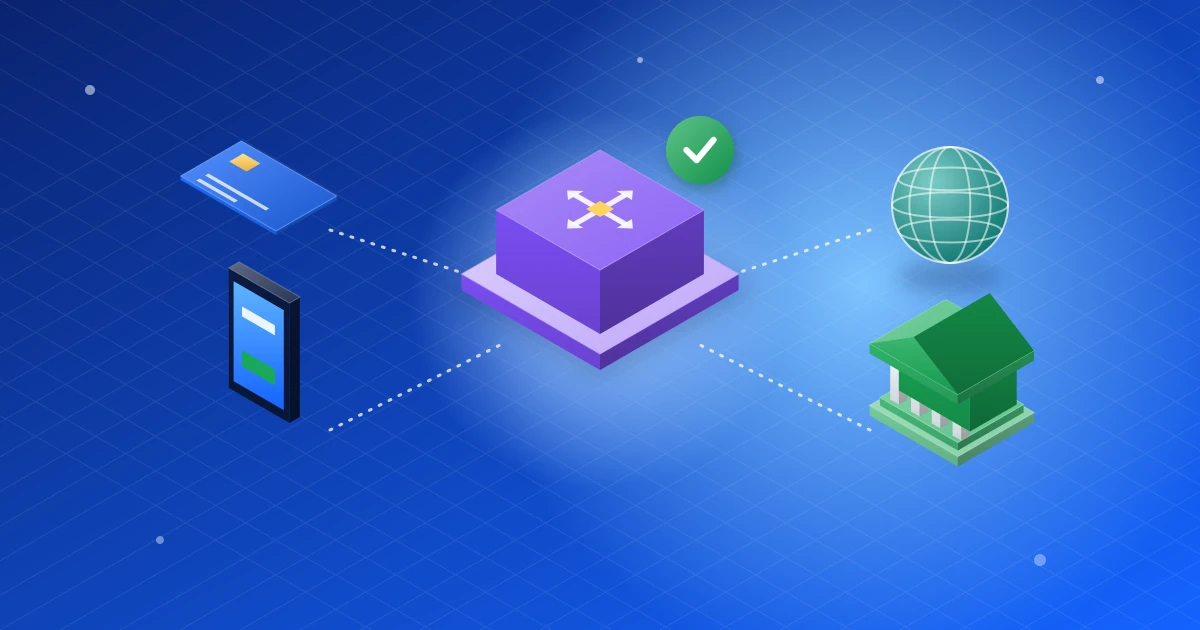
A payment processor is the company that carries your payment request between the shop, the card network and the banks, and then moves the money afterwards. You never see it. However, it touches almost every card payment you make. This guide explains what a payment processor does, how it works step by step, how it differs from a gateway, and which companies process payments in Nigeria.
Quick answer: A payment processor is the behind-the-scenes service that routes a payment request to the card network and the customer’s bank, then returns the approval. Later, it handles clearing and settlement so the merchant gets paid. In Nigeria, companies such as Interswitch, NIBSS, and Unified Payment Services (UPSL) provide this processing among others.
In this guide
- What is a payment processor?
- What does a payment processor do?
- Front-end vs back-end processing
- How a payment processor works, step by step
- Payment processor vs payment gateway vs acquirer
- Who processes payments in Nigeria?
- How much does payment processing cost?
- Frequently asked questions
- Key takeaways
What is a payment processor?
First, every card payment needs a messenger. When you tap a card or click “Pay”, someone must carry that request to the right card network and your bank, and then bring back the answer. In short, that messenger is the payment processor.
In simple terms, a payment processor is the engine room of digital payments. For example, the gateway or POS terminal collects your details. The processor then formats them into the message banks understand, sends them to the right place, and tracks the result.
Most customers never deal with a processor directly. Instead, merchants usually connect to one through a bank, a payment gateway or a POS provider.
What does a payment processor do?
Above all, a payment processor handles five main jobs:
- Routing: it reads the card number and sends the request to the right card scheme and issuing bank.
- Authorisation: it carries the approve-or-decline answer back to the terminal or checkout page.
- Security checks: it applies fraud rules and keeps sensitive data encrypted.
- Clearing: it collects the day’s approved transactions and matches them with each bank.
- Settlement: it works with the banks so the money lands in the merchant’s account.
In addition, many processors provide reports, refunds, chargeback handling, and dashboards for banks and merchants.
Front-end vs back-end processing
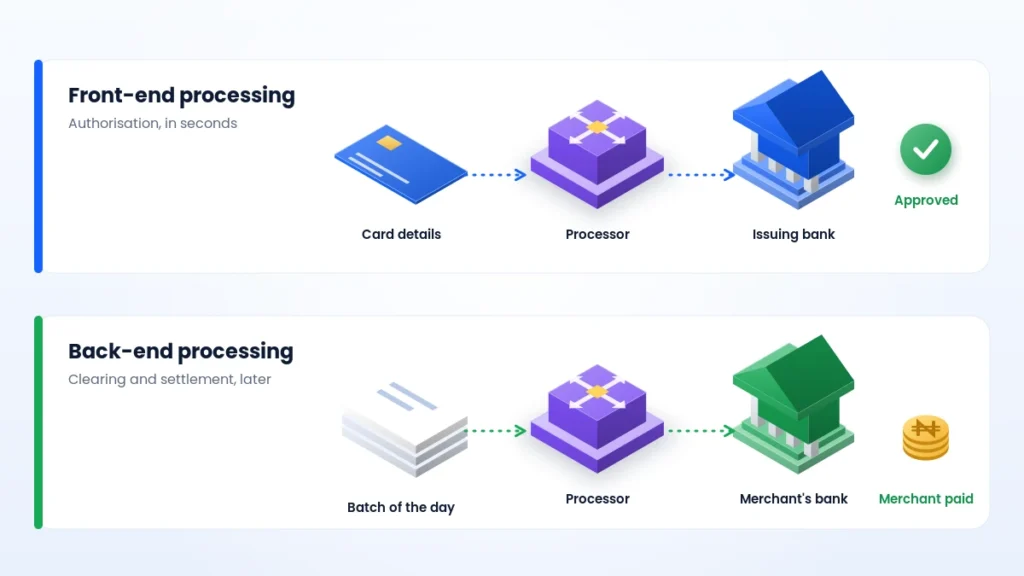
Payment processing happens in two stages. However, people often mix them up.
| Stage | What happens | When |
|---|---|---|
| Front-end processing | Authorisation: the request goes to the bank, and the approval comes back | In seconds, while you wait |
| Back-end processing | Clearing and settlement: approved payments are totalled and the money moves | Later, usually in daily batches |
This split also explains a common puzzle. Your debit alert arrives at once, because the front end has finished. However, the merchant may get the money a day later, because the back end runs on a schedule.
How a payment processor works, step by step
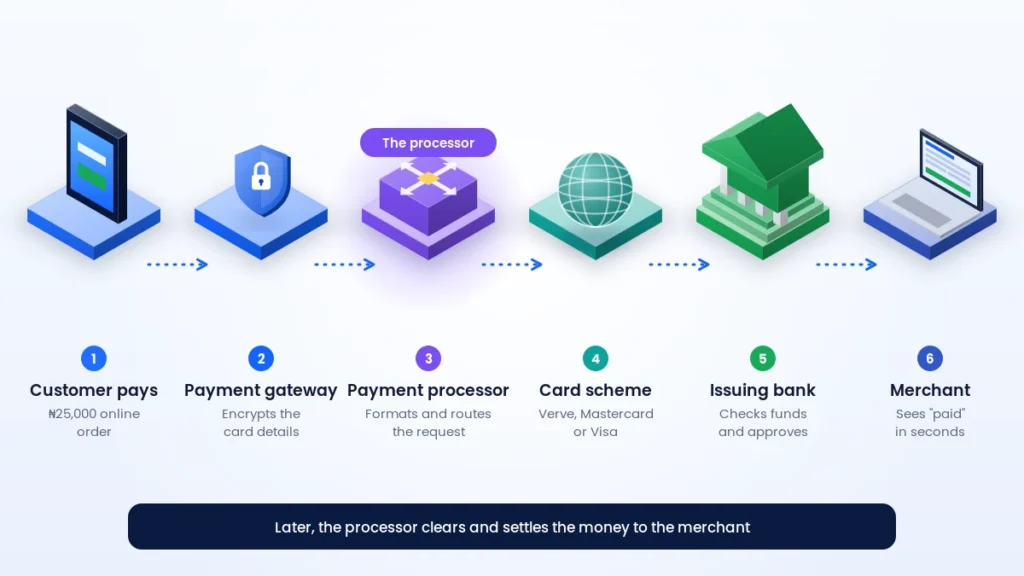
Let’s follow one ₦25,000 online order from start to finish:
- The customer pays. Chidi buys a pair of shoes online and enters his Mastercard details at checkout.
- The gateway encrypts. Next, the payment gateway protects the card details and passes the request on.
- The processor routes. Then the payment processor reads the card number, formats the message and sends it to Mastercard’s network.
- The card scheme forwards it. After that, the network delivers the request to Chidi’s bank.
- The bank decides. Chidi confirms with an OTP, and his bank approves the ₦25,000.
- The answer returns. Finally, the approval travels back through the processor, and the shop sees “Paid” within seconds.
- Clearing and settlement follow. Later, the processor includes the payment in the day’s batch, and the shop’s bank receives ₦25,000 minus fees.
In other words, the processor appears twice: once to get the approval, and once to make sure the money actually moves.
Payment processor vs payment gateway vs acquirer
These three roles work together, so it helps to see them side by side.
| Role | Main job | Simple analogy |
|---|---|---|
| Payment gateway | Collects and encrypts payment details at checkout | The shop’s card machine |
| Payment processor | Routes the request and handles clearing and settlement | The delivery company |
| Acquiring bank | Holds the merchant’s account and receives the money | The merchant’s bank account |
In fact, many modern providers bundle these roles. For example, a fintech may give you a gateway, use a processor behind it and pay you through a partner bank. Our guide to what a payment gateway is covers the checkout side in more detail.
Who processes payments in Nigeria?
In practice, Nigeria’s card payments run on a small number of licensed switching and processing companies. The best known include:
- Interswitch: a major switch and processor, and the company behind the Verve card scheme.
- NIBSS (Nigeria Inter-Bank Settlement System): owned by the CBN and the banks; it runs instant transfers, settlement and AfriGo, and acts as a terminal aggregator.
- Unified Payment Services (UPSL): a processor and switch for banks, and the second terminal aggregator for POS terminals.
- Global card schemes: Mastercard and Visa also process transactions on their own networks.
The CBN licenses these firms separately from gateways. Under its December 2020 licence categories, switching and processing is its own licence. By contrast, payment gateways hold a Payment Solution Service Provider (PSSP) licence, and POS terminal providers hold a PTSP licence. So, when you pay through a fintech app, a licensed processor often works quietly behind it.
How much does payment processing cost?
In most cases, customers pay nothing extra. Instead, the merchant pays a fee on each successful payment, often called the merchant service charge.
Several parties then share that single fee:
- Issuing bank: earns part of it for approving the payment.
- Card scheme: charges its own network fee.
- Processor and acquirer: keep a margin for routing, clearing, and settlement.
However, most small businesses never see this split. Instead, they pay one bundled rate to their gateway or POS provider. Therefore, compare the full rate, the settlement speed, and any extra charges before you choose. Our POS transactions guide shows how the same fee works in a shop.
Frequently asked questions
Is Paystack a payment processor?
Paystack is best known as a payment gateway. It collects payments for merchants and works with processors, card schemes, and banks to complete them. Many people still call it a processor because the merchant only sees one service.
What is the difference between a switch and a payment processor?
A switch connects many banks and routes messages between them. A payment processor may run a switch, but it also handles clearing, settlement, and reporting. In Nigeria, however, the same companies often do both.
Who pays the payment processor?
The merchant pays, usually through the bundled fee charged by their gateway, bank or POS provider. As a result, the customer normally pays only the price of the goods.
Why does settlement take longer than approval?
First, approval happens one payment at a time, in seconds. Settlement, however, groups the day’s payments, checks them against each bank’s records, and then moves the money, so it usually runs on a daily cycle.
Can a small business work with a payment processor directly?
Rarely. Instead, most small businesses connect through a payment gateway or a bank, because direct processor contracts usually suit large merchants and banks.
Key takeaways
- A payment processor routes your payment request and makes sure the money moves.
- Front-end processing approves the payment in seconds; back-end processing settles it later.
- Gateways collect payment details, processors route them, and acquirers receive the money.
- In Nigeria, licensed firms such as Interswitch, NIBSS, and UPSL provide processing.
- Merchants pay one bundled fee, and the bank, the scheme, and the processor share it.
Want to see the full picture? Browse our digital payments guides.