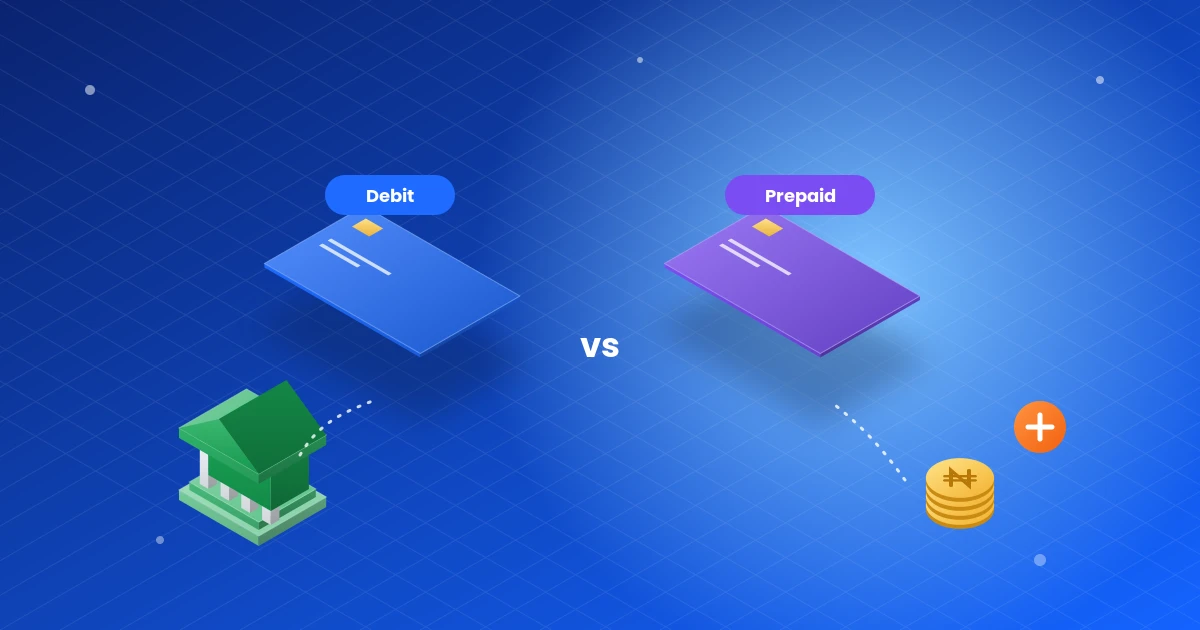
Debit card vs prepaid card: both look the same, both work at POS terminals and online, and both carry a Verve, Mastercard or Visa logo. However, the real difference is where the money comes from. A debit card spends straight from your bank account, while a prepaid card spends only the money you load onto it first. This guide explains how each card works, compares them side by side and shows which one to use for everyday situations in Nigeria.
Quick answer: A debit card is linked to your bank account, so every payment comes directly from your balance. A prepaid card holds a separate balance that you top up in advance, so you can never spend more than you loaded. Use a debit card for everyday spending, and a prepaid card when you want to limit risk or control a budget, such as on new websites or for foreign subscriptions.
In this guide
- What is a debit card?
- What is a prepaid card?
- Debit card vs prepaid card: key differences
- Which is safer: a debit card or a prepaid card?
- Using debit and prepaid cards for international payments
- When to use a debit card or a prepaid card
- Debit card and prepaid card fees to check
- How to get a prepaid card in Nigeria
- Frequently asked questions
- Key takeaways
What is a debit card?
A debit card is a payment card that your bank issues and links to your current or savings account. As a result, when you pay, the money leaves your account almost immediately.
In fact, most Nigerians receive a debit card when they open a bank account. You use it with a PIN at POS terminals and ATMs, and with an OTP for online payments. Because it draws on your full account balance, a debit card is convenient for daily spending. However, if someone steals the card details, your whole balance is at risk until you block the card.
What is a prepaid card?
A prepaid card is a payment card with its own balance. Instead of spending from your bank account, you load money onto the card first, and then spend only that amount.
Prepaid cards also come in several forms:
- Reloadable naira prepaid cards: offered by banks and fintechs for budgeting, gifts or staff allowances.
- Dollar prepaid cards: loaded in US dollars for foreign websites, subscriptions and travel.
- Virtual prepaid cards: card details that live in an app, made for online payments only.
- Gift cards: single-use or limited cards for a specific shop or service.
You still need to verify your identity with your BVN or NIN for most prepaid cards, because issuers must follow know-your-customer rules.
Debit card vs prepaid card: key differences
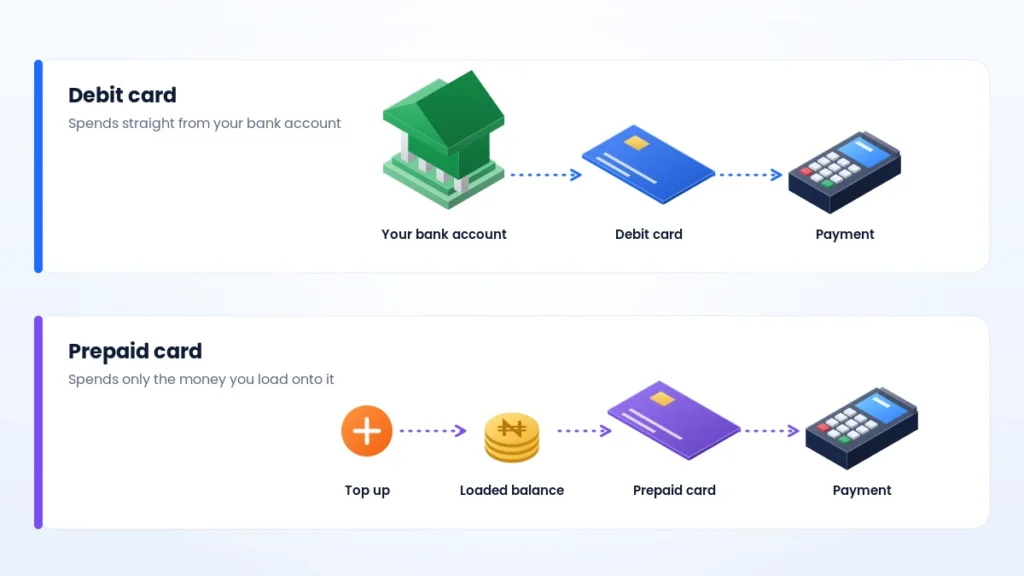
The table below compares a debit card vs prepaid card on the points that matter most:
| Feature | Debit card | Prepaid card |
|---|---|---|
| Where the money comes from | Your bank account | A balance you load in advance |
| Spending limit | Your account balance and bank limits | Only what you loaded |
| Risk if details are stolen | Your whole account balance | Only the card balance |
| Needs a bank account | Yes | Not always |
| Currency | Usually naira | Naira or dollars |
| Typical fees | Issuance and maintenance fees | Issuance, funding and FX fees |
| Best for | Everyday spending | Online safety, budgets and foreign payments |
In short, a debit card offers convenience, while a prepaid card offers control.
Which is safer: a debit card or a prepaid card?
For online shopping, a prepaid card is usually safer. If a website leaks your card details, a fraudster can only take what is on the card. With a debit card, by contrast, the same leak exposes your bank account until you block the card.
That said, safety also depends on the issuer. Banks have clear dispute processes for debit cards, and the CBN requires them to resolve failed card transactions within set timelines. Prepaid cards from smaller fintechs can carry a different risk. For example, in July 2022 several fintechs had to suspend their virtual dollar cards after their card partner’s network access was suspended. Therefore, keep only the money you need on any prepaid card.
Using debit and prepaid cards for international payments
Naira debit cards work abroad again, but with tight limits that vary by bank. In August 2026, for example, reported limits ranged from $100 a month at Stanbic IBTC to $20,000 a quarter for eligible GTBank customers. Your bank also converts each payment at its own exchange rate.
A dollar prepaid card avoids some of these limits, because you fund it in dollars upfront. As a result, it suits foreign subscriptions such as streaming, software or online courses. Before you choose one, check the funding rate, the monthly fee and whether the issuer is a licensed bank or a fintech working through one.
When to use a debit card or a prepaid card
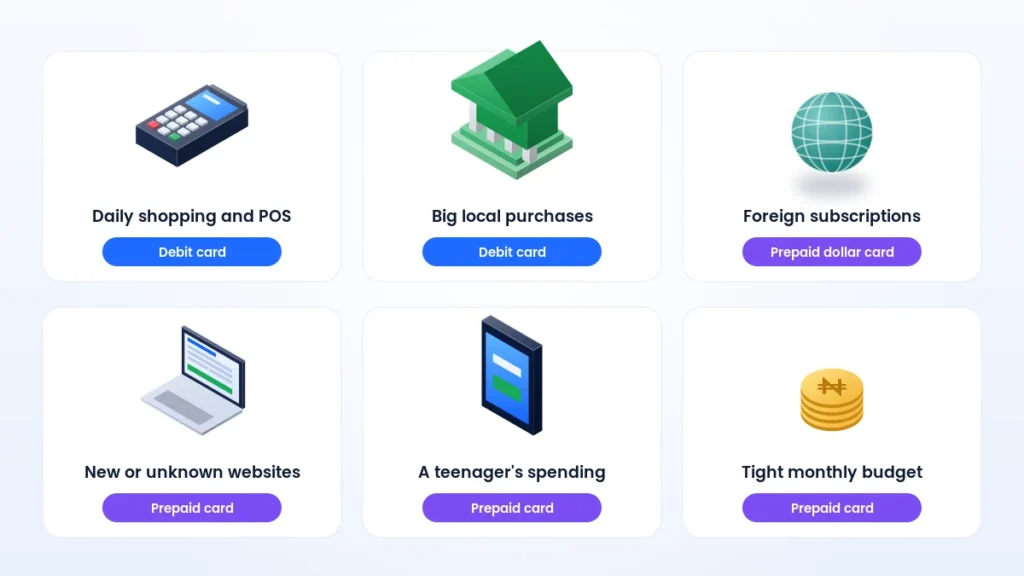
To sum up, here is a simple way to decide:
| Situation | Better choice | Why |
|---|---|---|
| Supermarkets, fuel and POS payments | Debit card | Fast, accepted everywhere, no top-up needed |
| Large local purchases | Debit card | No need to move money first |
| Netflix, software and foreign subscriptions | Prepaid dollar card or a naira card within your bank’s limit | Avoids failed renewals and protects your main account |
| A website you have never used before | Prepaid card | Limits your loss if the site is a scam |
| Pocket money for a teenager | Prepaid card | Spending stops when the balance runs out |
| Sticking to a monthly budget | Prepaid card | You can only spend what you load |
Many people use both. For instance, they keep a debit card for daily life and a small prepaid card for online shopping and subscriptions.
Debit card and prepaid card fees to check
Card fees vary widely, so always read the issuer’s fee page first. Look out for:
- Issuance or replacement fees: charged when you collect a new card.
- Maintenance fees: a small monthly or quarterly charge on many debit cards.
- Funding fees: some prepaid cards charge each time you top up.
- Exchange rate margins: the gap between the official rate and the rate you actually pay on foreign transactions.
- Inactivity fees: some prepaid cards charge if you stop using them.
How to get a prepaid card in Nigeria
In general, getting a prepaid card is quick:
- Choose an issuer. First, compare banks and licensed fintechs that offer the card type you need.
- Verify your identity. Next, provide your BVN or NIN and any other details the issuer asks for.
- Request the card. Then order a physical card at a branch or create a virtual card in the app.
- Fund the card. After that, load only the amount you plan to spend.
- Set controls. Finally, turn on alerts and spending limits, and freeze the card when you are not using it.
To protect any card you own, follow our guide to keeping your POS transactions safe, and read our cybersecurity guides.
Frequently asked questions
Can a prepaid card go into overdraft?
No. A prepaid card can only spend the balance you loaded, so it cannot go below zero in normal use. A debit card also cannot overdraw unless your bank has given you an overdraft.
Is a virtual card the same as a prepaid card?
Not always. Many virtual cards are prepaid, but some banks also issue virtual debit cards linked to your account. Therefore, check whether the card spends from a loaded balance or from your account.
Can I use a prepaid card at a POS terminal?
Yes, if it is a physical card on a scheme the terminal accepts, such as Verve, Mastercard or Visa. However, virtual prepaid cards work only online.
Which is better for online shopping, a debit card or a prepaid card?
For new or unfamiliar websites, a prepaid card is better, because it limits what you can lose. For trusted shops you use often, a debit card is simpler.
Does using a prepaid card build my credit history?
Generally, no. A prepaid card spends your own money, so lenders do not treat it as borrowing.
Key takeaways
- The debit card vs prepaid card difference comes down to where the money comes from.
- A debit card spends from your bank account; a prepaid card spends only what you load.
- Prepaid cards also limit your risk online and help you stick to a budget.
- Naira cards now work abroad again, but each bank sets its own limits.
- Many people get the best of both by using a debit card daily and a prepaid card online.
Want to understand the systems behind your cards? Read what a payment processor is, or browse our digital payments guides.