
Calculators
Bank Charges Calculator
Work out what a bank transfer, ATM withdrawal or POS cash-out really costs in Nigeria, including VAT, stamp duty and the weekly cash limit fee. Every figure shows the rule behind it.
- Free, no sign-up
- Your data stays in your browser
Loading the Bank Charges Calculator…
This free bank charges calculator shows the most a Nigerian bank can charge you for everyday transactions. It covers transfer fees, the stamp duty on transfers, ATM fees at other banks, and the 3% fee on cash above your weekly limit. Above all, it tells you which rule each charge comes from, because the regulators change these rules from time to time.
How to use the bank charges calculator
- Choose what you are doing. First, pick a bank transfer, an ATM withdrawal, a POS agent cash-out, or a card payment at a shop.
- Enter the amount. Then type the amount in naira. Commas are fine.
- Add the details. Next, say who you are sending to, whose ATM you are using, or what the agent charges. For cash, also enter what you have already withdrawn this week.
- Select Calculate. The bank charges calculator then lists each charge, the reason for it, and the total that leaves your account.
- Compare the rules. Finally, for transfers, switch between the rules in force and the CBN’s 2026 proposal to see what may change.
Why bank charges change
Bank charges in Nigeria are not fixed by your bank alone. Instead, the Central Bank of Nigeria (CBN) sets the most a bank may charge in its Guide to Charges, and it reviews that guide every few years. On top of that, the CBN issues separate circulars on ATM fees and cash withdrawals, while new tax laws set duties such as the stamp duty on transfers.
For example, in 2025, the CBN changed ATM fees at other banks’ machines. In January 2026, a new cash withdrawal circular took effect, and the Nigeria Tax Act 2025 moved the ₦50 transfer duty from the receiver to the sender. Then, in April 2026, the CBN published an exposure draft of a new Guide to Charges for comment. So a fee list that was right last year may be wrong today.
That is why the bank charges calculator keeps every figure in one table, shows the date it was last checked, and names its sources. When a regulator changes a rule, we update that table, and the calculator updates with it.
What the bank charges calculator includes
- Transfer fees: the maximum fee for each amount band, plus 7.5% VAT, which banks add to their fees.
- Stamp duty: a flat ₦50 on electronic transfers of ₦10,000 or more, paid by the sender. It does not apply to transfers between your own accounts at the same bank, or to salaries.
- ATM fees: free at your own bank’s ATMs. At another bank’s ATM, ₦100 for every ₦20,000 or part of it, plus a surcharge of up to ₦500 at off-site machines.
- Weekly cash limit: individuals can withdraw ₦500,000 a week across ATMs, POS agents, and counters. Above that, a 3% fee applies to the excess.
- Daily ATM limit: a warning when your withdrawals go above ₦100,000 in a day.
- Card payments at a shop: free for you. The shop pays a merchant service charge instead.
A worked example with the bank charges calculator
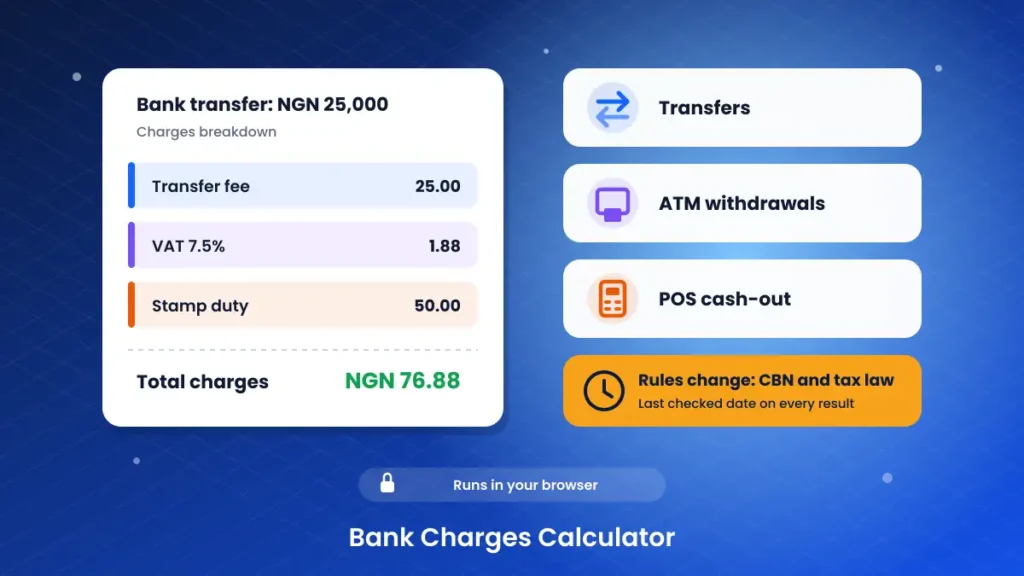
Suppose you send ₦25,000 to a friend at another bank. Under the rules in force, the transfer fee is ₦25, and VAT adds ₦1.88. Because the amount is ₦10,000 or more, stamp duty adds ₦50. So your charges come to ₦76.88, and ₦25,076.88 leaves your account. Under the 2026 proposal, the same transfer would cost ₦60.75, since the fee falls to ₦10.
Now suppose you withdraw ₦50,000 from another bank’s ATM at a fuel station that shows a ₦300 surcharge. The ATM fee is ₦300 because ₦50,000 is three slices of ₦20,000 or part of one. With the surcharge and VAT, you pay ₦645 in total. By contrast, the same withdrawal at your own bank’s ATM is free.
Limits of the bank charges calculator
The bank charges calculator shows the most the rules allow, not your bank’s exact price. Many banks charge less, some waive transfer fees for certain accounts, and POS agents set their own cash-out fees. In addition, the 2026 Guide to Charges is still a proposal, so treat its figures as possible future fees. Therefore, always check your bank’s current fee list, and read the debit alert after each transaction.
Frequently asked questions
Why do I pay ₦50 extra on some transfers?
That is the stamp duty on electronic transfers of ₦10,000 or more. Since January 2026, the sender pays it, and it goes to the government, not your bank.
Can my bank charge more than the bank charges calculator shows?
It should not. The CBN sets the maximum charges, and banks may charge less but not more. If you think a bank has overcharged you, complain to the bank first, then to the CBN if it does not resolve the issue.
Will the bank charges calculator change when the CBN finalises the 2026 guide?
Yes. Once the CBN confirms the final figures, we will update the charges table and the date it was last checked.
Do you store what I enter?
No. The calculator runs in your browser, and nothing you type is sent to us or anyone else.
To understand where these charges come from, read how bank transfers work, how ATM transactions work, and our POS vs ATM guide. Shop owners can estimate what they pay to accept cards with the payment processing fee calculator. For the official ATM fee rules, see the CBN’s ATM fee FAQs.