You type in an account number, check the name, and enter your PIN. A few seconds later, your sister in Kano gets an alert. Bank transfers are now the most common way Nigerians pay each other, from rent and school fees to a plate of suya. This guide explains what happens behind the screen and what each transfer costs. It also covers the limits that apply and what to do when money leaves your account but never arrives.
Quick answer: Most bank transfers in Nigeria use NIBSS Instant Payment (NIP), a switch run by the Nigeria Inter-Bank Settlement System. First, your bank confirms the account name and checks your balance, limits, and fraud rules. Then it debits you and sends the payment to NIBSS, which passes it to the receiving bank. That bank credits the account within seconds. The banks settle the money between themselves later. A transfer usually costs ₦10 to ₦50 plus 7.5% VAT, and transfers of ₦10,000 or more also attract ₦50 stamp duty. To see the full cost of any transfer, try our bank charges calculator.
In this guide
- What are bank transfers?
- How bank transfers work, step by step
- Bank transfers vs card payments
- Types of bank transfers in Nigeria
- How much do bank transfers cost?
- Bank transfer limits
- What to do when a bank transfer fails
- How to send bank transfers safely
- Frequently asked questions
- Key takeaways on bank transfers
What are bank transfers?
In short, a bank transfer moves money from one account to another without cash or a card. Also, you can start it in a mobile app, on internet banking, through USSD, or at a branch. Our guide to digital banking explains the app, internet, and USSD options in more detail.
In general, there are two kinds. An intra-bank transfer stays inside one bank, for example, between two GTBank accounts. So the bank simply moves the money on its own books. An inter-bank transfer, on the other hand, goes from one bank to a different one. Because two banks are involved, it needs a switch in the middle, and in Nigeria that switch is usually NIBSS.
Similarly, fintechs work the same way. For example, Blusalt, OPay, Moniepoint and Kuda hold licences that connect them to NIBSS, so their accounts send and receive transfers like any bank. Our guide to what fintech is explains how these companies work.
How bank transfers work, step by step
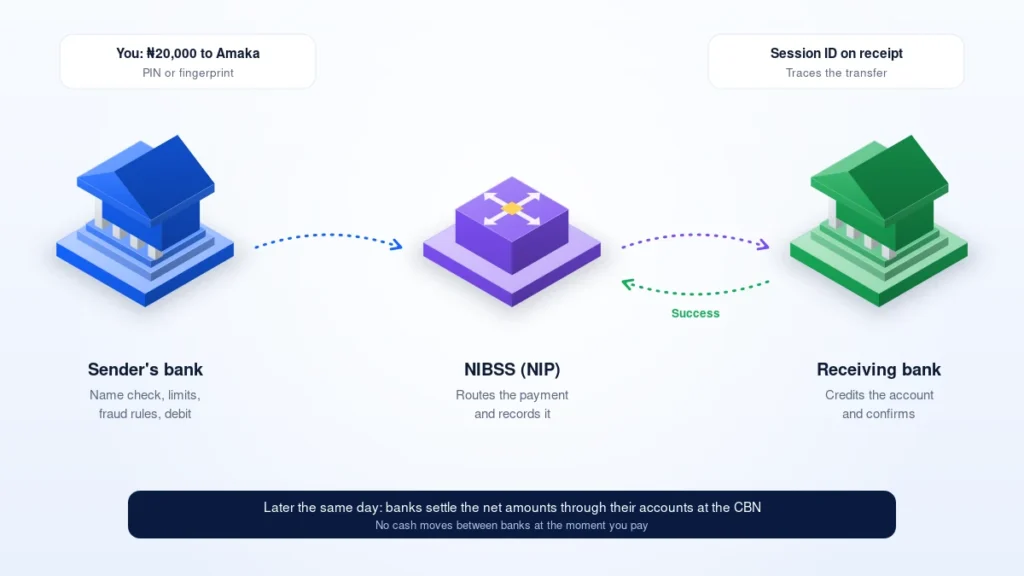
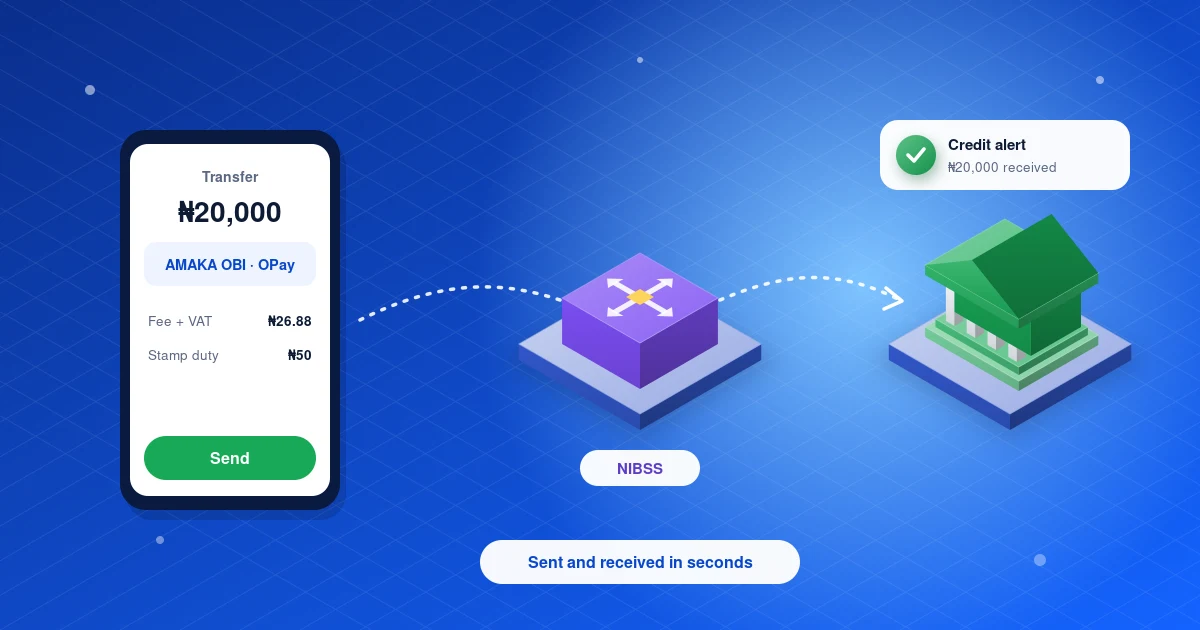
Here is what happens when Tunde sends ₦20,000 from his Access Bank app to Amaka’s OPay account:
- Name check. First, Tunde enters the account number and picks the bank. His bank sends a name enquiry through NIBSS, and Amaka’s name appears on screen.
- Authorisation. Next, Tunde confirms with his PIN, fingerprint, or a one-time code.
- Checks and debit. Then Access Bank checks his balance, daily limit, and fraud rules. If all is well, it debits ₦20,000 plus fees.
- Routing. After that, the bank sends the payment to NIBSS, which forwards it to OPay.
- Credit. Soon after, OPay credits Amaka’s account and confirms success back through NIBSS.
- Alerts. Finally, both of them get alerts, and the receipt shows a session ID that traces the transfer.
Notice that no real cash moved between the two banks at that moment. Instead, NIBSS records what each bank owes. Then the banks settle the net amounts several times a day through their accounts at the Central Bank of Nigeria (CBN).
Bank transfers vs card payments
Both move money between banks, but they work differently:
| Feature | Transfer | Card payment |
|---|---|---|
| Who starts it | The payer, from their own app | Instead, the merchant’s terminal or website |
| Network | NIBSS Instant Payment | A card scheme, such as Verve or Mastercard |
| Receiver gets money | Within seconds | Usually the next business day, after settlement |
| Who pays the fee | The sender | Instead, the merchant |
| Mistakes | Hard to recall, so check first | Also, chargeback rights through the issuer |
As a result, many small shops now prefer transfers, while card payments still offer buyers stronger protection. When a shop builds transfers into its checkout, this is called pay by bank.
Types of bank transfers in Nigeria
However, not every transfer uses the same rail. Here are the main options:
| Type | How fast | Typical use |
|---|---|---|
| NIP (instant) | Seconds | Everyday transfers from apps, USSD, and internet banking |
| Intra-bank | Also instant | Transfers between two accounts at the same bank |
| NEFT | Same or next business day | Bulk payments, such as some salaries and supplier payments |
| RTGS | Within the day | Very large payments between banks and big companies |
| International | One to five days | Money sent abroad through SWIFT or a remittance company |
In practice, you will use NIP almost every time. NIBSS handled about 11.2 billion electronic transactions worth over ₦1 quadrillion in 2024, according to figures reported by The Guardian, and instant transfers make up the biggest share. For cross-border payments, some people now use stablecoin payments instead of SWIFT. Behind the scenes, banks now send these payments in a shared message format, as our guide to ISO 20022 explains. Within Africa, some banks also use PAPSS to send money in local currencies.
Businesses can also collect transfers through a dedicated account number for each customer. Our guide to what a virtual account is explains how that works.
How much do bank transfers cost?
To start, transfers within the same bank are usually free. Inter-bank transfers, however, carry a small fee, plus 7.5% VAT on that fee. Most banks still use these charges:
| Amount sent | Transfer fee | VAT at 7.5% | Fee with VAT |
|---|---|---|---|
| Up to ₦5,000 | ₦10 | ₦0.75 | ₦10.75 |
| ₦5,001 to ₦50,000 | ₦25 | ₦1.88 | ₦26.88 |
| Above ₦50,000 | ₦50 | ₦3.75 | ₦53.75 |
In addition, transfers of ₦10,000 or more attract a flat ₦50 stamp duty. Since 1 January 2026, under the Nigeria Tax Act 2025, the sender pays it instead of the receiver. Salary payments and transfers between your own accounts at the same bank are exempt.
So, here is the total cost of a few typical transfers:
| Amount sent | Fee with VAT | Stamp duty | Total cost |
|---|---|---|---|
| ₦3,000 | ₦10.75 | None | ₦10.75 |
| ₦20,000 | ₦26.88 | ₦50 | ₦76.88 |
| ₦100,000 | ₦53.75 | ₦50 | ₦103.75 |
The CBN’s draft 2026 Guide to Charges proposes cheaper fees: free below ₦5,000, ₦10 from ₦5,000 to ₦50,000, and ₦50 above that, plus VAT. However, it is still a draft, so check your bank’s current charges. Also, many fintech apps give customers a number of free transfers each month.
Bank transfer limits
Above all, your account tier sets how much you can send. In turn, the CBN links each tier to how much identity information you have provided:
| What you provide | Account tier | Daily transfer limit |
|---|---|---|
| Basic details and BVN or NIN | Tier 1 | ₦50,000 |
| Also a valid ID | Tier 2 | ₦200,000 |
| Also proof of address | Tier 3 | Higher limits set by each bank |
Banks may also set their own lower limits on USSD and new devices. For example, a March 2026 CBN circular caps transfers at ₦20,000 for the first 24 hours after you activate banking on a new device.
What to do when a bank transfer fails
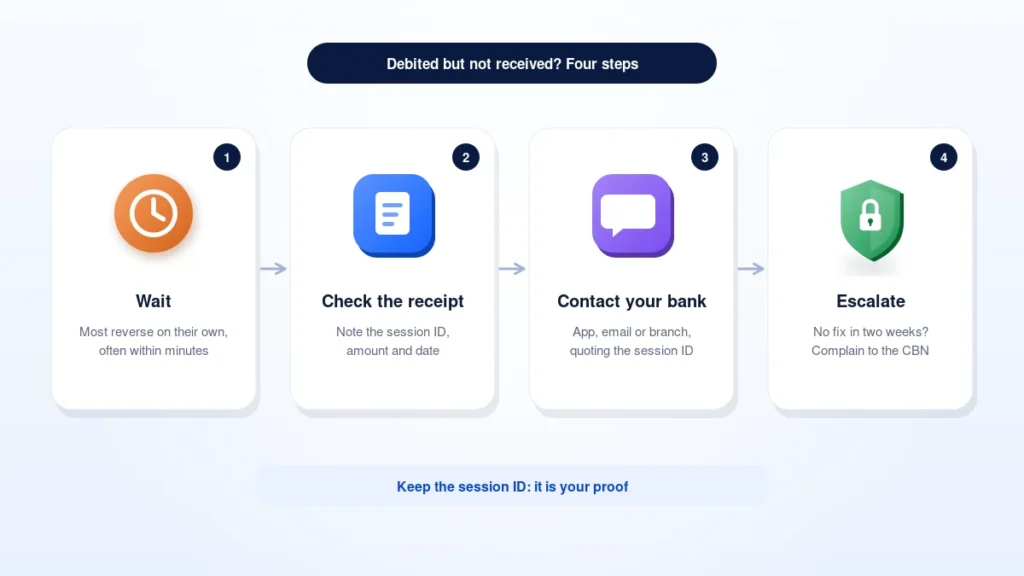
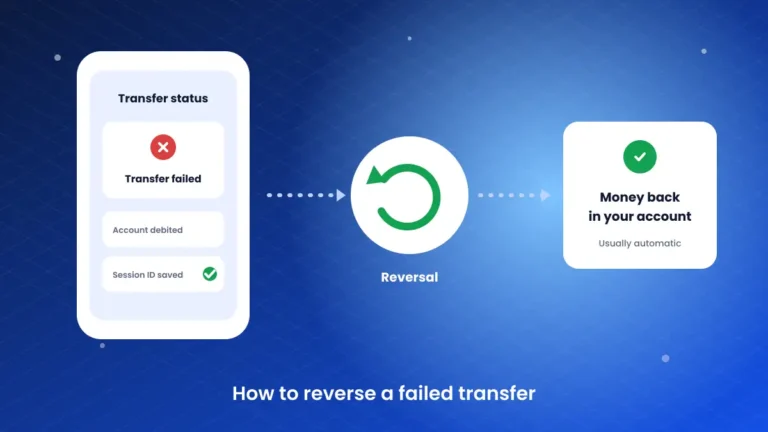
Sometimes your account is debited, but the receiver gets nothing. Usually, a network delay or a timeout at the receiving bank causes it. In most cases, the banks reverse the money automatically, often within minutes and usually within 24 hours. If yours does not come back, our guide on how to reverse a failed transfer explains what to tell your bank.
If the money does not come back:
- Check the receipt. First, note the session ID, amount, date, and the receiver’s bank.
- Confirm with the receiver. Next, ask them to check their balance, not just their SMS alerts.
- Contact your bank. Then raise a complaint through the app, email, or branch, quoting the session ID.
- Escalate if needed. Finally, if your bank does not resolve it within two weeks, complain to the CBN Consumer Protection Department.
Card payments that fail follow a different path. Our guide on why POS transactions fail covers those.
How to send bank transfers safely
Instant transfers are hard to recall once they land. So, a few habits protect you, and our guide on how to protect your bank account online covers the rest:
- Read the name. Always check the account name before you confirm, and stop if it does not match.
- Never pay to “verify” anything. No bank, employer, or agency asks you to send money to unlock an account or a job.
- Watch for fake alerts. Sellers should check their real balance, because fraudsters send fake SMS alerts. Our guide on how to recognise a phishing message covers the other tricks they use.
- Act fast on mistakes. If you send money to the wrong account, call your bank at once. The bank can contact the receiving bank, but it cannot remove money without the receiver’s consent or a court order.
- Guard your phone number. If your line suddenly loses signal, call your network and your bank at once, because it may be SIM swap fraud.
Frequently asked questions
How long do bank transfers take?
In most cases, NIP transfers arrive within seconds. NEFT payments, by contrast, can take until the next business day.
Can I reverse a transfer to the wrong account?
Not by yourself. However, report it to your bank immediately. The receiving bank can then ask the account owner to return it.
What is a session ID?
In short, it is a unique 30-digit number NIBSS gives for every NIP transfer. Banks use it to trace the payment, so keep it for any complaint.
Why does my transfer show “pending”?
Usually, the receiving bank has not confirmed the credit yet. Wait a few minutes, and avoid sending the money again until the status changes.
Is a USSD transfer different?
No, because USSD is only another way to start the transfer. In the end, the money still moves through NIP.
Key takeaways on bank transfers
- Most bank transfers in Nigeria move through NIBSS Instant Payment within seconds.
- Your bank checks the name, balance, limits, and fraud rules before it debits you.
- Inter-bank fees run from ₦10 to ₦50 plus 7.5% VAT, and transfers of ₦10,000 or more add ₦50 stamp duty.
- Also, your account tier sets your daily limit.
- Keep the session ID, because it is your proof when a transfer fails.
Want to see how card payments compare? Read how POS transactions work, or browse more digital payments guides.