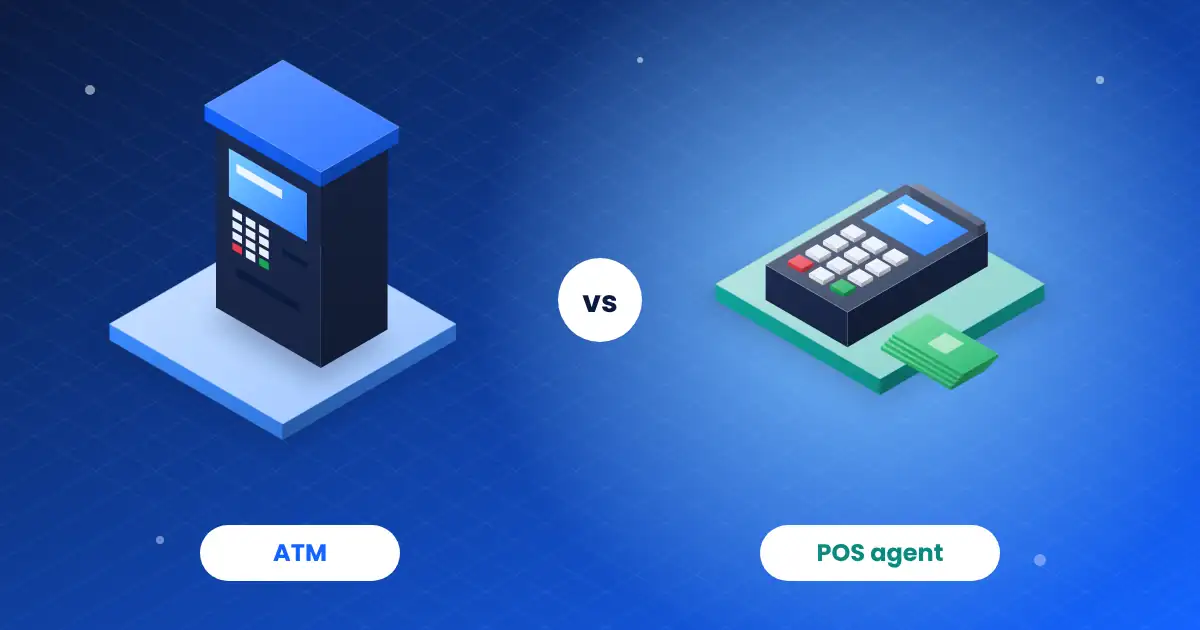
You need ₦20,000 in cash. There is a POS agent at the corner and an ATM ten minutes away. Which one should you use? This guide puts POS vs ATM side by side for cash withdrawals in Nigeria, with the fees, limits, refund rules, and safety points that actually decide the answer.
Quick answer: In the POS vs ATM choice, your own bank’s ATM is usually the cheapest way to get cash, because it is free and failed withdrawals are reversed fastest. A POS agent is more convenient, since agents are everywhere and often have cash when ATMs do not, but the agent sets the charge, and it is usually higher. Both use the same card network behind the scenes, and both count towards your ₦500,000 weekly cash limit.
In this guide
- POS vs ATM: the short answer
- How POS and ATM withdrawals work behind the scenes
- Fees: what a ₦20,000 withdrawal costs
- Limits: how much cash you can take out
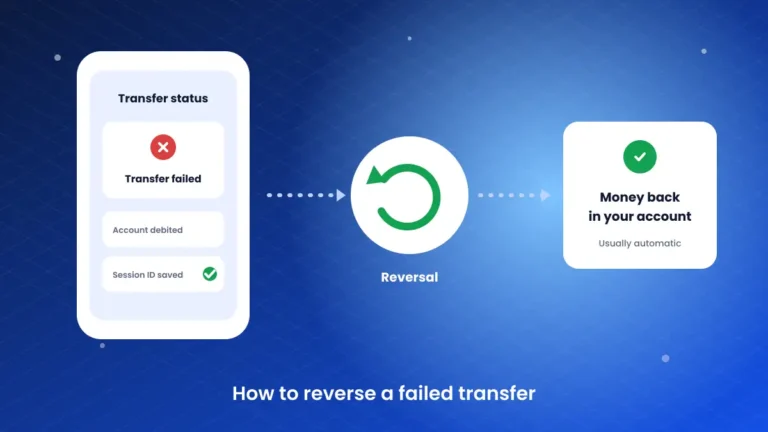
- Failed withdrawals: which one refunds faster?
- Safety: risks at the ATM and at the POS agent
- Why there are more POS terminals than ATMs
- POS vs ATM: which should you use?
- Frequently asked questions
- Key takeaways
POS vs ATM: the short answer
An ATM is a cash machine that a bank owns and fills with notes. A POS terminal, on the other hand, is a small card machine. In shops, it takes payments, while at an agent’s kiosk it lets you swap money in your account for the agent’s cash.
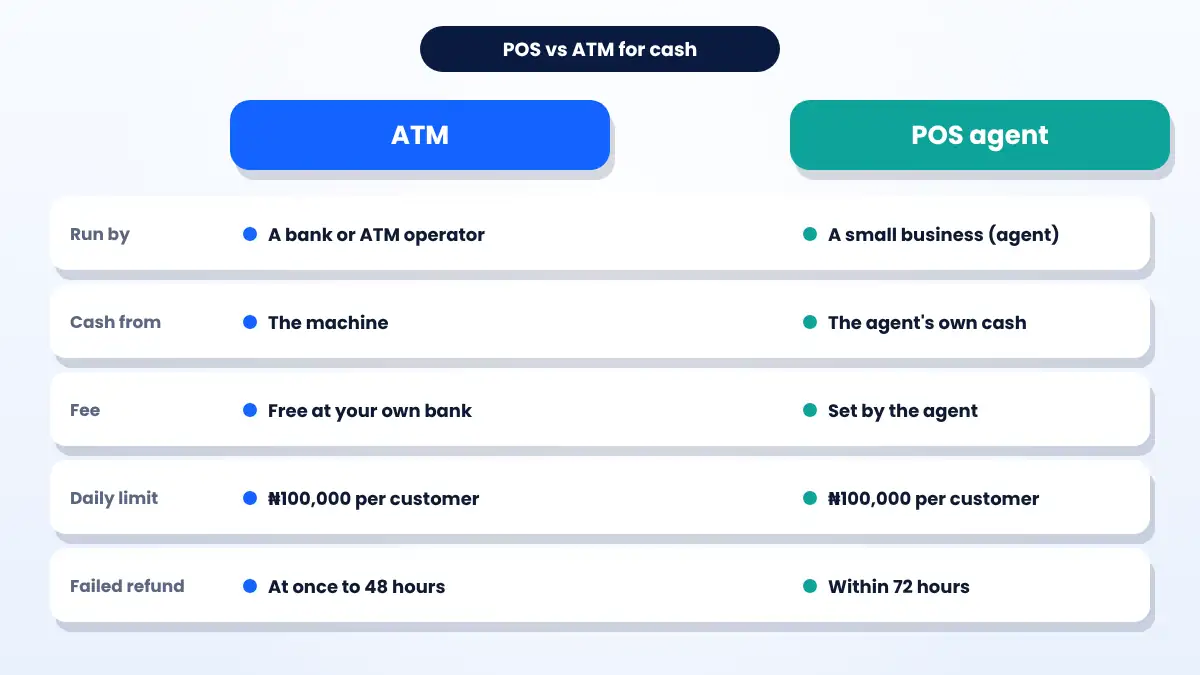
| ATM | POS agent | |
|---|---|---|
| Who runs it | A bank or a licensed ATM operator | A small business working for a bank or fintech |
| Where you find it | Bank branches, malls, airports, fuel stations | Shops, markets, kiosks and street corners |
| Cash comes from | The machine, which the bank fills | The agent’s own cash in hand |
| Fee | Free at your own bank; ₦100 per ₦20,000 plus VAT at other banks | Set by the agent, often ₦150 to ₦200 per ₦5,000 |
| Daily cash limit | ₦100,000 per customer | ₦100,000 per customer at agents |
| Failed withdrawal refund | At once, or within 48 hours at another bank’s ATM | Within 72 hours under CBN rules |
| Opening hours | Usually 24 hours, if it has cash | When the agent is open |
In short, an ATM wins on cost and refunds, while a POS agent wins on convenience.
How POS and ATM withdrawals work behind the scenes
Although the machines look different, the money travels the same road. When you insert your card and enter your PIN, the terminal or ATM encrypts your request. Next, a payment switch sends it through your card network to your bank. Your bank then checks your PIN, balance, and limits, and approves or declines the request.
The big difference is where the cash comes from:
- At an ATM, the machine counts out notes that the bank loaded into it. Your account is debited, and later the ATM’s bank is paid back through settlement.
- At a POS agent, the terminal records a card payment from your account to the agent’s account. The agent then hands you the same amount from their own cash.
So a POS cash-out is really a card payment to the agent, followed by a cash exchange. That is why the agent can charge a fee, and why you should only leave once you have both your cash and your debit alert. Our guides on how ATM and POS transactions work explain each step of the journey.
Fees: what a ₦20,000 withdrawal costs
Fees often decide POS vs ATM, so here is a withdrawal comparison. The ATM fees below are the CBN charges that took effect on 1 March 2025, and they still apply in August 2026.
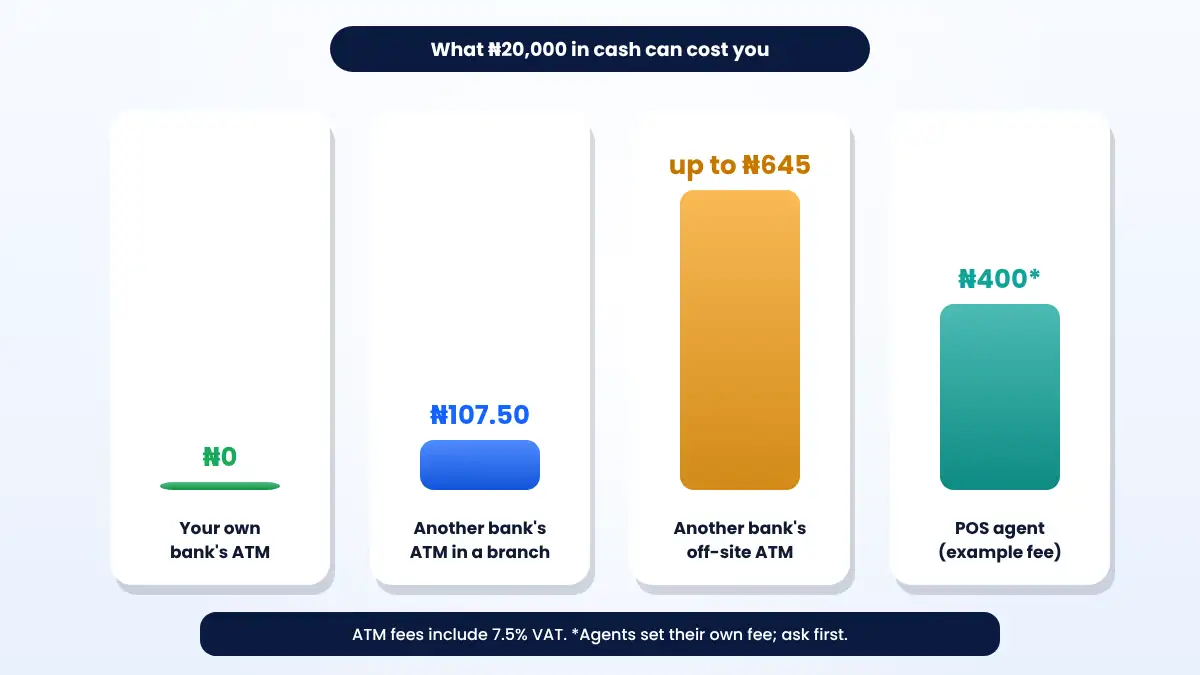
| Where you withdraw ₦20,000 | What you pay |
|---|---|
| Your own bank’s ATM | ₦0 |
| Another bank’s ATM in a bank branch | ₦100 plus 7.5% VAT, so ₦107.50 |
| Another bank’s ATM off-site, such as in a mall | Up to ₦600 plus VAT, so up to ₦645 |
| A POS agent | Whatever the agent charges, for example ₦400 |
POS agent charges are not fixed by the CBN. Instead, each agent sets their own price, and it tends to rise when cash is scarce. In January 2025, Techpoint Africa found that agents in Lagos charged ₦150 to ₦200 for withdrawals up to ₦5,000, and about ₦200 for withdrawals up to ₦10,000. Prices vary by area, so the ₦400 above is only an illustration. Always ask the agent for the full charge before you hand over your card.
Note that off-site ATMs must show their surcharge on the screen before you approve. Therefore, read the screen and cancel if the fee is too high. To compare the cost of any withdrawal, including the 3% fee above the weekly cash limit, use our bank charges calculator.
Limits: how much cash you can take out
From 1 January 2026, the CBN raised the daily ATM limit to ₦100,000 per customer. At POS agents, the daily cash-out limit is also ₦100,000 per customer, and each agent can pay out at most ₦1.2 million a day in total, under the CBN’s agent banking rules.
On top of the daily limits, individuals have a weekly cash limit of ₦500,000. It covers ATMs, POS agents, and bank counters together, across all your banks. If you go above it, you pay a 3% fee on the excess. Your bank may also set lower limits on your card, especially on a new or basic account.
Failed withdrawals: which one refunds faster?
Sometimes your account is debited, but no cash comes out. Fortunately, the CBN sets deadlines for refunds:
- Your own bank’s ATM: the reversal should happen at once. If it does not, your bank must fix it manually within 24 hours.
- Another bank’s ATM: the refund must arrive within 48 hours.
- POS transactions: failed or disputed POS payments must be resolved within 72 hours.
With a POS agent, there is a second risk. The payment may go through, but the agent says it failed and refuses to pay. In that case, show your debit alert and ask the agent to check their terminal history. If you cannot agree, report it to your bank and to the agent’s bank or fintech, whose name is usually on the terminal. Our guide to why POS transactions fail explains the common errors.
Safety: risks at the ATM and at the POS agent
Both channels are safe when you follow a few habits. However, the risks are different.
At the ATM, criminals may attach a skimmer to the card slot, fit a fake keypad, or watch you type your PIN. In addition, some fraudsters “offer help” when your card seems stuck.
At the POS agent, your card leaves your hand for a moment. A dishonest agent could swap it for another card, enter a higher amount, or watch your PIN. With bank transfers, some people also show agents fake credit alerts.
Here is how to stay safe in both places:
- Cover the keypad with your hand when you type your PIN.
- Never tell anyone your PIN, including a helpful stranger or the agent.
- Check the amount on the screen before you enter your PIN.
- Keep your card in sight at all times, and check that the card you get back is yours.
- Wait for your debit alert before you leave.
- Use ATMs in bank branches or busy, well-lit places when you can.
If your card is ever swallowed or swapped, block it at once through your banking app or your bank’s helpline.
Why there are more POS terminals than ATMs
Nigeria has millions of POS terminals but only tens of thousands of ATMs. In 2024, for example, Techeconomy counted over 3 million registered POS terminals against about 22,600 ATMs. Similarly, in Q1 2026, people made 2.92 billion POS transactions, compared with 438.6 million ATM transactions, according to TechCabal data cited by Legit.ng.
That gap is easy to explain. A POS terminal costs far less than an ATM and needs no cash-in-transit van. As a result, agents can open in villages and markets that no bank branch reaches. Interestingly, the same figures show ATM use growing again, by 6.6% in a year, while POS transactions fell by 19.9%.
POS vs ATM: which should you use?
The best choice depends on your situation:
| Your situation | Better choice |
|---|---|
| You want the lowest cost | Your own bank’s ATM |
| There is no working ATM nearby | A trusted POS agent |
| You need cash late at night | An ATM inside a bank branch, if it has cash |
| You are withdrawing a large amount | An ATM, because agent fees grow with the amount |
| You live in a rural area | A POS agent, since ATMs are often far away |
| A failed withdrawal would hurt you | Your own bank’s ATM, for the fastest reversal |
In practice, many people use both. For example, they withdraw from their bank’s ATM when they pass it, and they use an agent for small, urgent amounts.
Frequently asked questions
Is POS cheaper than ATM?
Usually not. Your own bank’s ATM is free, while a POS agent adds a charge to every withdrawal. Another bank’s off-site ATM can cost more than some agents, though, so compare the two fees.
Does a POS withdrawal count towards my weekly limit?
Yes. The ₦500,000 weekly limit for individuals covers POS agents, ATMs, and bank counters together.
Can I deposit cash with a POS agent?
Yes, most agents accept cash deposits into a bank account. You hand the agent cash, and the agent transfers the money to your account. Wait for the credit alert before you leave.
Why do ATMs run out of cash?
Banks have to load each ATM with notes, and busy machines can empty quickly, especially at weekends and month-ends. POS agents also run short because they rely on cash from their own customers and banks.
Who should I contact if a POS agent cheats me?
Contact your own bank first, with the date, time, amount, and the agent’s location. Then report the agent to the bank or fintech named on the terminal. If nothing changes, you can escalate to the Central Bank of Nigeria.
Key takeaways
- In POS vs ATM, your own bank’s ATM is the cheapest option, and it reverses failed withdrawals the fastest.
- POS agents are more convenient and widespread, but each agent sets their own charge.
- Both have a ₦100,000 daily limit and share the ₦500,000 weekly cash limit.
- Failed withdrawals must be refunded within 24 to 48 hours at ATMs and within 72 hours for POS.
- Cover your PIN, check the amount, and wait for your debit alert wherever you withdraw.