
Calculators
Chargeback Ratio Calculator
Work out your chargeback ratio by count and by value, compare it with the threshold you monitor, and see how many more chargebacks you can absorb before you cross it.
- Free, no sign-up
- Your data stays in your browser
Loading the Chargeback Ratio Calculator…
This free chargeback ratio calculator helps merchants, acquirers and payment operations teams track disputes before they become a problem. For the cardholder side, see our guide to what a chargeback is. Enter your figures for any period, set your own threshold, and the result updates as you type.
How the chargeback ratio calculator works
The chargeback ratio calculator offers two ratios, because teams measure disputes in different ways:
- Count-based ratio = number of chargebacks ÷ number of transactions × 100.
- Value-based ratio = chargeback amount ÷ sales value × 100.
In addition, you choose the denominator. Some teams divide by transactions in the same month, while others divide by the previous month’s transactions. Therefore, the calculator lets you pick the method and warns you when the figures may not match.
A worked example with the chargeback ratio calculator
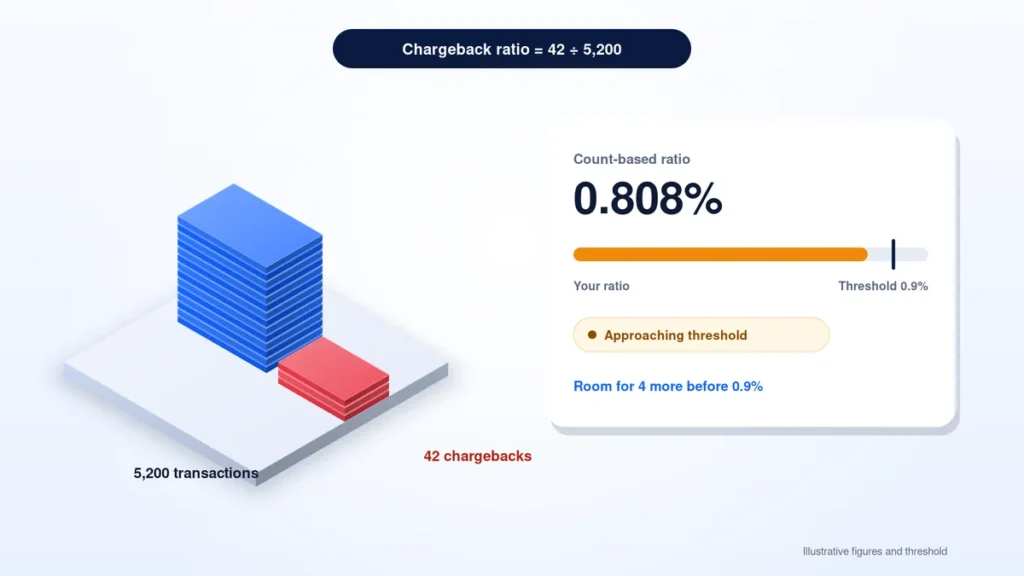
Suppose a merchant had 42 chargebacks on 5,200 card transactions in a month. The count-based ratio is 42 ÷ 5,200 × 100 = 0.808%. If the merchant monitors an illustrative threshold of 0.9%, it can absorb up to 46 chargebacks, so it has room for 4 more. Because 0.808% is above 80% of the threshold, the calculator marks it as approaching the threshold.
However, the 0.9% here is only an example. Use the level your acquirer or your risk team actually monitors.
Counts, values, fraud ratios and scheme programmes
A count-based ratio treats every dispute the same, whatever its size. By contrast, a value-based ratio shows how much money is at risk. A fraud ratio is different again, because it measures fraud losses rather than all disputes. Card schemes also run their own monitoring programmes, with their own definitions, measurement periods and eligibility rules. So, this chargeback ratio calculator does not tell you whether you are in a scheme programme; it shows where you stand against the threshold you set.
How to lower your chargeback ratio
- Use a clear billing descriptor, so customers recognise the charge on their statement.
- Answer refund requests quickly. A fast refund is cheaper than a chargeback.
- Keep proof of delivery and customer messages, so you can win the disputes you contest.
- Screen risky orders before you ship, for example orders with mismatched names and addresses.
Frequently asked questions
What is a good chargeback ratio?
Lower is always better. The right level depends on your acquirer, your industry and the card schemes involved, so ask your acquirer which threshold applies to you.
Should I use counts or values?
Use both if you can. In practice, the count-based ratio is the one most programmes watch, while the value ratio shows the financial impact.
Is my data stored?
No. The chargeback ratio calculator runs in your browser, and nothing you enter is sent to us or anyone else.
Want to understand disputes better? Read what a card acquirer does and why POS transactions fail, or see Visa and Mastercard for their official dispute rules.