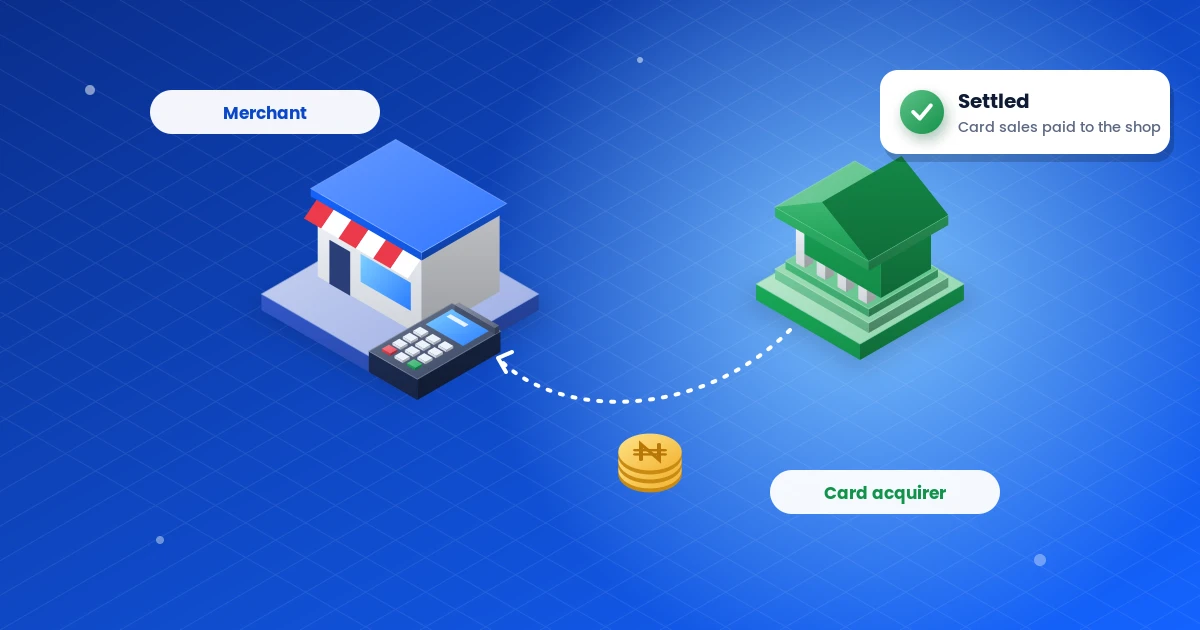
When you pay with a card in a supermarket, your bank sends the money, but someone has to receive it for the shop. That job belongs to the card acquirer. It is the bank or licensed payment company that signs up the merchant, provides the POS terminal or payment gateway, and pays the shop for every card sale. This guide explains what an acquirer does, what it costs a business, and what a shop owner actually signs up for when they get a POS terminal in Nigeria.
Quick answer: A card acquirer, also called an acquiring bank or merchant acquirer, is the bank or licensed payment company that lets a business accept card payments. It onboards the merchant, provides a POS terminal or online gateway, sends each payment for approval, and settles the money into the merchant’s account, usually by the next business day. In return, the merchant pays a merchant service charge on each payment. Under the CBN’s 2026 charges guide, that charge is 0.5% of the payment, capped at ₦10,000, plus VAT.
In this guide
- What is a card acquirer?
- What does a card acquirer do?
- How a card acquirer works, step by step
- Card acquirer vs card issuer
- What a merchant signs up for with a card acquirer
- How much does a card acquirer charge?
- How a card acquirer settles the merchant
- Frequently asked questions
- My Ugly Work Encounter
- Key takeaways
What is a card acquirer?
A card acquirer is the financial institution on the merchant’s side of a card payment. In other words, while your card issuer works for you, the acquirer works for the shop.
Every card payment therefore has two sides. The issuer approves and sends the money, and the acquirer collects it for the merchant. The card scheme, such as Verve, Mastercard, Visa, or AfriGo, connects the two. Our guide to what a card issuer is covers the customer’s side in detail.
For example, if a supermarket in Ibadan banks with Access Bank and uses an Access Bank POS terminal, Access Bank is its acquirer. Whether you pay with a Zenith card or an OPay card, the money still reaches the supermarket through Access Bank.
What does a card acquirer do?
An acquirer has five main jobs:
- Onboarding merchants. First, it checks the business, its owners, and its documents, then opens a merchant profile.
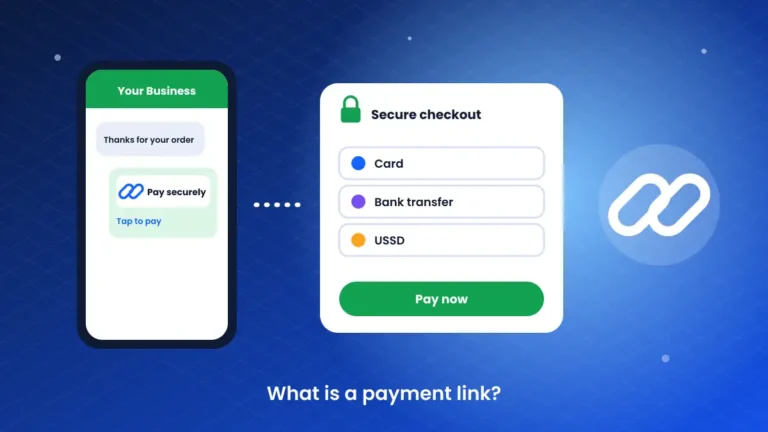
- Providing payment tools. Next, it arranges a POS terminal, a payment gateway, or a payment link, often through a licensed terminal provider.
- Sending payments for approval. Then, it passes each payment through a switch and the card scheme to the customer’s issuer.
- Settling the merchant. After that, it collects the money from issuers and pays the merchant, minus fees. See how card settlement works for the full process.
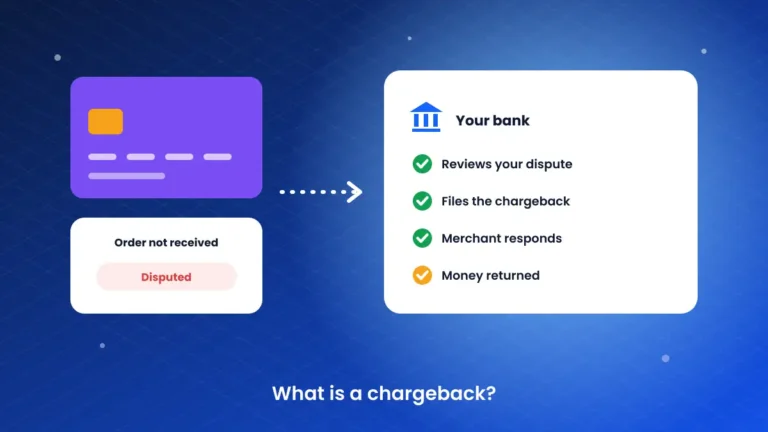
- Managing risk and disputes. Finally, it monitors merchants for fraud and answers chargebacks when customers dispute a payment. Our guide explains what a chargeback is and how a dispute moves between banks.
How a card acquirer works, step by step
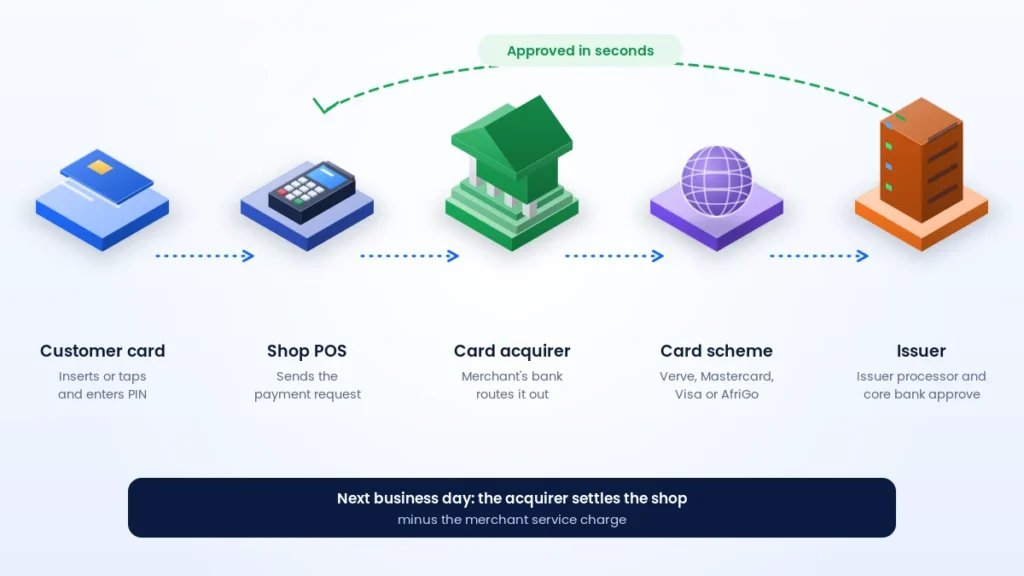
Here is what happens when a customer pays ₦25,000 at a supermarket:
- The customer pays. The cashier enters ₦25,000, and the customer inserts or taps their card and enters a PIN.
- Request sent. Next, the terminal sends the request through a terminal aggregator, such as NIBSS or UPSL, to the acquirer’s processor.
- The issuer decides. Then the card scheme routes it to the customer’s issuer, whose issuer processor checks the PIN and fraud rules before the core banking system approves the debit.
- Receipt printed. Within seconds, the approval comes back, and the supermarket hands over the goods.
- Settlement follows. Finally, the acquirer settles the supermarket, usually by the next business day, after deducting the merchant service charge.
For a full view of the terminal side, read our guide to how POS transactions work.
Card acquirer vs card issuer
In short, the two roles mirror each other:
| Feature | Acquirer | Issuer |
|---|---|---|
| Serves | The merchant | The cardholder |
| Provides | ATM, POS terminals, gateways & settlement | Cards, PINs, OTPs and alerts |
| In the payment | Sends the request and receives the money | Approves the request and sends the money |
| Earns | A share of the merchant service charge | Interchange, which is also part of that charge |
| In a dispute | Defends the merchant | Raises the chargeback for the customer |
Sometimes, one bank plays both roles. For instance, if a GTBank customer pays at a shop that uses a GTBank terminal, GTBank is both the issuer and the acquirer.
What a merchant signs up for with a card acquirer
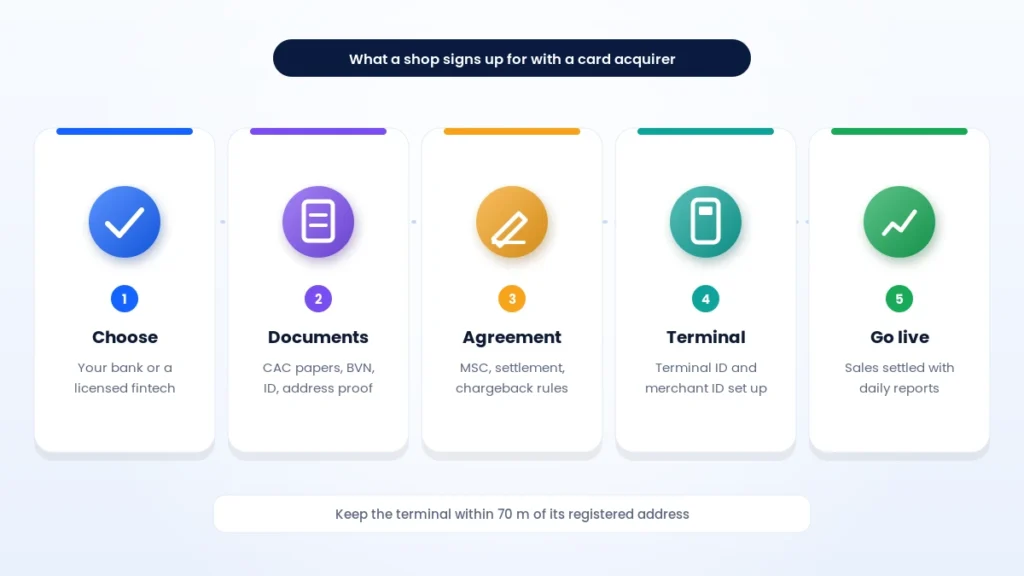
Imagine Bola, who runs a mid-sized supermarket in Ibadan and wants to accept cards. Here is what getting an acquirer usually involves.
1. Choosing a card acquirer
Bola can go to her own bank, which is the usual route for an established shop. Alternatively, she can use a licensed fintech, such as Blusalt, Moniepoint, OPay, or Paystack, that provides terminals through partner banks or its own licence. In practice, she should compare the charge per payment, settlement speed, terminal cost, and support quality.
2. Submitting documents
Next, the acquirer runs know-your-customer checks. Typically, Bola provides:
- first, her CAC business registration documents;
- also, the BVN and valid ID of each owner or director;
- then, proof of the business address, such as a utility bill;
- finally, a business bank account for settlement.
3. Signing the merchant agreement
Then Bola signs a merchant agreement. It is the contract that matters most, so she should read it closely. It usually covers:
- first, the merchant service charge and any terminal fees;
- also, the settlement account and settlement timeline;
- in addition, who pays if a customer wins a chargeback;
- then, rules on keeping the terminal at the registered address;
- finally, a ban on adding a surcharge to customers who pay by card.
4. Getting the terminal
After that, a licensed terminal provider (PTSP) sets up the POS terminal. Each device receives a terminal ID, and the shop receives a merchant ID. Also, these codes appear on every receipt and help trace any disputed payment.
The terminal must also stay near its registered address. Under the CBN geo-fencing rule, terminals that move more than 70 metres from their approved location can be disabled.
5. Going live
Finally, Bola starts taking payments. From then on, she receives settlement into her account, together with a daily report she can match against her sales.
How much does a card acquirer charge?
Merchants pay a merchant service charge (MSC) on each card payment. The customer, in contrast, does not pay anything extra to buy goods with a card at a POS terminal.
Under the CBN’s 2026 Guide to Charges, released in April 2026, the MSC for POS payments is 0.5% of the transaction value, capped at ₦10,000. Bank charges also attract 7.5% VAT. Some reports describe the 2026 guide as an exposure draft, so check your acquirer’s current schedule of charges before you sign.
| Sale amount | MSC at 0.5% | VAT at 7.5% | Total cost to the merchant |
|---|---|---|---|
| ₦10,000 | ₦50 | ₦3.75 | ₦53.75 |
| ₦100,000 | ₦500 | ₦37.50 | ₦537.50 |
| ₦5,000,000 | ₦10,000 (cap) | ₦750 | ₦10,750 |
Behind the scenes, the acquirer shares this charge with the other parties in the chain. For example, the issuer, the card scheme, the terminal provider, and the processor each take a portion. Online payment providers set their own prices, so compare them separately; our guide to payment gateways shows typical online fees.
How a card acquirer settles the merchant
Settlement is how the money actually moves from the customer’s bank to the merchant’s account. During the day, however, approved payments are only promises. At the end of the business day, the switches and schemes calculate what each issuer owes each acquirer. Then the money moves between banks, and the acquirer credits the merchant.
In Nigeria, most merchants receive card sales by the next business day. However, some fintech acquirers settle faster, sometimes within minutes, while weekends and public holidays can cause delays. If a settlement is missing, the merchant should contact the acquirer with the terminal ID, date, and amount. Our guide to what a payment processor is explains the processing side of settlement in more detail.
Frequently asked questions
Is a card acquirer the same as a POS provider?
Not always. The acquirer is the licensed institution that settles the merchant. Meanwhile, the terminal provider (PTSP) supplies and maintains the device. Sometimes one company arranges both, but they are different roles.
Can a merchant have more than one acquirer?
Yes. In fact, many large shops use terminals from two banks or fintechs. That way, if one network is down, they can still accept payments.
Who pays the merchant service charge?
The merchant pays it. In contrast, under CBN rules, customers should not pay extra for buying goods with a card at a POS terminal.
What happens to the merchant in a chargeback?
First, the acquirer receives the chargeback from the issuer and asks the merchant for evidence, such as a signed receipt or delivery proof. If the merchant cannot prove the sale, the acquirer usually deducts the amount from future settlements. Our free chargeback ratio calculator shows how close a merchant is to its acquirer’s threshold.
Can a POS agent use any acquirer?
Agents must work with one principal, such as a bank or licensed fintech, under the CBN agent banking rules. As a result, that principal usually provides the terminal and handles settlement.
My Ugly Work Encounter 🫣
From the author’s experience
The cost of a single data entry error: an expensive mapping mistake
Under Central Bank of Nigeria (CBN) regulations, a registered Payment Terminal Service Provider (PTSP) is responsible for configuring POS terminals for merchants on behalf of an acquirer. This configuration relies on a file sent by the acquirer containing critical parameters, including merchant details, the Merchant Category Code (MCC), the Terminal ID (TID), and the Merchant ID (MID). Crucially, the MID designates the exact bank account where the acquirer settles funds received from the issuing bank.
During my time in this domain, a configuration officer accidentally cross-mapped these details. They assigned the MID belonging to Merchant A (at Bank A) to Merchant B (at Bank B).
Consequently, every single transaction processed on Merchant A’s physical POS terminal was automatically settled into Merchant B’s bank account. By the time the error was discovered, a massive financial discrepancy had accumulated. Resolving the crisis turned into a major ordeal, requiring extensive litigation, inter-bank escalations, and the involvement of law enforcement agencies to successfully recover and transfer the wrongfully settled funds back to Merchant A.
Recognising the severe financial and legal risks of manual data entry, our organisation immediately took action. We engineered and instituted an automated POS provisioning process to completely eliminate human error, ensuring that such a costly misconfiguration could never happen again.
Lesson for merchants: when your terminal goes live, check that the business name on the first receipts is yours, and confirm that the first settlement lands in your own account. If anything looks wrong, stop using the terminal and call your acquirer at once.
Key takeaways
- A card acquirer is the bank or licensed payment company that lets a merchant accept card payments.
- It onboards the merchant, provides the terminal or gateway, routes payments for approval, and settles the merchant.
- The issuer serves the customer, while the acquirer serves the merchant; the card scheme connects them.
- Under the 2026 CBN guide, the POS merchant service charge is 0.5%, capped at ₦10,000, plus 7.5% VAT, and the merchant pays it.
- Most merchants receive their card sales by the next business day.
Ready to explore more? Read what a card issuer is, or browse more digital payments guides.