
Reference and lookup
EMV Chip Card Glossary
A free EMV glossary with plain-English definitions of more than 90 chip card terms, from AID and ARQC to TVR. Every entry shows the EMV tag, an example, and its sources.
- Free, no sign-up
- Your data stays in your browser
Loading the EMV Chip Card Glossary…
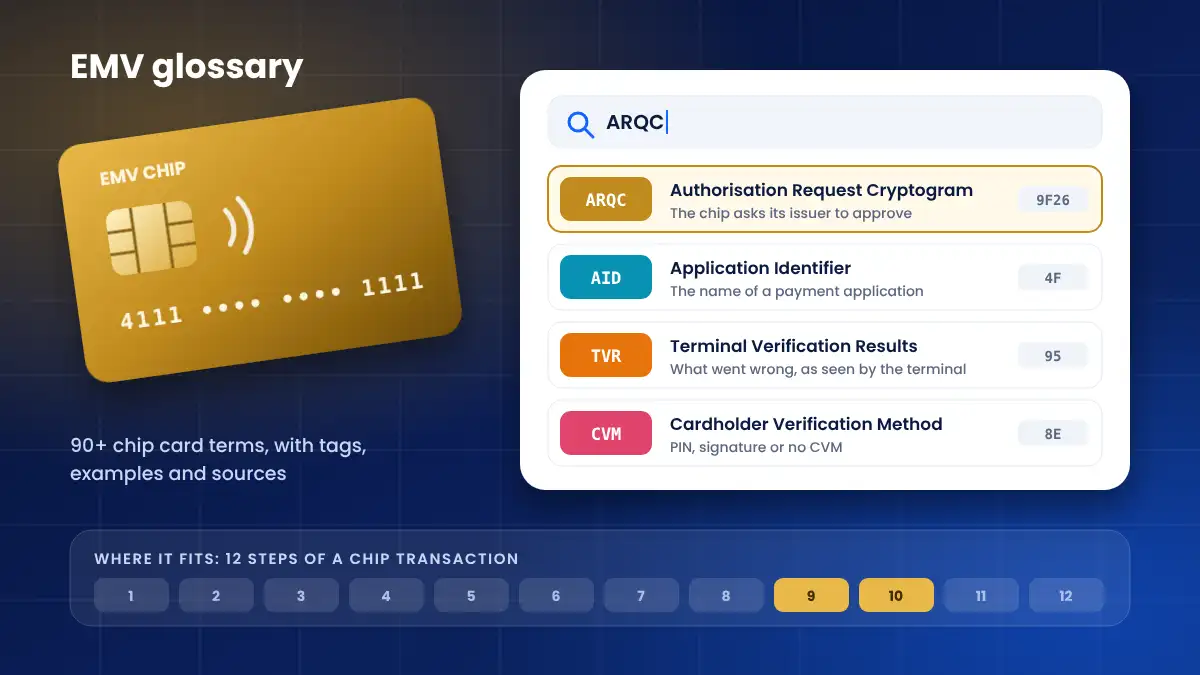
This EMV glossary explains the words you meet when you work with chip cards, POS terminals and card issuing. Each entry starts with a short definition in plain English. Then it adds the technical detail, the EMV tag, and where the term fits in a chip transaction. Finally, it lists related terms and the sources we checked. Because the results update as you type, you can find a term by acronym, full name, tag, or keyword in seconds.
How to use the EMV glossary
- Search or browse. First, type an acronym such as ARQC, a tag such as 9F27, or a word such as cryptogram. Alternatively, pick a category or a letter.
- Open a term. Select any result. On a phone, the definition then slides up from the bottom of the screen.
- Read the step strip. Next, the highlighted boxes show where the term is used in the 12 steps of a chip transaction.
- Follow the links. Related terms also open in the same panel. In addition, linked response codes open in our payment response code decoder.
- Copy or share. Use Copy definition to paste the entry, with its sources, into a ticket or a training note. Similarly, Copy link gives you a direct link to the term.
What the EMV glossary covers
| Category | Examples | Useful for |
|---|---|---|
| EMV fundamentals | APDU, TLV, kernel | For example, anyone new to chip cards |
| Application selection | AID, PSE, PPSE | Also, terminal setup and contactless issues |
| Chip application data | AFL, IAD, CVR | In particular, card profiles and host parsing |
| Cryptograms and authentication | ARQC, ARPC, CDA | Especially issuer hosts, HSMs and declines |
| Cardholder verification | CVM List, PIN, CDCVM | Likewise, PIN problems and contactless limits |
| Terminal and issuer processing | TVR, TSI, TAC / IAC | Above all, reading terminal logs |
| Issuance, lifecycle, security and testing | Personalisation, issuer scripts, L3 testing | Finally, card projects and certification |
The 12 steps of a chip transaction
Most EMV terms belong to one step of the transaction flow in EMV Book 3. For this reason, the glossary shows these steps on every entry, so you can see the bigger picture at a glance:
- Application selection: first, the terminal and card agree on an AID.
- Initiate application processing: GET PROCESSING OPTIONS returns the AIP and AFL.
- Read application data: next, the terminal reads the card records.
- Offline data authentication: SDA, DDA, or CDA.
- Processing restrictions: dates, versions, and usage control.
- Cardholder verification: then the CVM List decides PIN, signature, or no CVM.
- Terminal risk management: the floor limit and velocity checks.
- Terminal action analysis: the TVR is compared with the action codes.
- Card action analysis: then the card returns a TC, AAC, or ARQC.
- Online processing: after that, the issuer checks the ARQC and may send an ARPC.
- Issuer script processing: optional commands for the card.
- Completion: the final GENERATE AC approves or declines.
For the story behind a real card, however, read our guide to card issuance, or see how a payment travels in how POS transactions work in Nigeria.
EMV rules vs scheme rules
EMV sets the common rules. However, it leaves some details to others. For example, the Issuer Application Data tag is defined by EMV, while its contents are set by each card application. Likewise, contactless limits come from regulators, card schemes, and issuers. Therefore, every entry carries a badge:
- EMV specification: defined in the EMVCo books.
- ISO standard: defined in an ISO standard that EMV uses, such as ISO/IEC 7816.
- Scheme or issuer specific: in other words, the detail depends on Visa, Mastercard, Verve, your processor, or your card product.
- Industry practice: in short, a common term that no single specification defines.
How we check the EMV glossary
First, we check each entry against the EMVCo specifications (EMV 4.4, Books 1 to 4) and the other sources listed on it. Each entry also shows the date we last reviewed it, so you know how current it is. In addition, examples use public or synthetic values only. As a result, you will never see real card numbers or keys here. If you find a mistake, please tell us through the contact page.
Frequently asked questions
What is an EMV glossary?
It is a reference list of the terms used in EMV chip card payments. In addition, this one shows where each term fits in a transaction and which EMV tag carries it.
What is the difference between ARQC and ARPC?
The card creates the ARQC to ask its issuer for approval. Then the issuer replies with the ARPC, which proves the answer really came from the issuer.
Can I search by EMV tag?
Yes. For example, type 9F26 or 9F27, with or without a space, and the matching term opens.
Does the glossary decode my TVR or card data?
No. It explains what each data element means, but it does not parse live data. Also, never paste real card data or keys into any website.
Is the EMV glossary free?
Yes. It is free, with no sign-up. Moreover, it runs in your browser, so your searches stay private.
EMV is a registered trademark of EMVCo, LLC. DigiLifeGuide is not affiliated with EMVCo. Definitions are written by DigiLifeGuide for learning and are not a substitute for the official specifications.
For more free tools, visit the payment tools hub.