You fill out a form at the branch, and a week later you collect a debit card that works at any ATM. It looks simple. However, card issuance involves a card scheme, two sets of secret keys, a card bureau, and several security checks. This guide follows one card from the scheme’s rulebook to your wallet, step by step.
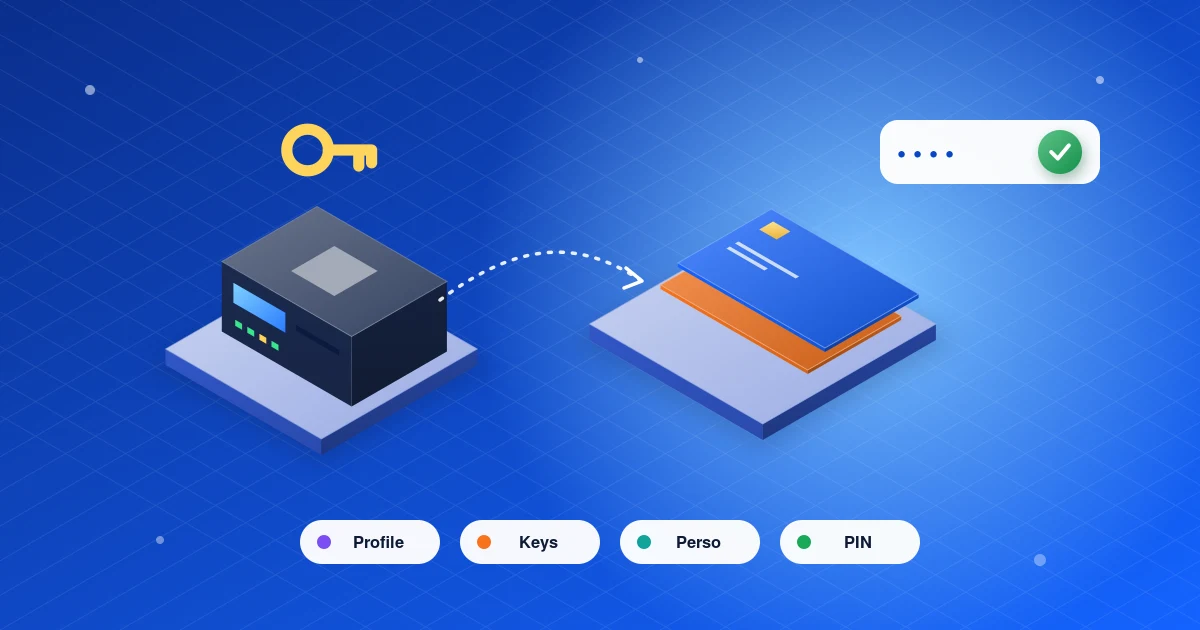
Quick answer: Card issuance is the process a bank follows to produce a working payment card. First, the bank adopts an EMV card profile from the scheme. It then gets its issuer public key certified and generates secret 3DES keys on a hardware security module (HSM). Next, it sets card limits and prepares each card’s data. Then it sends that data, encrypted with PGP, to a certified personalisation bureau that writes it onto the chip. Finally, the customer activates the card and chooses a PIN.
In this guide
- What is card issuance?
- The card issuance journey at a glance
- Step 1: Get the EMV card profile from the scheme
- Step 2: Generate and sign the issuer public key certificate
- Step 3: Generate 3DES keys on the HSM
- Step 4: Set up card limits
- Step 5: Prepare the card data
- Step 6: Share the data with the perso bureau using PGP
- Step 7: Personalisation and validation by the bureau
- Step 8: Card activation and PIN selection
- My Ugly Work Experience
- Frequently asked questions
- Key takeaways on card issuance
What is card issuance?
Card issuance covers everything between a card request and a card that works at a terminal. In other words, it is the factory line behind the plastic.
Most Nigerian banks do not run card issuance alone. Instead, an issuer processor, such as Blusalt, Interswitch, or Unified Payments, often hosts the card system and the HSM for the bank. On every payment, the processor checks the PIN, the card status, and fraud rules. Meanwhile, the core banking system only approves the debit. As a result, much of the setup below happens on the processor’s side. Our guide to what a card issuer is explains that split in more detail.
The card issuance journey at a glance
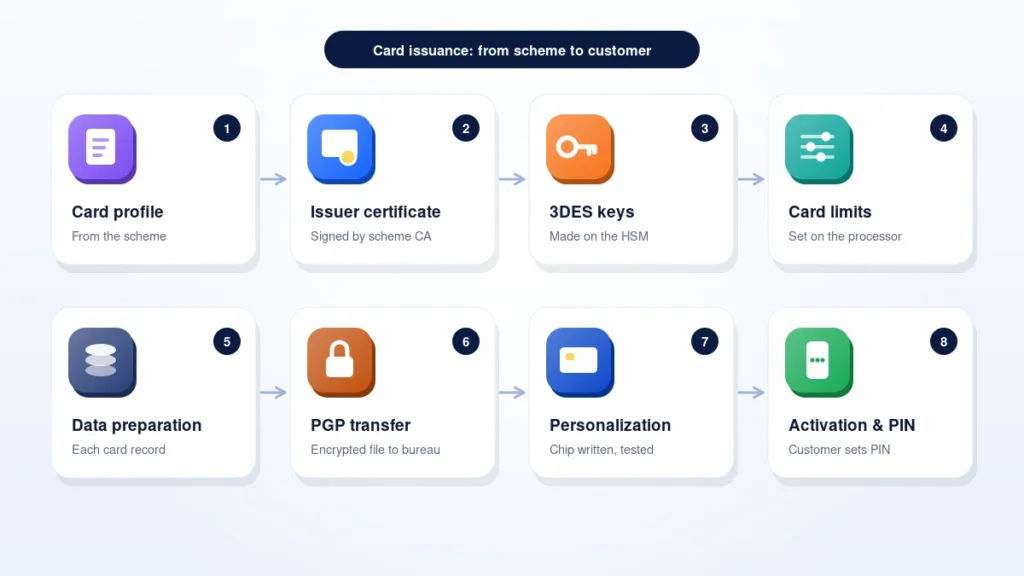
Here is who does what:
| Stage | Who does it | Done how often |
|---|---|---|
| 1. Card profile | Scheme and bank | Once per card product |
| 2. Issuer certificate | Bank, processor and scheme | Once per key, then renewed before expiry |
| 3. 3DES keys | Bank or processor key custodians | Once per BIN, then rotated |
| 4. Card limits | Bank, set on the processor | Once per product, then changed as needed |
| 5. Data preparation | Card management system | For every batch of cards |
| 6. PGP transfer | Processor and bureau | For every batch |
| 7. Personalisation | Personalisation bureau | For every card |
| 8. Activation and PIN | Customer | Once per card |
Step 1: Get the EMV card profile from the scheme
Every chip card follows EMV, the global chip standard. However, each scheme, such as Verve, Mastercard, Visa, or AfriGo, publishes its own card profile. It tells the chip how to behave. Our guide to what an EMV chip card is explains what the chip does each time you pay.
For example, the profile sets:
- first, the chip application and its ID (the AID), which tells the terminal which scheme the card belongs to;
- also, the cardholder checks the card supports, such as online PIN or offline PIN;
- in addition, the risk settings, including whether the card may ever approve a payment offline;
- Finally, the currency and country codes, such as 566 for the naira.
The bank fills in these settings for each card product. Then the scheme reviews the profile and tests sample cards before card issuance begins.
Step 2: Generate and sign the issuer public key certificate
Chip cards prove they are genuine with public key cryptography. Our free EMV glossary explains each chip term you meet in a card profile, from AIP to CDA. To start, the bank or its processor generates an RSA key pair inside an HSM. The private key never leaves the HSM, while the public key goes to the scheme.
Next, the scheme’s certification authority (CA) signs that public key with its own CA private key. In return, the bank receives an issuer public key certificate, which it loads into its data preparation system.
The chain then works like this:
- Terminals hold the scheme’s CA public key, which the acquirer loads on every ATM and POS.
- The card carries the issuer certificate, so the terminal can check that the scheme signed it.
- Each card also carries its own certificate, signed with the issuer’s private key.
As a result, a terminal can confirm the card is real, even before it goes online. Certificates also expire, so the bank must renew them in time.
Step 3: Generate 3DES keys on the HSM
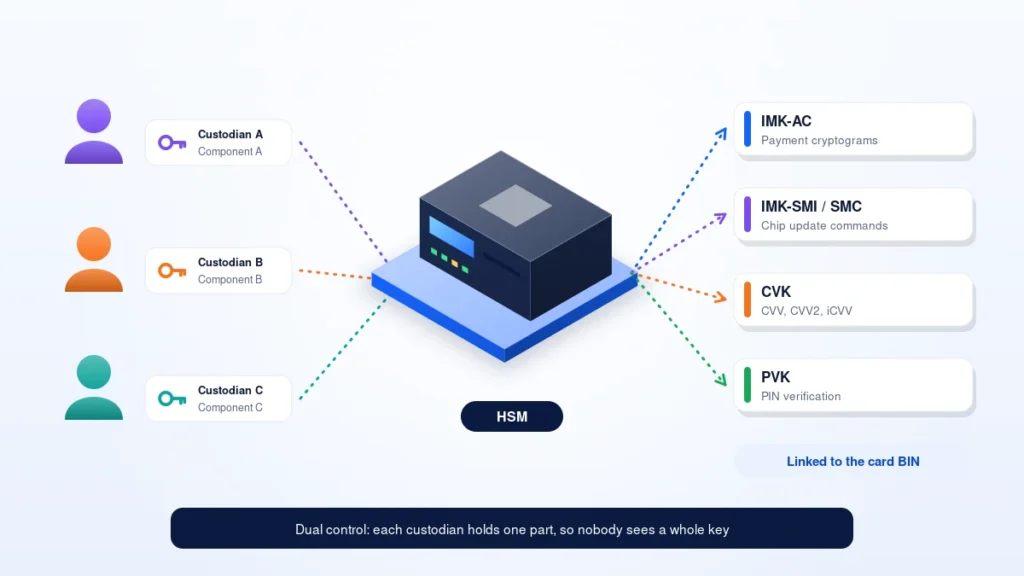
Besides the RSA keys, every BIN needs a set of secret 3DES keys. The HSM creates them in a formal key ceremony, under dual control. That means two or three key custodians each hold one part, called a component, so nobody holds the whole key. For example, our HSM key generation tutorial walks through a real key ceremony on a Thales payShield 10K. To see how components combine, try our keyshare generator with test values.
The main keys are:
| Key | What it protects |
|---|---|
| IMK-AC (issuer master key for cryptograms) | Checks the unique code (ARQC) the chip creates for every payment |
| IMK-SMI and IMK-SMC | Protects commands the bank sends back to the chip, such as a PIN change or a block |
| CVK (card verification key) | Creates the CVV, the CVV2 on the back, and the chip’s iCVV |
| PVK (PIN verification key) | Creates the PIN offset or PVV that checks the PIN |
Next, the custodians load the keys on the processor’s HSM and map them to the card BIN. That way, the processor knows which key to use when a payment arrives. Each card also gets its own keys, derived from the master keys using the card number. Consequently, one stolen card cannot expose any other card.
Step 4: Set up card limits
Before any card goes out, the bank sets its limits on the issuer processor. They apply before the core banking system sees the debit.
Typical limits include:
- first, a daily amount and number of payments for ATM, POS, and online channels;
- also, a separate limit for international payments on naira cards;
- finally, chip offline limits, which most Nigerian banks set to zero, so every payment goes online.
Because the limits sit on the product, the bank can change them later without new card issuance. Our guide on why POS transactions fail shows what customers see when a payment hits one of these limits.
Step 5: Prepare the card data
Data preparation turns an approved request into the exact bytes the chip needs. First, the card management system creates the card record. It holds the card number, the expiry date, the service code, and the name. The card number itself comes from an account range inside the issuer’s BIN, which our BIN management guide explains with a free calculator. For a quick estimate of how many cards one BIN can hold, try the card issuing capacity calculator.
Next, the data preparation system uses the HSM to:
- calculate the CVV, CVV2 and iCVV with the CVK;
- derive the card’s own keys from the master keys;
- create the card’s RSA key pair and sign its certificate;
- arrange everything into the EMV data the profile expects.
Finally, it writes a personalisation file, often in the EMV Common Personalization Specification (CPS) format. The card’s secret keys stay encrypted in that file under a transport key only the bureau’s HSM can open.
Step 6: Share the data with the personalisation bureau using PGP
The file now travels to an external personalisation bureau. In Nigeria, this is a PCI-certified card plant, such as MPI, Berkeley, EpayPlus, or SecureID. To protect it in transit, both sides use PGP encryption.
The exchange works like this:
- Swap public keys. At the start, the processor and the bureau exchange PGP public keys and confirm the fingerprints by phone.
- Encrypt and sign. Next, the processor encrypts the file with the bureau’s public key and signs it with its own private key.
- Send securely. Then the file goes over a secure channel, such as SFTP.
- Check and open. After that, the bureau checks the signature and decrypts the file inside its secure area.
As a result, only the bureau can read the file, and it knows the sender is genuine.
Step 7: Personalisation and validation by the bureau
Personalisation is where a blank card becomes your card. The bureau’s machines print or emboss the name and number, encode the magnetic stripe, and write the data onto the chip.
However, the bureau does not run the full batch at once. Instead, it first produces a few sample cards. The bank tests them on real ATMs and POS terminals, checking the PIN, the chip code, and the certificate chain. Once the bank signs off, the bureau runs the batch.
During production, the bureau also reads each chip back to check it. Then it destroys spoiled cards and sends the batch to the bank by secure courier. To budget card production and the rest of a launch, try our free card program cost calculator.
Step 8: Card activation and PIN selection
The card arrives inactive, so a stolen parcel is useless. First, the bank confirms your identity. Then you activate the card through the app, USSD, an ATM, or the branch.
Next, you choose your PIN. Many Nigerian banks now let you set it in the app or at their own ATM, instead of posting a PIN mailer. The app or ATM encrypts your PIN the moment you enter it. Then the processor’s HSM turns it into a PIN offset and stores only that value.
On your first payment, the processor checks the chip code, the PIN, the card status, and the limits. If everything passes, it asks the core banking system to approve the debit. In short, card issuance is complete, and the card works. If you are still deciding which type of card to apply for, our debit vs credit vs prepaid card comparison can help.
My Ugly Work Experience: Wrong 3DES Key Mapping Setup🫣
From the author’s experience
A card issuance launch without a pilot: 100 cards that could not transact
Situation: During a high-stakes product migration for a client bank in another African country, we hit a severe card personalisation failure. On that Visa programme, Visa generated the 3DES keys and shared them with us. On our Mastercard programmes, by contrast, the issuer generated its own keys.
Task: The client bank was under heavy commercial pressure. As a result, it rushed out more than 100 cards at once, without waiting for a pilot. Shortly after the cards reached customers, every single transaction on them was declined across the network.
Action: First, we led a joint investigation with the scheme. It showed that, during the migration, the Visa-shared 3DES keys had landed in the wrong mapping in our card management system. Because the keys did not match the card BIN, the processor’s HSM could not verify the chip’s payment code, so it declined every payment. Next, I coordinated the technical team to wipe the faulty setup, rebuild it from scratch, and load the keys correctly. Meanwhile, I managed communication with the client and apologised formally to manage the relationship.
Result: We restored the system and reissued the cards correctly. After this incident, I introduced a mandatory “pilot-first” policy across our organisation. Every client must run a low-volume live card pilot to validate the keys and end-to-end processing before a full launch, however urgent the market pressure.
Lesson for issuers: before a full launch, personalise a handful of live pilot cards and use them for real ATM, POS, and online payments. A wrong key then fails on the first test payment, not after 100 cards are already in customers’ hands.
Frequently asked questions
How long does card issuance take?
For a personalised card from a bureau, it usually takes five to ten working days. Instant cards printed in the branch, on the other hand, can be ready within minutes.
Can a bank do card issuance in-house?
Yes. Some banks print instant cards in branches. However, the keys, profile, and certificate still come from the central setup.
Does the bank know my PIN?
No. The system encrypts the PIN as you type it. After that, the HSM stores only a value derived from it.
Key takeaways on card issuance
- The scheme provides the EMV profile, and the bank sets it for each card product.
- Its CA signs the issuer public key, so terminals can trust the chip.
- Under dual control, the HSM creates secret 3DES keys and links them to the BIN.
- Limits sit on the issuer processor, which checks them before the core banking system approves the debit.
- A certified bureau writes the PGP-protected data onto the chip after sample tests.
- Card issuance ends when the customer activates the card and chooses a PIN.
Want to see the card at work? Read how ATM transactions work, or browse more digital payments guides.