If you sell online in Nigeria, you know this message well: “I have paid, please check your account.” Then you scroll through dozens of alerts to find one transfer. A virtual account fixes that. It gives each customer, or each order, its own account number, so every payment arrives already labelled. This guide explains how it works, the difference between dedicated and temporary accounts, what they cost, and how to use them safely.
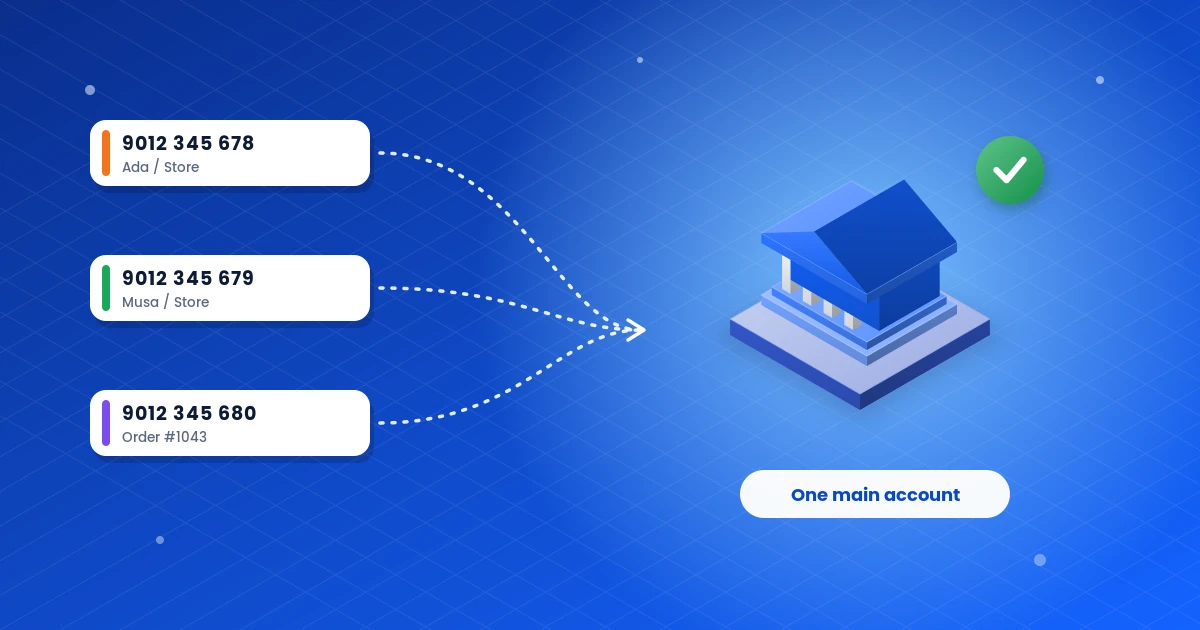
Quick answer: A virtual account is a real 10-digit bank account number that doesn’t hold money on its own. Instead, it routes every transfer it receives to a main account and tells the business exactly who paid. Banks and payment companies such as Paystack, Blusalt, and Flutterwave issue them. A dedicated one belongs to one customer for the long term, while a temporary one is created for a single payment and expires. Businesses use them to collect payments and match each one automatically.
In this guide
- What is a virtual account?
- How a virtual account works
- Dedicated vs temporary virtual accounts
- What businesses use virtual accounts for
- How much does a virtual account cost?
- Are virtual accounts safe?
- How to get a virtual account in Nigeria
- Frequently asked questions
- Key takeaways
What is a virtual account?
A virtual account is an account number linked to a main account, often called a collection or settlement account. In other words, it works like a labelled door into the same room. The customer sees a normal bank account number and sends money by transfer as usual. Behind the scenes, however, the money lands in the business’s main account, and the system records which virtual account received it.
For example, a fashion store on Instagram might give each regular customer their own number at Wema Bank. When Ada sends ₦18,500, the store’s dashboard instantly shows “Ada paid ₦18,500”, with no screenshots and no guessing.
They use the standard 10-digit Nigerian account number format, so any bank app can send money to them. Most transfers to them move over the NIBSS Instant Payment (NIP) system, so the money usually arrives within seconds. Our guide to how bank transfers work explains that journey step by step.
How a virtual account works
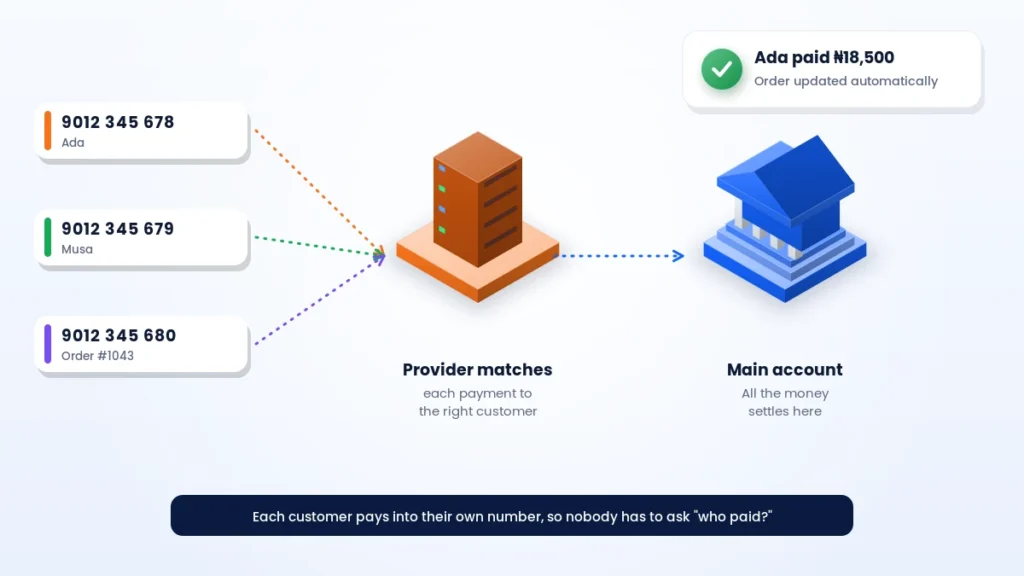
Here is what happens when a customer pays into one:
- The business creates the account. First, it asks its bank or payment provider for an account number linked to a customer or an order.
- The customer sends a transfer. Next, the customer pays from any bank app, exactly as they would pay a friend.
- The bank confirms the name. Before sending, the customer’s app shows the account name, often in a format such as “Business Name / Customer Name”.
- The provider matches the payment. Then the provider sees which number received the money and links it to that customer or order.
- The business gets notified. After that, it receives an alert, an email, or a webhook that can update an order automatically.
- Settlement follows. Finally, the money moves into the business’s main account, minus any fees.
Dedicated vs temporary virtual accounts
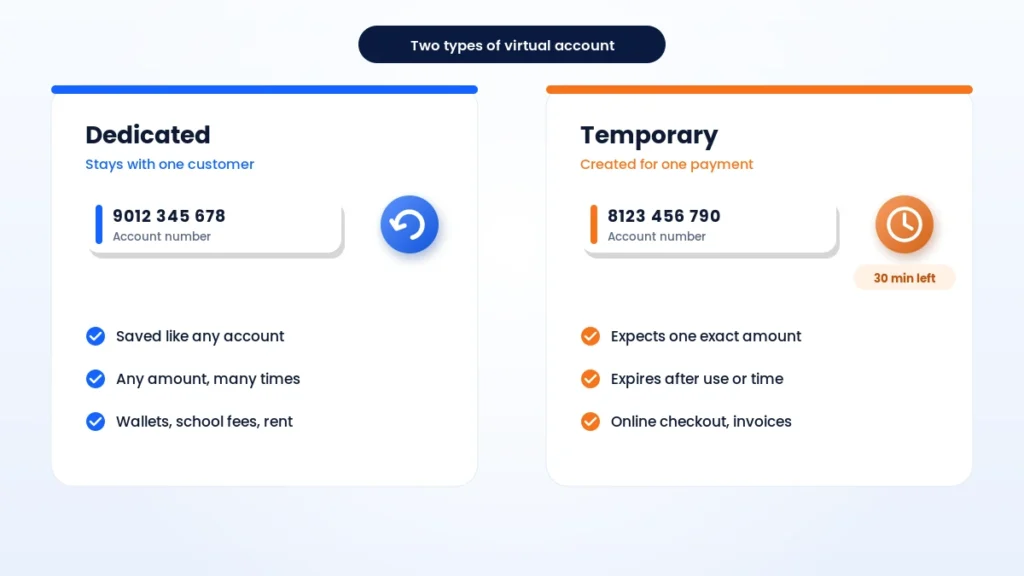
There are two main types, and each one suits a different job:
| Feature | Dedicated | Temporary |
|---|---|---|
| How long it lasts | Stays with one customer for months or years | Expires after one payment or a short time |
| Best for | Regular customers, wallets, school fees, rent | Online checkout, one-off invoices |
| Amount | Accepts any amount, many times | Usually expects one exact amount |
| Example | A wallet funding account in a fintech app | “Pay with transfer” at an online checkout |
| Main benefit | Customers can save it like any account | Every order gets its own clean reference |
In practice, many businesses use both. For instance, a school might give each parent a dedicated account for fees, while its online shop uses temporary accounts at checkout. In fact, virtual accounts are a common form of embedded finance, where non-bank businesses offer financial services.
What businesses use virtual accounts for
These accounts solve one big problem: knowing who paid what. As a result, they are common in several areas:
- Collections: online stores, landlords, and schools give each customer a number, so payments match automatically.
- Reconciliation: finance teams stop matching alerts by hand, because every payment already carries a label.
- Wallet funding: fintech apps give every user a personal account number for adding money to their wallet.
- Payroll and payouts: some businesses use separate collection numbers for each project or branch to track money in and out.
- Marketplaces: platforms collect money for many sellers and then split it correctly.
How virtual accounts end the “I have paid” problem
Without this setup, ten customers paying into one account look alike. You see ten alerts, but the narrations are vague, the names may differ from the buyer’s name, and two people may pay the same amount. Consequently, someone has to call or chat with each customer to confirm.
With a virtual account per customer, the account number itself tells you who paid. The order updates automatically, so the customer gets a receipt and the business ships faster. In short, the back-and-forth disappears.
How much does a virtual account cost?
Opening one is usually free for the business. Instead, providers charge a fee on each payment received. For example, Paystack lists its dedicated virtual account fee in Nigeria as 1% per transaction, capped at ₦300, and other providers set similar per-transaction fees. Banks may also offer virtual accounts as part of a corporate collection package.
Like most payment fees in Nigeria, these charges can attract 7.5% VAT, so check your provider’s pricing page for the final cost. Here is how the Paystack fee works out, with VAT shown separately:
| Payment received | Fee at 1% (capped at ₦300) | VAT at 7.5%, if charged |
|---|---|---|
| ₦5,000 | ₦50 | ₦3.75 |
| ₦20,000 | ₦200 | ₦15 |
| ₦100,000 | ₦300 (cap) | ₦22.50 |
The customer, on the other hand, pays only their own bank’s normal transfer charge.
Are virtual accounts safe?
Accounts from licensed banks and payment companies are safe. Still, scammers also use temporary account numbers, so both customers and businesses should take care.
For customers:
- Always check the account name your bank app shows before you send money.
- Be wary if the name does not match the business you are paying.
- Pay temporary accounts within their time limit, and send the exact amount requested.
- Keep your transfer receipt and its session ID in case you need to trace the payment.
For businesses:
- Use a licensed provider, and verify your customers where the provider requires it.
- Turn on webhooks or alerts, so you never ship an order before the money arrives.
- Reconcile your collection reports against your main account every day.
The CBN has also tightened fraud controls on instant payments. A March 2026 circular, for instance, requires stronger checks on new accounts and devices, with banks given until July 2026 to comply.
How to get a virtual account in Nigeria
Getting started is straightforward:
- Register your business. First, most providers require CAC registration and a business bank account.
- Choose a provider. Next, compare banks and payment companies on fees, settlement speed, and support.
- Complete verification. Then submit your business documents and, where needed, your customers’ details.
- Create the accounts. After that, create the numbers in the dashboard or through the provider’s API.
- Share the numbers. Finally, send each customer their account number, or show a temporary number at checkout.
If you also accept cards online, our guide to what a payment gateway is explains how gateways bundle virtual accounts with card payments.
Frequently asked questions
Is a virtual account a real bank account?
It is a real account number at a licensed bank, so transfers work normally. However, it does not hold a separate balance; the money settles into the business’s main account.
Can an individual get a virtual account?
Yes. Many fintech apps give each user a personal account number for funding their wallet. Business accounts of this kind, however, usually require CAC registration.
What happens if I pay the wrong amount into a temporary account?
Usually, the provider flags it or refunds it, because the account expects one exact amount. Contact the business with your transfer receipt, so they can confirm or reverse it.
Is a virtual account the same as a virtual card?
No. A virtual account receives money by bank transfer. A virtual card, on the other hand, is a card number you use to make online payments.
How long does the payment take?
Most transfers arrive within seconds because they use instant payment rails. Settlement into the business’s main account then follows the provider’s schedule.
Key takeaways
- A virtual account is a 10-digit account number that routes payments into a main account and labels who paid.
- Dedicated accounts stay with one customer, while temporary ones are created for a single payment.
- Businesses use them for collections, reconciliation, wallet funding, and marketplaces.
- Providers usually charge per payment received, for example, 1% capped at ₦300 at Paystack, and VAT may apply.
- Always check the account name before you send money to any account number.
Want to learn more about how money moves online? Read what a payment processor is, or browse more digital payments guides.