You book a flight and pay on the airline’s website. You top up a wallet inside a ride-hailing app. Then, you borrow airtime from your mobile network. None of these companies is a bank, yet each one just handled money for you. That is embedded finance. This guide explains what it is, how it works, common examples, the benefits and risks, and how a small business can use it.
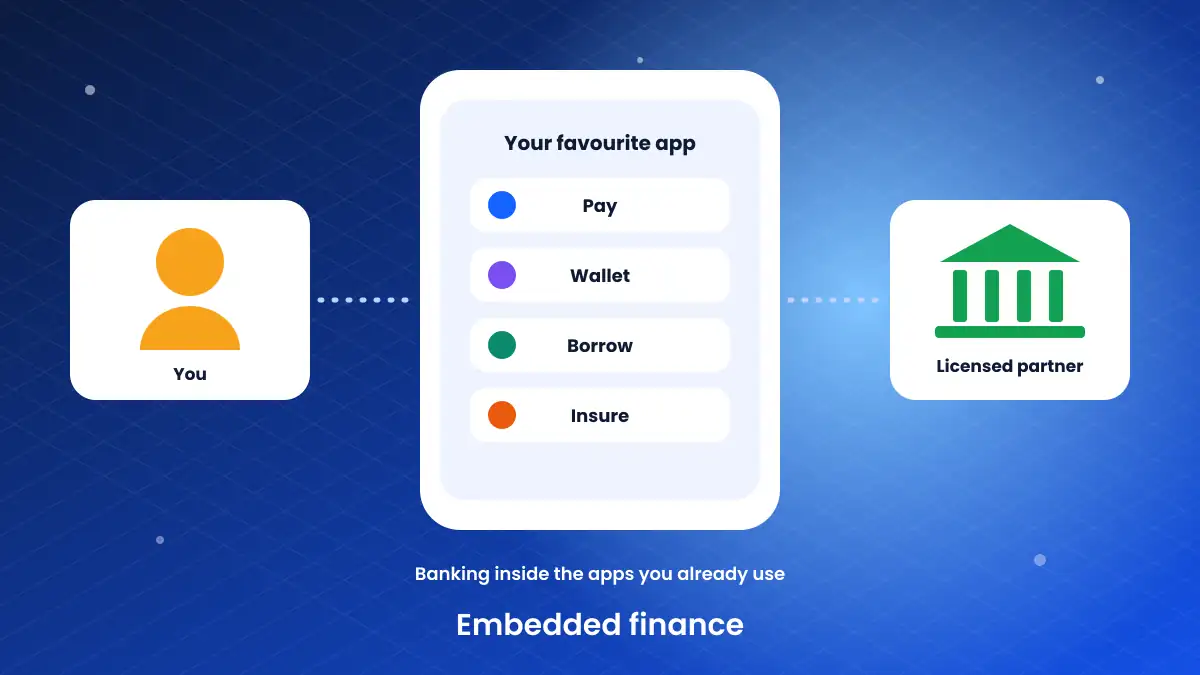
Quick answer: Embedded finance means a non-financial business offers a financial service, such as payments, a wallet, a loan, or insurance, inside its own app or website. A licensed bank or fintech does the regulated work in the background, connected through software called APIs. For customers, it is faster and simpler. For businesses, it can add sales and income, but the partner must be properly licensed.
In this guide
- What is embedded finance?
- How embedded finance works
- Types of embedded finance
- Embedded finance vs fintech vs banking-as-a-service
- Examples you already use
- How big is the market?
- Benefits for customers and businesses
- Risks to watch
- How a small business can use embedded finance
- Frequently asked questions
- Key takeaways on embedded finance
What is embedded finance?
Put simply, embedded finance is when a company whose main business is not finance builds a financial service into its own product. Instead of sending you to a bank, the app lets you pay, save, borrow, or buy insurance on the spot.
For instance, a delivery company might let customers keep money in an in-app wallet. Similarly, an online shop might offer payment by card or bank transfer without leaving its checkout page. In both cases, though, the business is not a bank. Instead, a licensed partner holds the money and handles the rules.
Bain & Company describes it as a non-financial software platform providing an adjacent financial service, in its embedded finance report. In other words, the money service sits next to the main product.
Our guide on what fintech is explains the wider industry that makes this possible.
How embedded finance works
Most services follow the same five steps:
- You use the app. First, you choose to pay, top up, or borrow inside a non-bank app.
- The app calls a provider. Next, the app sends the request to a fintech or bank through an API, a link that lets two systems talk.
- The licensed partner does the regulated work. Then, the partner checks your identity, moves the money, or approves the loan.
- Money moves. After that, funds pass between accounts held at licensed banks.
- The app shows the result. Finally, you see the payment, balance, or loan in the same app.
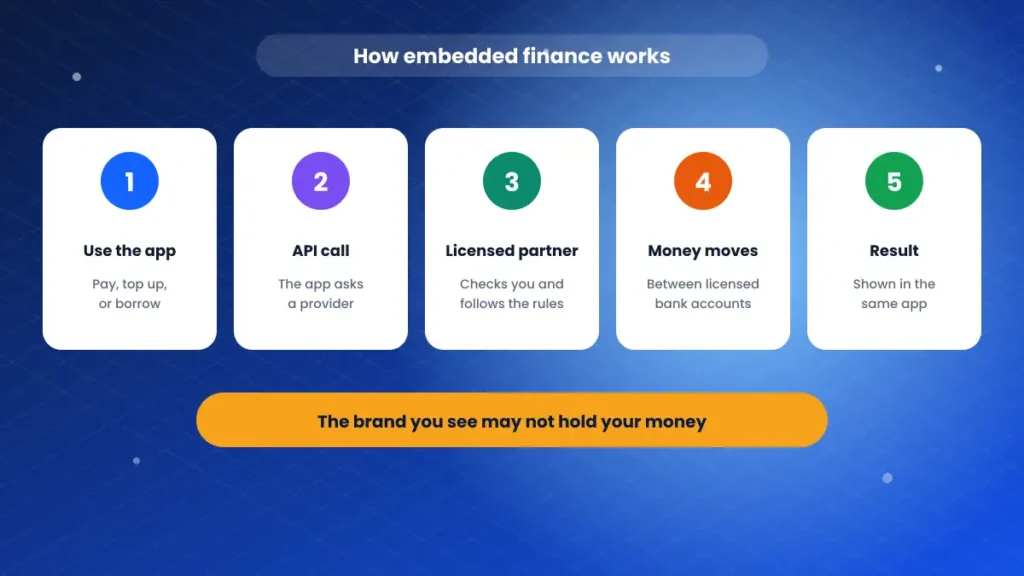
As a result, the brand you see is often not the company holding your money. That difference matters when something goes wrong. Our guide to what an API is explains the technology in more detail.
Types of embedded finance
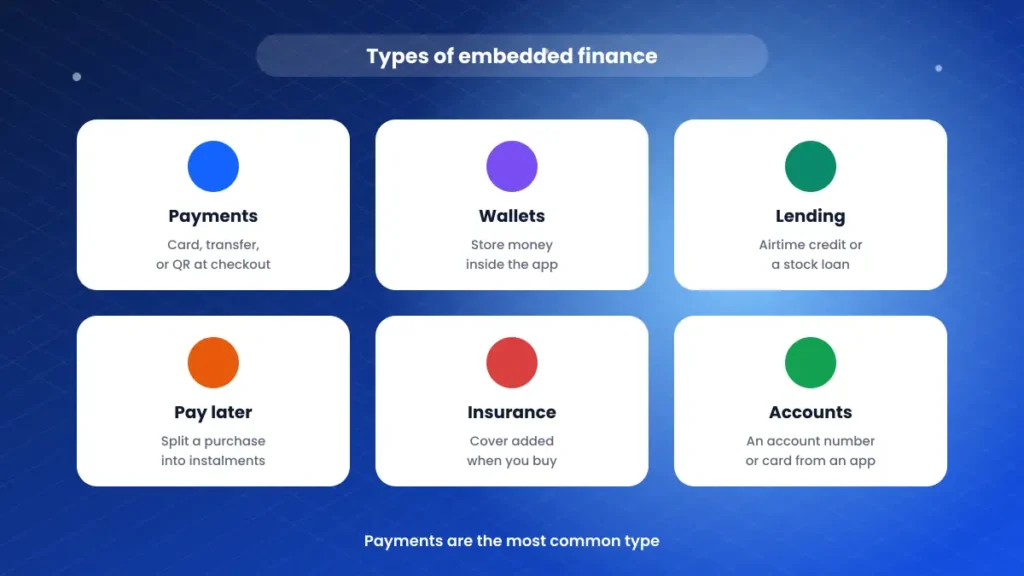
This model comes in several forms:
- Payments. Pay by card, bank transfer, or QR code inside a website or app. Our guide to what a payment gateway is explains how this works.
- In-app wallets. Store money in an app to pay for its services. See our guide to what a digital wallet is.
- Lending. Borrow inside the app, for example, airtime credit or a loan to buy stock.
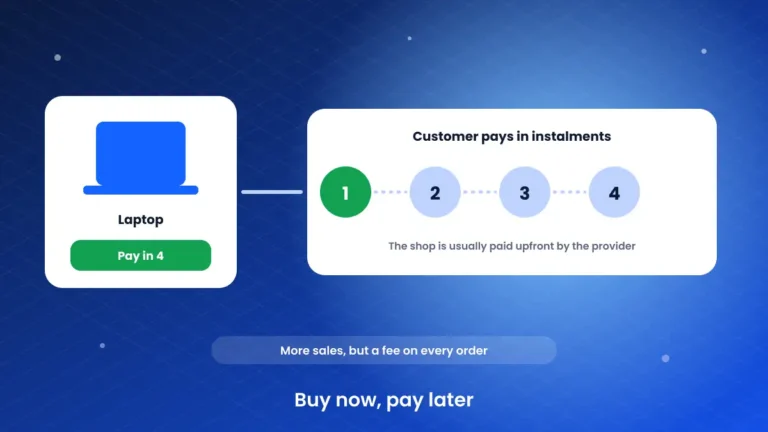
- Buy now, pay later. Split a purchase into instalments at checkout. Our guide to buy now, pay later explains what it means for merchants.
- Insurance. Add cover, such as delivery or device protection, when you buy.
- Accounts and cards. Get an account number or card from a non-bank brand. Our guide to virtual accounts shows one common form.
Embedded finance vs fintech vs banking-as-a-service
These terms overlap, so here is a simple comparison:
| Feature | Embedded finance | Fintech app | Banking-as-a-service |
|---|---|---|---|
| Main business | Not finance, such as travel or retail | Finance | Supplying banking tools to others |
| What you see | The non-bank brand | The fintech brand | Usually nothing; it works behind the scenes |
| Who holds the licence | A partner | The fintech, or its partner bank | The bank or licensed provider |
| Example | A wallet inside a delivery app | A mobile banking app | A bank renting out its accounts through APIs |
In short, banking-as-a-service is the plumbing, and the embedded service is the tap the customer uses. Kora, a payments company, explains the difference in its guide to embedded finance and BaaS.
Examples you already use
Chances are, you already use some of these:
- Airline and event bookings. Pay by card or transfer without leaving the booking site.
- Ride-hailing and delivery wallets. Top up once, then pay for each trip or delivery from the app.
- Airtime borrowing. Your mobile network lends you airtime and takes it back on your next top-up.
- Asset finance for workers. Some platforms help riders pay for motorbikes in instalments.
- Insurance at checkout. Add cover for a phone or a parcel as you pay.
In Africa, a 2025 market report named Flutterwave, Paystack, and Max.ng among Nigerian examples, according to a Business Wire summary.
How big is the market?
Estimates vary widely, so treat these as rough guides:
- Africa. The same report valued the African market at about $11.9 billion in 2024, rising to about $18 billion by 2030.
- United States. In 2022, Bain forecast that these services would handle over $7 trillion of US transactions by 2026, more than 10% of the total.
Meanwhile, Nigeria’s open banking rules, which allow customers to share their bank data with consent, could make more of these services possible. Our guide to open banking in Nigeria explains how that works.
Benefits for customers and businesses
For customers, the main benefit is fewer steps. You pay, borrow, or insure where you already shop, often in seconds.
For businesses, the benefits also include:
- More sales. A smooth checkout means fewer people give up before paying.
- New income. Some businesses earn a share of fees on payments, loans, or insurance.
- Loyal customers. A wallet balance encourages people to come back.
- Better data. Payment records help a business understand its customers.
Risks to watch
However, the model also brings risks:
- Unclear responsibility. For example, if a payment fails, you may not know whether to contact the app or its partner.
- Unlicensed partners. Money held by an unlicensed company may not be protected.
- Hidden costs. Loans and instalment plans can carry high fees. Moreover, charges change, and regulators can change the rules on what providers may charge.
- Data sharing. Your details may pass between several companies.
- Easy debt. Finally, one-tap borrowing makes it easy to take on more debt than you can repay.
So, before you keep money in an app or borrow through it, check who the licensed partner is. In Nigeria, you can confirm a bank or payment company’s licence on the CBN website. Our guide on how to protect your bank account online covers other safety habits.
How a small business can use embedded finance
You do not need to become a bank to offer these services. Instead, follow this simple path:
- Start with payments. Add a payment gateway to your website or online store, so customers pay in one place. Our guide on how to accept online payments explains the options.
- Use dedicated account numbers. Some gateways give each customer a virtual account, so transfers match orders automatically.
- Choose a licensed partner. Check the provider’s CBN licence and read its terms on settlement times and refunds.
- Compare fees. Fees change over time, and regulators can change the rules, so check the current rates before you sign up.
- Add more later. Once payments work well, consider instalments or insurance through the same partner.
If you are still building your shop, our guide on how to start an online store covers the first steps.
Frequently asked questions
Is embedded finance the same as fintech?
Not quite. Fintech companies make financial services their main business. By contrast, here a non-financial business offers a financial service inside its own product, usually through a fintech partner.
Is my money safe in an in-app wallet?
It depends on the partner. Generally, money is safer when a licensed bank or payment company holds it. Check the app’s terms to see who that is.
Do I need a licence to offer financial services in my app?
Usually not, if a licensed partner does the regulated work. However, rules differ by service and country, so ask the partner and check the CBN’s guidance.
Is buy now, pay later a type of embedded finance?
Yes. In fact, instalment plans offered at checkout are one of the most common types.
How is embedded finance different from open banking?
Open banking lets you share your bank data with other apps. Meanwhile, embedded finance lets non-bank apps offer financial services. In fact, open banking can support embedded finance.
Key takeaways on embedded finance
- It lets non-financial businesses offer payments, wallets, loans, or insurance inside their own apps.
- A licensed bank or fintech does the regulated work behind the scenes, through APIs.
- Common examples include in-app checkout, ride-hailing wallets, and airtime borrowing.
- It can boost sales, but customers should check who holds their money.
- Small businesses can start with a payment gateway and add more services later.
Want to understand the systems behind it? Read our guides to what digital banking is and agentic commerce, or browse all our digital business guides.