Card issuing has changed fast. Today, a single sponsor bank or card-as-a-service (CaaS) provider may run cards for dozens of fintechs. Each one has its own product, growth plan, and processor setup. In that world, BIN management is no longer a back-office chore. Instead, it decides how quickly you can launch a new programme, and whether you must wait months for a new BIN. This guide explains the numbers behind six-digit and eight-digit BINs and shows how account ranges really limit capacity. It also gives you a free calculator to plan allocations across your fintech customers. To budget the programme itself, use our card program cost calculator.
Quick answer: BIN management is the work of planning, assigning, and monitoring the card-number space under an issuer’s approved BINs and account ranges. For a 16-digit card number, a six-digit BIN leaves a theoretical 1 billion numbers, while an eight-digit BIN leaves 10 million. However, schemes define capacity through account ranges: Visa uses nine-digit ranges, and Mastercard supports 11-digit ranges. Good BIN management therefore means using approved ranges efficiently through segmentation, reserves, and forecasting, not simply requesting more BINs.
In this guide
- Why BIN management matters for fintech card issuing
- What is a BIN?
- The evolution from six-digit to eight-digit BINs
- How many cards can a BIN support?
- BIN segmentation: the core of BIN management
- BIN management best practices from Visa and Mastercard
- How BIN management avoids wastage
- The BIN management calculator
- BIN management implementation checklist
- Frequently asked questions
- Conclusion: disciplined BIN management pays off
- References
Why BIN management matters for fintech card issuing
Every card programme needs card numbers. Moreover, every card number sits under a BIN that a scheme has assigned to a licensed issuer. So when one issuer serves many fintechs, those numbers become a shared, limited resource that needs BIN management. Consequently, poor BIN management creates problems that are slow and costly to fix:
- Unnecessary BIN requests. Teams ask for a new BIN because nobody can see the unused space in existing ones.
- Fragmented account ranges. Small, scattered assignments leave gaps that are too small for the next programme.
- Poor capacity visibility. No single inventory shows what teams have assigned, issued, reserved, or left free. For a quick estimate of how many cards one BIN can hold, try our card issuing capacity calculator.
- Duplicate or overlapping assignments. As a result, two programmes end up configured on the same range.
- Inconsistent product identification. Ranges carry the wrong product or funding attributes, which breaks routing, fees or reporting.
- Difficult migrations. Moving a programme to a new processor is harder when its cards are spread across many ranges.
- No forecasting. Nobody plans for next year’s programmes, renewals or replacement cards.
In short, the goal of BIN management is not to collect more BINs. It is to get the most usable capacity out of the BINs and account ranges you already have, through controlled segmentation, allocation, monitoring and forecasting.
What is a BIN?
A BIN, or bank identification number, is the prefix at the start of a card number that identifies the issuer. The international standard calls it the issuer identification number (IIN), defined in ISO/IEC 7812-1:2017. Visa notes that, in its system, IINs are referred to as bank identification numbers, so the two terms describe the same prefix.
The full card number, meanwhile, is the primary account number (PAN). It has three parts: the BIN, the individual account identifier, and a final check digit. The Luhn formula sets the check digit, so nobody can choose it freely.
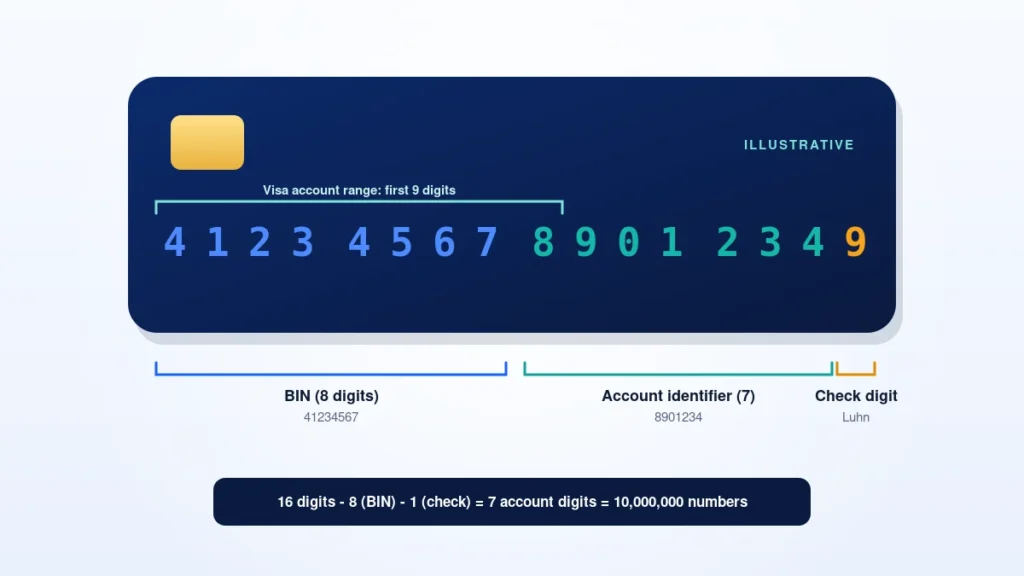
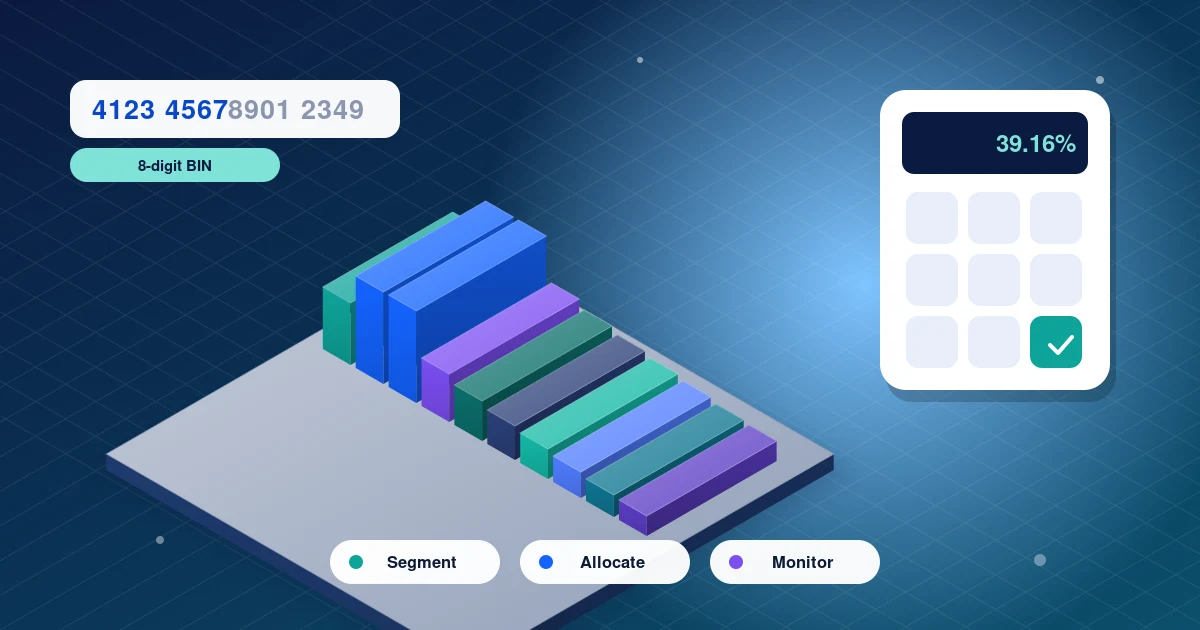
For example, here is a fictional 16-digit example, 4123 4567 8901 2349, broken into its parts:
| Part | Digits in the example | What it means |
|---|---|---|
| BIN (8 digits) | 41234567 | First, it identifies the issuer and, through scheme tables, its products |
| Account identifier (7 digits) | 8901234 | Then it tells one card account apart from another under that BIN |
| Check digit (1 digit) | 9 | Finally, the Luhn formula is used to catch typing errors |
This number is illustrative only, so it does not belong to any real issuer or card.
Key BIN management terms to keep separate
People often mix up several terms, so good BIN management starts by defining them before doing any maths:
| Term | Meaning |
|---|---|
| Issuing BIN or IIN | First, the six-digit or eight-digit prefix a scheme assigns to an issuer |
| PAN | Then the full card number, usually 16 digits, including the check digit |
| Account range | A block of PANs under a longer prefix, so it can carry its own product and processing attributes |
| Card account vs card | One account can have several cards, such as a physical card and a virtual card, each with its own PAN |
| Funding range vs token range | Funding PANs sit in issuer ranges, whereas network tokens come from separate token ranges |
| Theoretical vs approved capacity | The raw numbering space, as opposed to the space the scheme and processor have actually set up |
| Assigned range vs issued cards | The block a programme holds, compared with the cards it has actually issued so far |
| Customers vs cards | One cardholder may need several card numbers over time, so cardholders and cards are different measures |
Importantly, a fintech that receives a range from its sponsor issuer or processor does not own that BIN. Instead, the scheme assigns the BIN to the licensed issuer, and the fintech uses part of it under contract.
The evolution from six-digit to eight-digit BINs
For decades, BINs were only six digits long. However, the growth of card programmes, prepaid products, fintechs and tokenisation put pressure on that space. As a result, ISO expanded the issuer identification number from six to eight digits in the 2017 edition of ISO/IEC 7812-1. Then the schemes set dates to adopt it.
After that, the key milestones were:
- Visa: Visa’s 8-digit BIN guidance for issuers and processors gives April 22, 2022, as the final effective date. From the April 2022 release, Visa stopped assigning new six-digit issuing BINs.
- Mastercard: Mastercard began assigning eight-digit BINs to issuers by request from April 2022, and required acquirers and their processors to support 11-digit account ranges and the eight-digit BIN standard by then.
- Prefix sharing: Visa then said that eight-digit BINs sharing the same six-digit prefix would start to appear from April 2023, across different issuers and countries.
Existing six-digit BINs were not converted automatically. Visa’s eight-digit BIN FAQ confirms that both six-digit and eight-digit BINs continue to exist, and that issuers set their own timeline for any expansion. In practice, therefore, many portfolios now run a mix of legacy six-digit BINs and newer eight-digit BINs.
What the change means for systems
The longer BIN affects much more than card printing. For BIN management teams, for example, it changes:
- Issuer processors: card management and authorisation systems must read eight digits and the full account range.
- Routing: Visa tells clients to route on Visa-supplied routing tables, not on the first six digits.
- Fraud tools: rules and risk models keyed on six digits may treat several issuers as one.
- Reporting: BIN-level reports, fees and reconciliation need the longer key.
- PCI DSS controls: teams must review masking and truncation formats, as covered later. Our PCI DSS readiness checklist covers masking under item 3.4.
How many cards can a BIN support?
The maths behind BIN management is simple, as long as you remember the check digit. In a 16-digit PAN, the Luhn formula sets the last digit. So the digits available for account numbers are the PAN length, minus the BIN length, minus one.
| BIN length | PAN length | Account digits | Theoretical PANs per BIN |
|---|---|---|---|
| 6 digits | 16 | 9 | 10^9 = 1,000,000,000 |
| 8 digits | 16 | 7 | 10^7 = 10,000,000 |
| 6 digits | 19 | 12 | 10^12 = 1,000,000,000,000 |
| 8 digits | 19 | 10 | 10^10 = 10,000,000,000 |
So, a six-digit BIN with 16-digit cards has a theoretical 1 billion numbers, not 10 billion. An eight-digit BIN has 10 million, which is 100 times fewer.
Theoretical capacity is not usable capacity
However, these figures describe numbering space, not cards you can issue tomorrow. In reality, the schemes manage capacity through account ranges, which are longer prefixes with their own attributes:
- Visa defines an account range as the first nine digits of the PAN. Visa’s BIN prefix sharing notice calls it best practice to define product, service, and routing at the nine-digit level or beyond.
- Mastercard requires processors to support 11-digit account ranges, and its BIN Lookup data publishes product code, funding source, and acceptance brand for each account range.
As a result, here is what that means for an eight-digit BIN with 16-digit cards:
| Range format | Ranges in one 8-digit BIN | Card numbers per range |
|---|---|---|
| Visa, 9-digit ranges | 10 | 1,000,000 |
| Mastercard, 11-digit ranges | 1,000 | 10,000 |
As a result, a 10-million number BIN is really 10 Visa ranges of 1 million each. Alternatively, it is 1,000 Mastercard ranges of 10,000 each. A programme that needs only 1,000 cards may still use a whole range, because product and processing attributes attach to the range. In addition, other limits apply. For instance, issuers keep some numbers for testing. Also, the scheme and processor must configure each range, and scheme rules govern how issuers assign PANs within a range.
Cards, accounts and tokens use capacity differently
In BIN management, capacity planning should count card numbers, not customers. However, each card type behaves differently:
| Item | Uses a PAN from your range? | Planning note |
|---|---|---|
| Physical card | Yes | In general, one PAN per card |
| Virtual card | Yes | Similarly, each virtual card normally has its own PAN |
| Replacement for a lost or stolen card | Usually yes | Issuers normally give a new PAN, so plan for it |
| Renewal at expiry | It depends | Many issuers keep the PAN and change the expiry date; check your policy |
| Several cards on one account | Yes, usually one each | So count every card, not every account |
| Network token in a wallet | No | Instead, tokens come from token ranges; Mastercard’s data marks token and PAN ranges separately |
Therefore, a fintech with 100,000 cardholders may need far more than 100,000 card numbers over the life of the programme.
BIN segmentation: the core of BIN management
BIN segmentation means dividing approved BINs and account ranges into clear blocks for different programmes or fintech customers. As a result, an issuer or an authorised CaaS provider can track each block separately. Every assignment, however, remains subject to the sponsor issuer’s approval, scheme rules, processor configuration, product eligibility and the relevant regulatory and contractual terms.
For example, consider this illustrative portfolio of nine fintech programmes:
| # | Customer | Required card capacity |
|---|---|---|
| 1 | Customer A | 1,000,000 |
| 2 | Customer B | 2,000,000 |
| 3 | Customer C | 500,000 |
| 4 | Customer D | 250,000 |
| 5 | Customer E | 100,000 |
| 6 | Customer F | 50,000 |
| 7 | Customer G | 10,000 |
| 8 | Customer H | 5,000 |
| 9 | Customer I | 1,000 |
| All | Total demand | 3,916,000 |
At first glance, 3,916,000 cards fit easily inside one eight-digit BIN of 10 million. However, the range format changes the answer:
| Planning view | Ranges needed | Capacity consumed | Share of one 8-digit BIN |
|---|---|---|---|
| Theoretical (no ranges) | Not applicable | 3,916,000 | 39.16% |
| Visa 9-digit ranges | 10 | 10,000,000 | 100% |
| Mastercard 11-digit ranges | 393 | 3,930,000 | 39.3% |
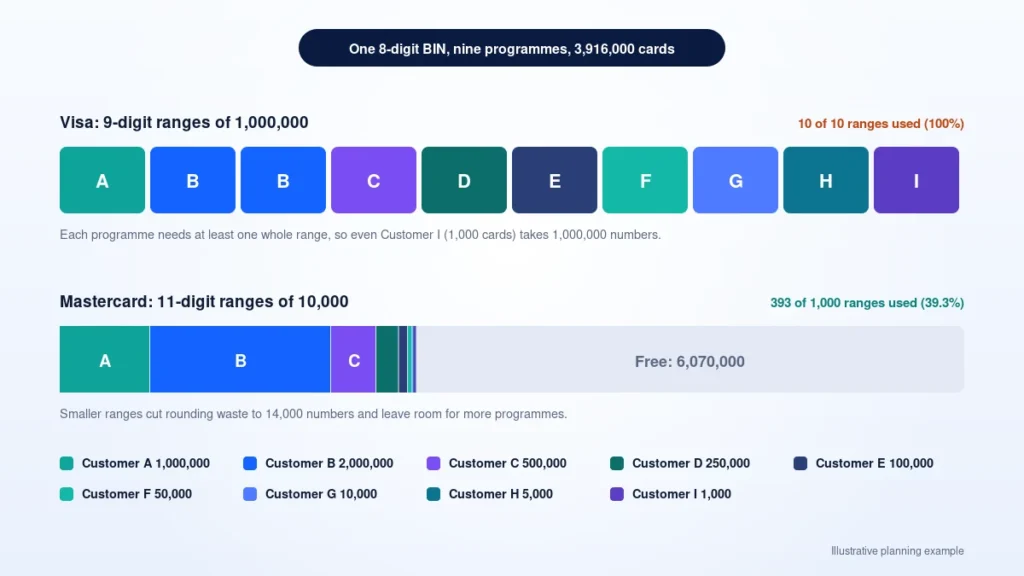
With Visa-sized ranges, each of the nine programmes needs at least one whole range, and Customer B needs two. So the plan uses all 10 ranges, even though demand is under 40% of the numbering space. With Mastercard-sized ranges, by contrast, the rounding waste is only 14,000 numbers.
This is exactly why BIN management needs a calculator. For this reason, the calculator below works out these figures, proposes non-overlapping range assignments, and shows where demand will not fit.
BIN management best practices from Visa and Mastercard
The table summarises what each scheme’s public documents say. “Rule” marks a requirement, while “Recommendation” marks guidance. Where a public document does not cover a topic, the table says so, rather than guessing. Above all, confirm current rules with your scheme representative.
BIN management rules for readiness, ranges and routing
| Topic | Visa guidance | Mastercard guidance | Practical action for programme managers |
|---|---|---|---|
| BIN length readiness | Rule: acquirers and processors had to support eight-digit BINs from April 2022, and Visa no longer assigns six-digit issuing BINs | Rule: similarly, acquirers and processors had to support the eight-digit BIN standard by April 2022, and issuers can request eight-digit BINs | First, confirm that every system, report, and vendor reads eight digits |
| Account-range management | Recommendation: define product, service, and routing at the nine-digit range level or beyond | Rule: in addition, processors must support 11-digit account ranges | Also keep your inventory at the scheme’s range level, not just the BIN |
| Product identification | Product type is set at BIN level, while clearing tables carry funding source, product and geography | By contrast, Mastercard publishes product code, funding source, and acceptance brand per account range | Then keep one programme’s attributes per range, and document them |
| Routing and BIN tables | Rule: route on Visa routing tables, not the first six digits, and do not route on the clearing table | Likewise, processors must handle 11-digit ranges in their tables | So refresh scheme tables on every release and remove six-digit logic |
Allocation, tokens, PCI DSS and testing
The second half of the comparison covers day-to-day allocation and security.
| Topic | Visa guidance | Mastercard guidance | Practical action for programme managers |
|---|---|---|---|
| Range allocation and fragmentation | Recommendation: consolidate in-use nine-digit ranges into as few eight-digit BINs as possible | However, the public documents reviewed do not cover this | Instead of scattering programmes, allocate contiguous blocks and track gaps |
| Tokenisation | Random PAN assignment across ranges is prohibited for BINs enrolled in Visa Token Service | Also, BIN data marks token ranges separately from PAN ranges | So plan token ranges with your token service, separately from funding ranges |
| PAN masking and PCI DSS | However, truncation alone is not enough if the full eight-digit BIN and last four are kept | Display intent is first six and last four; truncation may keep at most the first eight and any other four | In addition, follow PCI SSC FAQ 1492 and each brand’s truncation format |
| Testing and change management | Recommendation: coordinate with processors and third parties on testing, schedules, and reporting | However, the public documents reviewed do not cover this in detail | Finally, test every new range end to end before live issuance |
PCI DSS and eight-digit BINs
On PCI DSS, the PCI Security Standards Council’s FAQ 1492 sets a clear default. Screens should show no more than the BIN and last four digits, unless a documented business need allows more. In addition, its 8-digit BIN blog adds that truncation formats vary by brand and PAN length. Mastercard’s paper also asks entities to assume, for PCI purposes, that all Mastercard PANs have eight-digit BINs.
How BIN management avoids wastage
Most wasted capacity comes from habits, not from a shortage of BINs. Therefore, these BIN management practices protect your ranges:
- Keep one central range inventory. Above all, record every BIN, account range, programme, status, and attribute in one place.
- Segment by capacity, not by habit. Size each block from the programme’s real card-number need, rounded to the scheme’s range format.
- Base allocations on realistic forecasts. Use launch plans, growth rates and card-per-customer ratios, not optimistic hopes.
- Set reserves and growth buffers. Then hold back capacity for replacements, renewals and new programmes.
- Monitor utilisation. Track issued cards against each allocation every month, and flag ranges above an agreed threshold.
- Control approvals and releases. Use a written workflow for assigning, changing and releasing ranges, with sign-off from the sponsor issuer.
- Avoid random PAN allocation where guidance prohibits it. For example, Visa prohibits random assignment across ranges for BINs enrolled in its token service.
- Review dormant ranges first. Before requesting more capacity, check for unused or abandoned ranges you can reclaim.
- Plan for replacements, renewals and migrations. Leave room for reissued cards and for moving programmes between products or processors.
- Separate card count from allocated capacity. Also report both, so stakeholders do not mistake an allocated range for issued cards.
The BIN management calculator
The calculator has two modes. First, the Quick Capacity Planner works out the theoretical capacity of one BIN and totals your demand. It also shows how many Visa or Mastercard ranges that demand would use. Second, the Range Allocation Planner takes your approved BIN and range boundaries. Then it proposes contiguous, non-overlapping assignments for each programme.
In short, here is how it calculates:
- Theoretical capacity equals 10 to the power of (PAN length minus BIN length minus one).
- Range size equals 10 to the power of (PAN length minus range-prefix length minus one).
- Existing allocations come from the bottom of the parent range, while the reserve comes from the top.
- Each request grows by any growth percentage, then rounds up to whole account ranges.
- Placement follows table order, first fit, with optional manual start boundaries and split ranges.
- All numbers use exact integer arithmetic, so long prefixes keep every digit, including leading zeros.
Loading the BIN Management Calculator…
Still, keep its limits in mind. For example, the tool treats one account-range prefix as the smallest unit you can allocate, because that is where scheme attributes attach. Your processor may support smaller sub-allocations, which you can model with the Custom scheme option. Also, the Visa and Mastercard range lengths are planning settings, not confirmation of what a scheme will approve. Finally, nothing you enter leaves your browser, and the output is a planning proposal, not a scheme allocation.
BIN management implementation checklist
Before you assign a range to a fintech customer, use this BIN management checklist:
- Approval: first, the sponsor issuer has approved the programme, product and allocation.
- Scheme set-up: confirm the BIN and account range with the scheme for this product.
- Attributes: check that product, funding source and geography on the range match the programme.
- Processor: make sure the processor has configured the range and refreshed its routing tables.
- Demand: count card numbers, including virtual cards, replacements and renewals, not just customers.
- Buffers: agree and record a reserve and a growth buffer.
- Overlaps: verify that the new block does not overlap any existing or reserved range.
- Tokens: plan token ranges separately with the token service provider.
- PCI DSS: align PAN masking and truncation with PCI DSS and each brand’s rules for eight-digit BINs.
- Testing: pass end-to-end tests for authorisation, clearing, tokenisation, and reporting.
- Records: enter the allocation, owner, and review date in your BIN management inventory.
- Contract: finally, state in the contract that the fintech does not own the BIN.
Frequently asked questions
What is the difference between a six-digit and eight-digit BIN?
Simply put, an eight-digit BIN uses two more digits to identify the issuer. For 16-digit cards, that leaves 10 million theoretical numbers instead of 1 billion.
Can an eight-digit BIN theoretically support 10 million 16-digit PANs?
Yes, in theory: seven account digits give 10^7 numbers. However, usable capacity depends on the account ranges the scheme and processor have set up.
Can multiple fintech customers share an issuer-managed BIN?
Yes, commonly. In fact, the issuer can assign different account ranges to different programmes, subject to scheme rules, processor support and the sponsor issuer’s approval.
Does a fintech need its own BIN to issue cards?
No. Most fintechs issue through a sponsor bank or CaaS provider, which assigns them ranges under the issuer’s BIN. Some fintechs with their own licence hold BINs directly.
What is the difference between a BIN and an account range?
First, the BIN identifies the issuer. An account range, by contrast, is a longer prefix, such as Visa’s nine digits or Mastercard’s 11 digits, that can carry its own product and processing attributes.
Can an issuer allocate a range based on projected demand?
Yes. In fact, allocating from realistic forecasts, plus an agreed buffer, is good practice. Review the forecast regularly, though, and reclaim capacity that is not used.
How do Visa and Mastercard account-range requirements differ?
Visa defines account ranges at nine digits, while Mastercard requires support for 11-digit ranges. So, the smallest scheme-level block differs, and you should confirm details with each scheme.
What happens when a customer uses up its allocation?
Usually, the issuer then assigns a further block, ideally next to the existing one. If no space is left, it may use reserve capacity or request a new range or BIN.
Can an issuer reassign unused ranges immediately?
Not always. Cards may still be live, and scheme or processor records may need updating. Visa, for example, holds returned BINs for at least a year before reassigning them.
Does a virtual card consume card-number capacity?
Yes, because a virtual card normally has its own PAN, so it uses a number from the range just like a physical card.
How should an issuer account for replacement cards?
Treat replacements as extra demand. Lost, stolen, and damaged cards usually get new PANs, so add a replacement allowance to every forecast.
How often should BIN management teams review range utilisation?
Monthly is a sensible minimum for active programmes, and weekly for fast-growing ones. In addition, good BIN management reviews utilisation before every new programme launch.
Conclusion: disciplined BIN management pays off
Eight-digit BINs hold a hundred times fewer numbers than six-digit ones. Moreover, scheme account ranges cut the usable space further. So the issuers that grow smoothly are the ones that treat ranges as a managed inventory. In other words, disciplined BIN management, with clear utilisation reports and honest forecasting, lets you serve more fintechs from the BINs you already hold.
Finally, use the calculator above as a planning aid. Then, before you make any real assignment, confirm the plan with your issuer processor and your scheme representative. For more on the parties involved, read our guides to what a card issuer is , how card issuance works and HSM key generation.
References
- ISO, ISO/IEC 7812-1:2017 Identification cards: Identification of issuers, Part 1: Numbering system, edition 5, published January 2017, confirmed in 2022.
- Visa, Is your organization 8-digit BIN ready? Issuers and processors, undated, final effective date April 22, 2022.
- Visa, Preparing for the eight-digit BIN: frequently asked questions, January 2020.
- Visa, Numerics Initiative: timing for BIN prefix sharing, Visa Business News, August 11, 2022.
- Mastercard, 8-digit BIN expansion and PCI standards, updated October 20, 2021.
- Mastercard Developers, BIN Lookup API data elements, accessed October 2026.
- PCI Security Standards Council, FAQ 1492: PAN masking and truncation after migrating to 8-digit BINs, April 2024.
- PCI Security Standards Council, 8-digit BINs and PCI DSS: what you need to know, September 2, 2021.