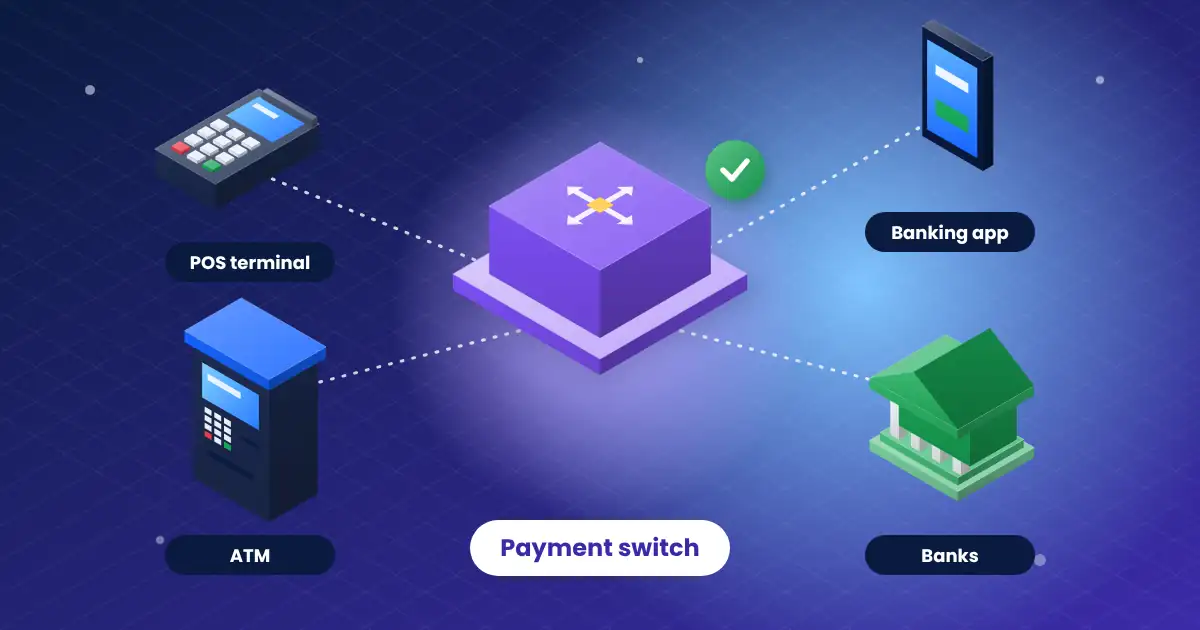
Every time you pay with a card at a shop, withdraw from another bank’s ATM, or send money to a friend at a different bank, something in the middle connects the two sides. That connector is a payment switch. It decides where each payment request should go, passes it on in a language the other side understands, and brings the answer back, usually in a few seconds. This guide explains what a payment switch is, how it works step by step, who runs the main switches in Nigeria, and what happens when a switch goes down.
Quick answer: A payment switch is a system that connects banks, card schemes, payment terminals and apps so that payment messages can travel between them. When you pay, the switch receives the request, works out which bank or network should handle it, converts the message into the right format and forwards it. It then returns the approval or decline to the terminal or app. In Nigeria, NIBSS, Interswitch, Unified Payments, and eTranzact are well-known switches, and the CBN licenses switching and processing companies separately from other payment firms.
In this guide
- What is a payment switch?
- What does a payment switch do?
- How does a payment switch work?
- An example: a ₦10,000 payment through a payment switch
- Payment switches in Nigeria
- Payment switch vs payment gateway vs payment processor
- Common problems with a payment switch
- Frequently asked questions
- Key takeaways
What is a payment switch?
A payment switch is the traffic controller of the payment world. On its own, a POS terminal or a banking app cannot talk to every bank in the country. Instead, it talks to a switch, and the switch talks to everyone else.
Think of it like a telephone exchange. You dial one number, and the exchange connects you to the right line. Similarly, a POS terminal sends one request, and the payment switch connects it to the right card network or bank.
Switches handle many kinds of payments. For example, the Techpoint guide to switching licences lists ATM withdrawals, POS payments, interbank transfers and card payments. Without a switch, every bank would need a direct link to every other bank, terminal owner and card scheme. That would mean thousands of separate connections.
What does a payment switch do?
A payment switch does more than pass messages along. Here are its main jobs.
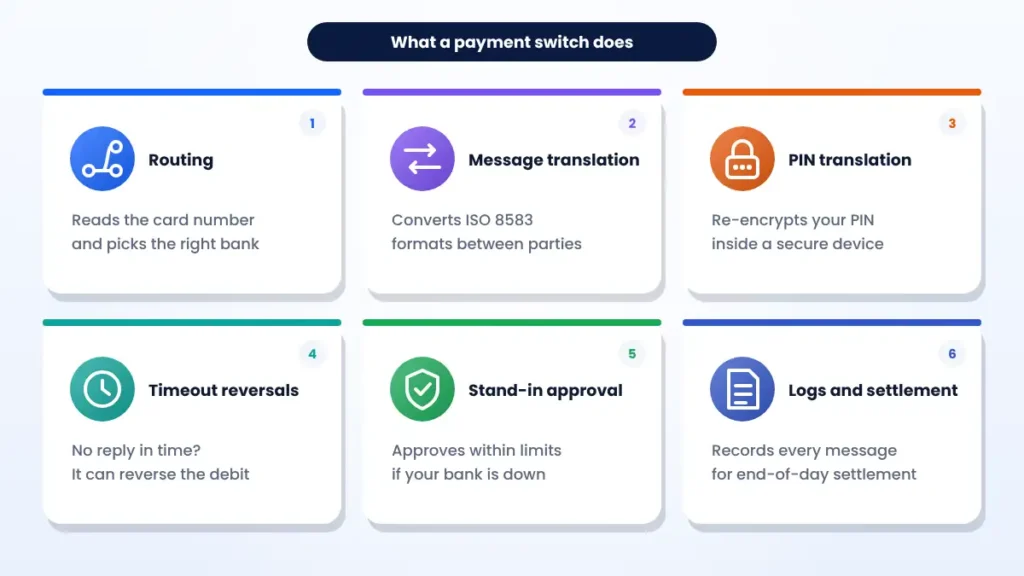
| Job | What it means in practice |
|---|---|
| Routing | First, reads the card number or account details and sends the request to the right bank or network |
| Message translation | Converts the request between formats, because terminals, banks and card schemes often use different versions of the ISO 8583 message standard. Bank transfers use a newer standard, ISO 20022. |
| PIN and key translation | Re-encrypts your PIN with the next party’s key inside a secure hardware device, so the PIN is never visible in clear text |
| Timeouts and reversals | Waits a set time for a reply and, if none comes, can send a reversal so you are not debited for a failed payment |
| Stand-in processing | If your bank is unreachable, some switches can approve small payments on the bank’s behalf, within limits the bank sets |
| Logging and settlement | Also records every message, then produces the reports that banks use to settle money with each other later |
So the switch is both a router and a record keeper. In addition, it is often the first place engineers look when payments start failing.
How does a payment switch work?
The exact path depends on the payment type. However, a card payment at a shop usually follows these steps.
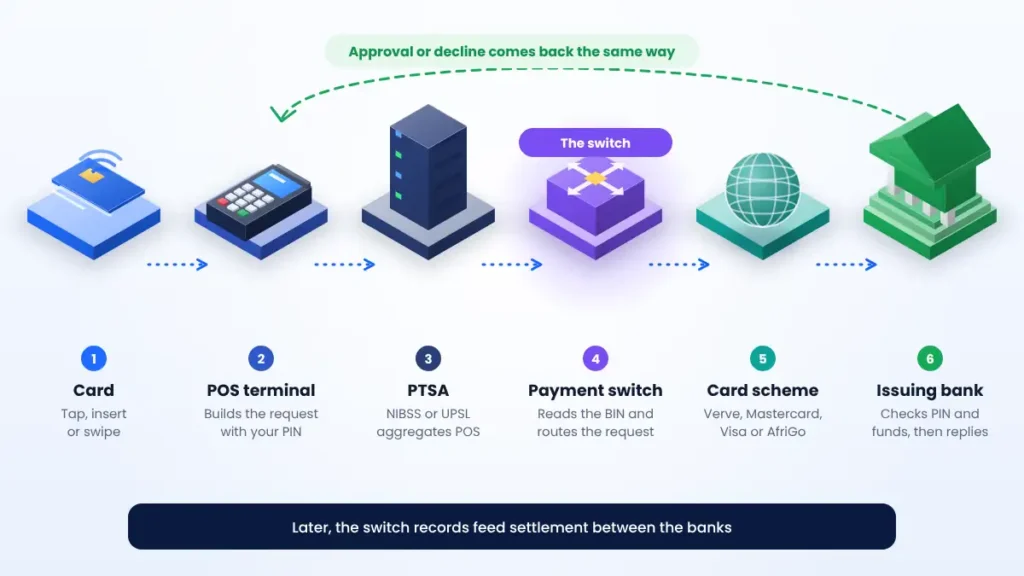
- You pay. You tap, insert, or swipe your card and enter your PIN.
- The terminal builds a message. It packs the card number, amount, merchant details, and your encrypted PIN into a request.
- The request reaches an aggregator. In Nigeria, POS traffic first goes to a Payment Terminal Service Aggregator (PTSA) such as NIBSS or Unified Payments.
- The payment switch routes it. The switch reads the first digits of your card number, known as the BIN, and works out which scheme and bank issued the card. Our BIN management guide explains these digits.
- The issuer decides. The request reaches your bank, or its processor, which checks your PIN, balance, and fraud rules. Our guide on what a card issuer is covers this step.
- The answer comes back. The approval or decline travels back through the same switches to the terminal. The whole trip usually takes a few seconds.
- Settlement happens later. At the end of the day, the switch’s records feed the settlement process, which moves the real money between banks.
Bank transfers follow a similar idea. When you send money through the NIBSS Instant Payment (NIP) system, NIBSS acts as the switch between the sending and receiving banks. Our guide to how bank transfers work walks through that path.
An example: a ₦10,000 payment through a payment switch
Here is a simple, illustrative example. Ada buys groceries worth ₦10,000 at a supermarket in Lagos. Her debit card comes from Bank A, but the POS terminal belongs to Bank B, the supermarket’s acquirer.
First, Ada inserts her card and enters her PIN. The terminal sends the request to the PTSA. Next, the payment switch sees that the card number belongs to Bank A, translates Ada’s encrypted PIN to the key it shares with the next party, and forwards the request. Then Bank A checks her balance and approves the payment.
After that, the approval returns to the terminal, and the receipt prints. Ada’s balance drops by ₦10,000 straight away. However, the supermarket gets its money later, after settlement. For more on Bank B’s role, see our guide to what a card acquirer is.
If Ada had used a Bank B card on a Bank B terminal, the payment would be “on-us“. In that case, the bank can often approve it internally without sending it to another bank. A “not-on-us” payment, like Ada’s, needs a switch to reach the other bank.
Payment switches in Nigeria
Nigeria has several companies that hold a switching licence. In December 2020, the CBN split payment licences into separate categories and set a minimum capital of ₦2 billion for switching and processing, TheCable reported.
| Company | Known for |
|---|---|
| NIBSS | Owned by the CBN and the banks; runs NIP transfers and acts as a PTSA for POS traffic |
| Interswitch | Card switching, ATM and POS routing, and the Verve card scheme |
| Unified Payments (UPSL) | Card switching and processing; also a licensed PTSA |
| eTranzact | Switching and mobile payment services |
| Newer licence holders | Firms such as Flutterwave, Paystack, Blusalt, Appzone and TeamApt (Moniepoint) also hold switching licences |
In addition, the CBN now wants POS traffic to have a backup route. A December 2025 circular requires POS transactions to be linked to both PTSAs, NIBSS and UPSL, so that payments can move to the other one if one goes down, Techpoint reported.
Switches carry huge volumes. For instance, Nigerian e-payments reached ₦284.99 trillion in the first quarter of 2025, according to NIBSS data reported by THISDAY.
Payment switch vs payment gateway vs payment processor
These three terms often get mixed up. Here is the short version.
| Term | Main job | Where you meet it |
|---|---|---|
| Payment gateway | Collects and protects card details for online payments | The checkout page on a website or app |
| Payment processor | Handles transactions for a merchant or bank from start to settlement | Behind the merchant or the bank |
| Payment switch | By contrast, connects many institutions and routes messages between them | In the middle of the network |
In practice, one company can do all three. For example, a firm may run a gateway for online shops, process payments for banks, and also switch traffic between them. Read more in our guides to the payment gateway and the payment processor.
Common problems with a payment switch
When a payment switch has trouble, customers notice quickly. These are the usual problems.
- “Issuer or switch inoperative”. This is response code 91. It means the switch could not reach your bank in time. Wait a few minutes and try again. You can look up any code with our response code decoder.
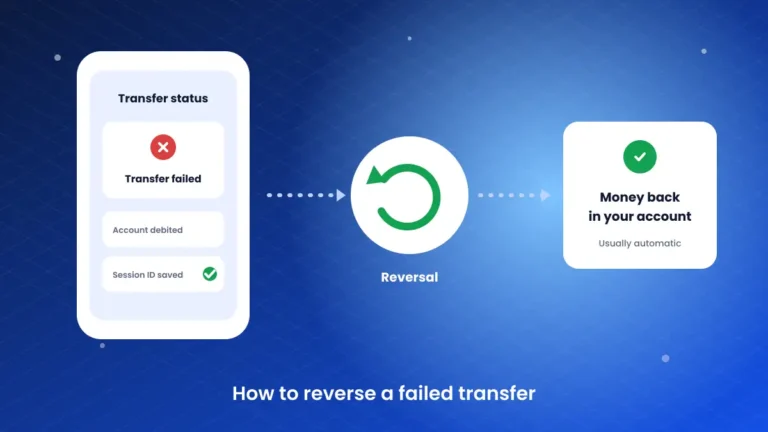
- Debited but the payment failed. The reply was lost on the way back, so the terminal shows a failure even though your bank debited you. In most cases, a reversal returns the money automatically. If it does not, CBN rules give your bank 72 hours for failed POS payments.
- Slow payments at busy times. Month-end and festive periods push traffic up. As a result, timeouts rise, and payments take longer.
- Routing errors. A new card range that has not been set up on the switch can fail with code 92. Banks and switches fix this between themselves.
For step-by-step fixes, see our guide on why POS transactions fail.
Frequently asked questions
Is NIBSS a payment switch?
Yes. NIBSS runs the NIP system that switches instant transfers between Nigerian banks. It also acts as a PTSA, routing POS transactions to the right processors.
Is Interswitch a payment switch?
Yes. Interswitch is one of Nigeria’s best-known payment switches. It routes card payments for ATMs, POS terminals, and online payments, and it also runs the Verve card scheme.
Does a payment switch hold my money?
No. A payment switch only moves payment messages, not your money. Instead, your money stays in your bank account until settlement moves it between banks.
Why do I need a PIN if the switch can see my card?
The switch never sees your PIN in clear text. It only re-encrypts the PIN inside a secure device and passes it on. Your bank is the party that checks it.
Can a payment switch approve a payment without my bank?
Sometimes. With stand-in processing, a switch can approve a payment when your bank is unreachable, but only within limits your bank has agreed in advance.
Who regulates payment switches in Nigeria?
The Central Bank of Nigeria. It issues switching and processing licences and also sets rules such as the dual POS routing requirement.
Key takeaways
- A payment switch connects terminals, apps, banks and card schemes so payment messages reach the right place.
- It routes requests, translates message formats, re-encrypts PINs, handles timeouts and keeps records for settlement.
- A card payment goes from the terminal to an aggregator, then through the switch to your bank, and the answer comes back the same way.
- In Nigeria, NIBSS, Interswitch, Unified Payments, and eTranzact are well-known switches, and the CBN licenses them.
- When a switch goes down, you may see code 91 or a failed payment, but reversals usually return your money.