The voice on the phone sounds exactly like your son. He is in trouble; he needs money now, and he begs you not to tell anyone. However, it may not be him at all. Deepfake scams use artificial intelligence (AI) to copy a real person’s voice or face, and criminals now target bank customers every day. This guide explains how deepfake scams work, the warning signs, and the simple habits that keep your money safe.
Quick answer: Deepfake scams use AI to fake the voice, face, or video of someone you trust, such as a relative, your boss, a bank official, or a celebrity. The goal is to rush you into sending money, sharing an OTP, or approving a payment. To stay safe, agree on a secret phrase with family, hang up and call back on a number you already know, and never share a PIN or OTP, no matter how real the caller seems.
In this guide
- What are deepfake scams?
- How deepfake scams work
- Common deepfake scams that target bank customers
- Real cases and what the numbers show
- How to spot a deepfake call or video
- How to protect yourself and your bank account
- What to do if you have been targeted
- How banks are fighting deepfake scams
- Frequently asked questions
- Key takeaways on deepfake scams
What are deepfake scams?
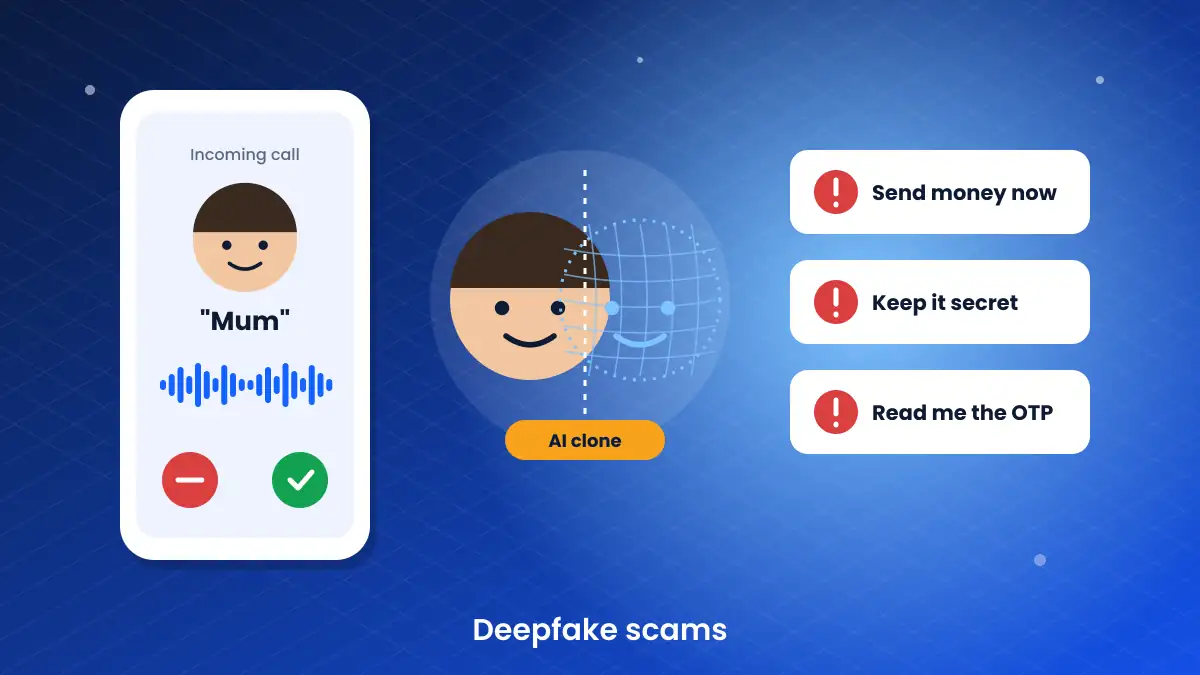
A deepfake is audio, video, or an image that AI has created or changed to look and sound like a real person. Deepfake scams use these fakes to trick you into trusting the wrong person.
In the past, a scammer had to disguise their voice or send a blurry photo. Today, cheap AI tools can clone a voice from a short clip and generate a convincing face on a live video call. Often, the goal is authorised push payment fraud, where you are tricked into sending money yourself. As a result, the old advice to “listen for a strange voice” no longer works on its own.
Deepfake scams usually fall into two groups:
- Voice deepfakes, where a cloned voice calls or sends voice notes on WhatsApp.
- Video deepfakes, where a fake face appears in a video call, a recorded clip, or an advert.
How deepfake scams work
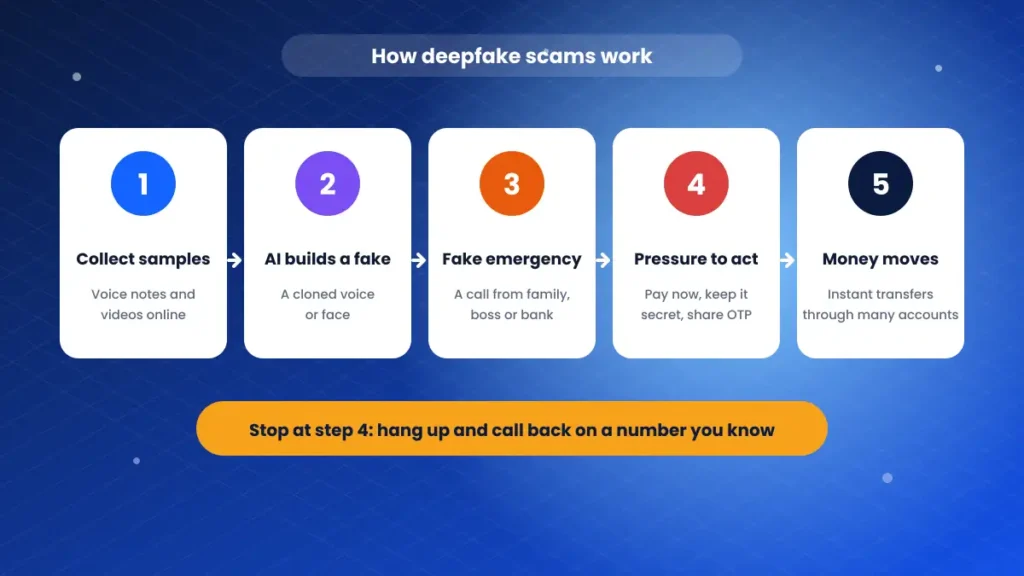
Most deepfake scams follow the same five steps:
- The scammer collects samples. They copy your relative’s voice or face from social media videos, voice notes, or old interviews. According to UK bank Starling, as little as three seconds of audio can be enough to clone a voice.
- They build the fake. Next, AI tools turn the samples into a voice or face that can say anything.
- They create a crisis. Then the “relative”, “boss,” or “bank officer” calls with an emergency, a secret deal, or a security alert.
- They demand fast action. You are told to transfer money, read out an OTP, or approve a prompt in your banking app, usually within minutes.
- The money disappears. Finally, the funds move through several accounts, which makes recovery hard.
Common deepfake scams that target bank customers
Criminals use the same technology in several ways:
| Scam | What you see or hear | What they want |
|---|---|---|
| Family emergency call | A cloned voice of a child or parent in trouble | An urgent transfer |
| Fake bank officer | A caller or video agent who sounds like your bank | Your OTP, PIN, or app approval |
| Boss or executive call | Your manager or director on a video call | A secret payment from the company account |
| Celebrity investment video | A famous person promoting a trading platform | A deposit into a fake investment |
| Romance video call | A partner whose face looks real on camera | Gifts, loans, or “travel money” |
| Fake identity check | Someone else’s face used to pass a bank’s selfie check | A new account in your name |
In addition, some scams mix methods. For example, a fake bank text may lead to a cloned voice call that “confirms” the story. Our guide on how to recognise a phishing message explains how that first message usually looks.
Real cases and what the numbers show
Deepfake scams are no longer a future risk. In early 2024, a finance worker at the engineering firm Arup joined a video call with what looked like the company’s chief financial officer and other colleagues. Every person on the call was a deepfake, and the worker sent HK$200 million (about $25.6 million) in 15 transfers.
Ordinary customers are targets too. In a Starling Bank survey of more than 3,000 UK adults, over a quarter said an AI voice-cloning scam had targeted them in the past year, and 46% did not know such scams existed. Meanwhile, UK Finance reported that fraud losses in the UK reached almost £1.3 billion in 2025, with criminals’ use of AI driving much of the growth.
Nigeria is seeing the same trend. Africa Check has debunked AI videos that used the faces of well-known Nigerians to promote fake investment schemes and health “cures”. Techpoint Africa also reported in March 2026 that criminals were selling thousands of Nigerian ID photos and identity profiles online, which fraudsters can pair with AI faces to open fake accounts.
How to spot a deepfake call or video
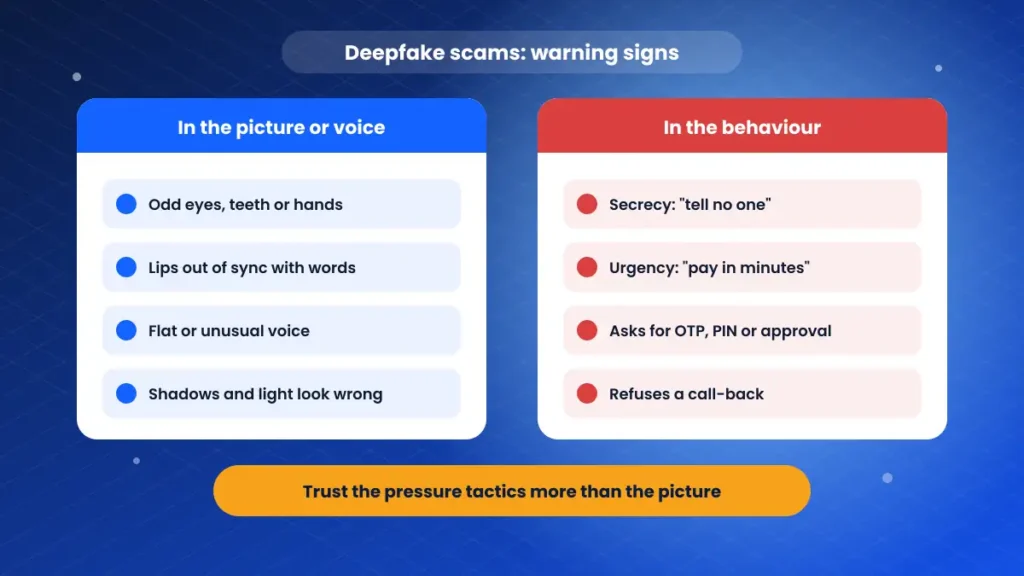
Deepfakes are getting better, so do not rely on spotting flaws alone. Still, the FBI’s public warning on AI fraud lists clues worth checking:
- Odd faces and bodies: blurred edges, strange teeth or eyes, or hands that look wrong.
- Poor sync: lips that do not match the words, or a slight delay or lag.
- Flat or unusual speech: a tone, accent, or choice of words that does not sound like the person.
- Bad lighting: shadows that fall the wrong way, or a face lit differently from the room.
More importantly, watch the behaviour, not just the picture. A real relative, boss, or bank rarely does these things:
- Insists on secrecy, such as “do not tell your father” or “keep this deal private”.
- Pushes extreme urgency, with a deadline of minutes.
- Asks for codes, such as your OTP, PIN, or a prompt approval.
- Changes the payment account at the last moment.
- Refuses a call-back, or says their phone is broken.
How to protect yourself and your bank account
A few simple habits defeat most deepfake scams:
- Agree on a secret phrase with your family. Choose a random phrase that only you know, and ask for it during any emergency call. The FBI and Starling Bank both recommend this.
- Hang up and call back. Use a number you already have saved, or the number on the back of your card, not the one that called you.
- Never share your PIN, OTP, or password. Your bank will never ask for them, whether by call, video, or chat.
- Slow down. Real emergencies can wait five minutes while you check.
- Share less of your voice and face online. Set social media accounts to private, and think twice before posting long voice notes or videos in public.
- Use your bank’s security tools. Turn on alerts, set daily transfer limits, and use two-factor authentication on every account.
- Check investment offers yourself. In Nigeria, investment platforms must register with the Securities and Exchange Commission (SEC), so look them up before you pay.
For more everyday habits, read how to protect your bank account online.
A simple example: Customer 1 receives a WhatsApp voice note from “her brother”, asking for money for an urgent hospital bill. The voice is perfect, but he refuses to pick up when she calls him back, and he does not know the family phrase. She checks with his wife, who confirms he is safe at home. The voice note was a deepfake.
What to do if you have been targeted
If you think a deepfake scam has reached you, act quickly:
- Stop all contact. End the call and do not reply to further messages.
- Call your bank at once. Use the number on your card or in the official app, and ask them to block or recall any transfer.
- Change your passwords and PINs, especially if you shared a code or approved a prompt.
- Warn the person who was copied. Their contacts may be the next targets.
- Report it. Tell your bank in writing and report the case to the police. If your bank does not resolve your complaint within two weeks, you can escalate it to the CBN’s Consumer Protection Department.
Speed matters, because money moved through instant transfers can leave the first account within minutes. If a scammer also controls your phone number, follow our guide to how SIM swap fraud works.
How banks are fighting deepfake scams
Banks and regulators are responding as well. Many banks now use active liveness checks, which ask you to turn your head or say a random phrase during a selfie check, because these are harder to fake than a still photo.
In Nigeria, the CBN issued updated anti-money laundering standards in March 2026 that require banks, fintechs and mobile money operators to use automated monitoring with behavioural analysis and machine-learning risk detection, according to Techpoint Africa. Banks also use AI of their own to flag unusual transfers, such as a large payment to a new account late at night. However, no tool is perfect, so your own checks remain the strongest defence.
Frequently asked questions
Can a scammer really clone my voice from social media?
Yes. Voice-cloning tools can work from short clips, so public videos and voice notes give scammers what they need. That is why a family secret phrase helps.
Will my bank ever call me by video?
Some banks use video for account opening or verification. However, a genuine bank will never ask you for your PIN, OTP, or password, on video or anywhere else.
Can deepfake scams beat my bank’s face check?
Sometimes, especially when a system only checks for a still photo. Active liveness checks are harder to fool, and banks keep adding other signals, such as device and behaviour checks.
Will I get my money back after a deepfake scam?
It depends on how fast you report it and on your bank’s investigation. Reporting within minutes gives the best chance of stopping the transfer.
Are deepfake scams illegal in Nigeria?
Yes. Using a fake identity to obtain money is fraud, whatever tool the criminal uses, and the Cybercrimes Act also covers identity theft and impersonation online.
Key takeaways on deepfake scams
- Deepfake scams use AI to fake the voice or face of someone you trust.
- A few seconds of audio from social media can be enough to clone a voice.
- Secrecy, urgency, and requests for codes are the clearest warning signs.
- A family secret phrase and a call-back on a known number stop most attacks.
- Report any scam to your bank immediately, because speed improves your chance of recovery.
Want to stay a step ahead of fraudsters? Browse all our cybersecurity guides, or learn how to spot a fake bank alert.