Most bank fraud used to mean someone stealing your card or your password. Today, many scammers skip that step entirely. Instead, they trick you into sending the money yourself, from your own banking app. This is called authorised push payment fraud, or APP fraud. This guide explains how authorised push payment fraud works, the most common scams, the warning signs, and what to do if it happens to you.
Quick answer: Authorised push payment fraud happens when a scammer tricks you into sending money to an account they control. Because you approve the transfer yourself, your bank sees it as a normal payment. To stay safe, slow down, check who you are paying through a channel you trust, and report any scam to your bank at once.
In this guide
- What is authorised push payment fraud?
- How authorised push payment fraud works
- Common types of APP fraud
- How big is the problem?
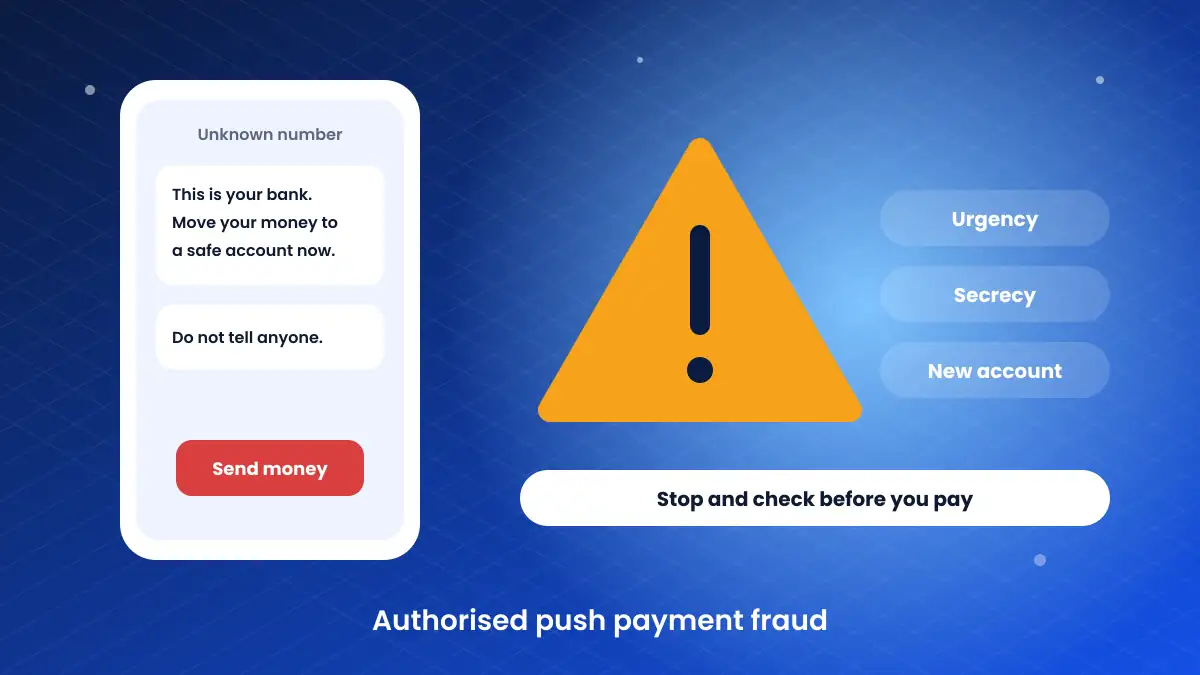
- Warning signs of authorised push payment fraud
- How to protect yourself from authorised push payment fraud
- What to do if you have been scammed
- Who pays for authorised push payment fraud?
- Frequently asked questions
- Key takeaways on authorised push payment fraud
What is authorised push payment fraud?
Authorised push payment fraud is a scam in which a criminal persuades you to “push” a payment from your account to theirs. The word “authorised” matters here. You enter the details and approve the transfer, so the payment looks genuine to your bank.
By contrast, in unauthorised fraud, a criminal takes money without your approval, for example with a stolen card. Our guide to how SIM swap fraud works explains one common type of account takeover.
In short, APP fraud attacks people, not systems. That is why strong passwords alone cannot stop it.
How authorised push payment fraud works
Most APP scams follow the same five steps:
- First contact. The scammer reaches you by phone, text, WhatsApp, email, social media, or an online marketplace.
- A believable story. Next, they pretend to be someone you trust, such as your bank, a seller, a relative, or an investment adviser.
- Pressure. Then, they create urgency, for example, by claiming your account is at risk or a deal ends today.
- The transfer. After that, you send money to an account they control, often believing it is safe or genuine.
- The money moves on. Finally, the scammer quickly moves the money through other accounts, so it is hard to trace.
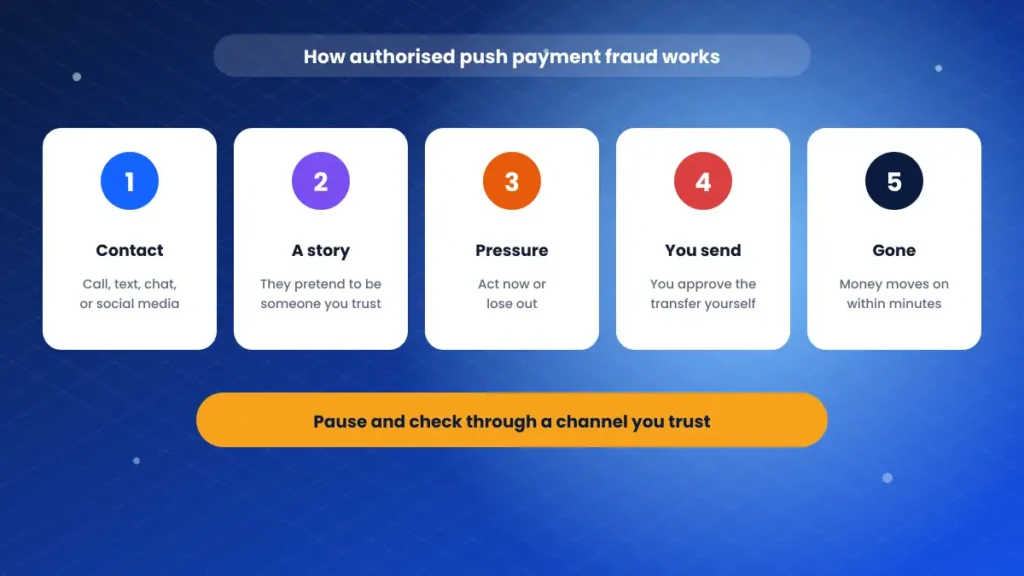
Instant transfers make this worse. Because money arrives in seconds, scammers can move it before you realise what happened. Our guide to how bank transfers work explains why transfers are hard to reverse.
Common types of APP fraud
Scammers use many stories, but most fall into a few groups:
| Scam type | What the scammer says | Red flag |
|---|---|---|
| Purchase scam | “Pay now, and I will deliver the item.” | Prices far below normal, transfer-only payment |
| Impersonation scam | “I am from your bank. Move your money to a safe account.” | Your real bank never asks you to move money |
| Investment scam | “Double your money in weeks.” | Guaranteed high returns |
| Romance scam | “I need help with an emergency.” | Someone you met online asks for money |
| Payment redirection scam | “Our bank details have changed.” | New account details sent by email or chat |
| Family emergency scam | “Mum, I lost my phone. Please send money to this number.” | A new number and an urgent request |
Some scammers now use AI to copy a familiar voice or face. Our guide to deepfake scams explains how to spot them.
How big is the problem?
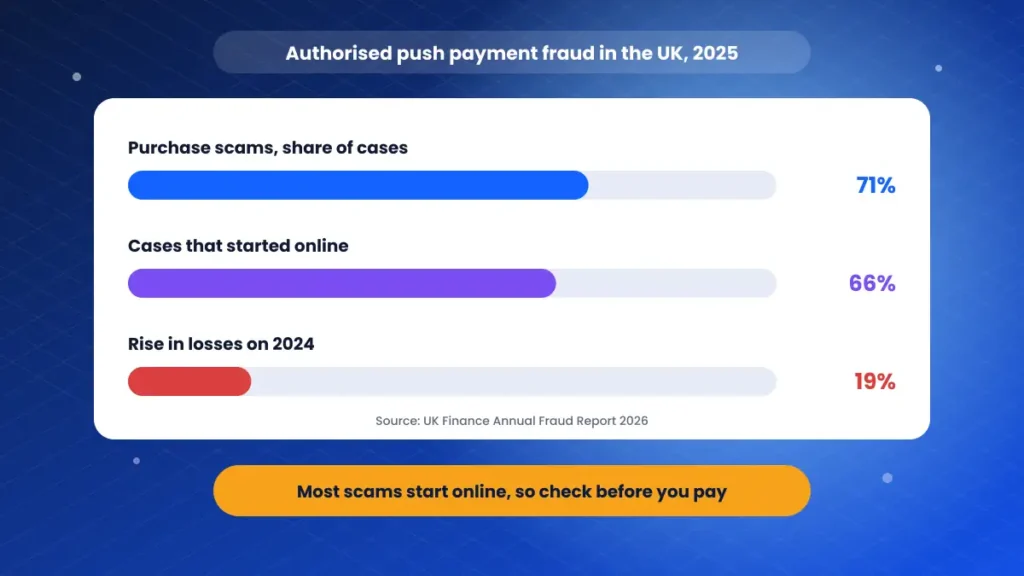
The UK publishes some of the clearest data on APP fraud. For example, UK Finance reported that APP fraud losses reached £576.4 million in 2025, up 19% on 2024, across 248,070 cases. Purchase scams made up 71% of cases, while investment scams caused the biggest losses. Moreover, 66% of cases started on online platforms.
In Nigeria, social engineering is the most common fraud technique, according to NIBSS. Encouragingly, NIBSS data shows digital payment fraud losses fell 51% in 2025. However, a Global Anti-Scam Alliance study cited by BusinessDay found that about 22% of Nigerian internet users lost money or personal data to scams, and only 4% of scam incidents were reported to the authorities.
Warning signs of authorised push payment fraud
Watch for these red flags before you send any money:
- Urgency. The caller says you must act now, or you will lose money or miss out.
- Secrecy. They ask you not to tell your bank, family, or friends.
- A new account. They tell you to pay a different account from usual, or a personal account for a business.
- A “safe account”. Someone claiming to be your bank asks you to move your money. Real banks never do this.
- Too good to be true. The price or return is far better than anywhere else.
- Pressure to ignore warnings. They tell you what to say if your bank asks questions.
Similarly, scammers often send fake links. Our guide on how to recognise a phishing message shows you what to look for.
How to protect yourself from authorised push payment fraud
You can stop most APP scams with a few simple habits:
- Pause before you pay. Real banks and businesses will wait while you check.
- Check through a trusted channel. Call your bank or the business on a number you already have, not one the caller gives you.
- Read the account name. In Nigeria, your banking app shows the account name before you send. If it does not match, stop.
- Pay safely online. Use a card or a trusted checkout where possible, because cards offer chargeback rights.
- Never move money to a “safe account”. That account always belongs to the scammer.
- Secure your accounts. Turn on two-factor authentication and never share codes.
For more everyday habits, read how to protect your bank account online.
What to do if you have been scammed
Act fast, because every minute counts:
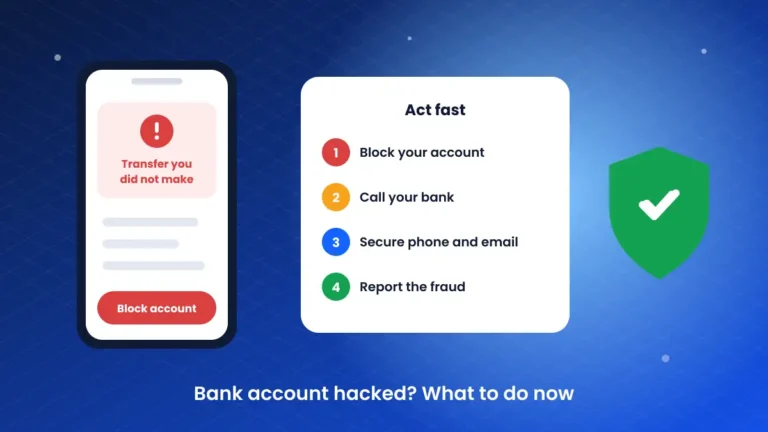
- Call your bank immediately. Use the number on your card or in your app, and ask them to try to stop or recall the payment.
- Report it to the receiving bank. Your bank can contact them, but you can also call them yourself.
- Keep the evidence. Save messages, call logs, account numbers, and transaction details.
- Report to the authorities. In Nigeria, you can report to the police and escalate an unresolved bank complaint to the CBN.
- Change your passwords. Do this if you shared any login details or codes. If criminals got into your account, follow our steps for when your bank account is hacked.
- Beware of recovery scams. Scammers often contact victims again, promising to get the money back for a fee.
For example, Customer 1 sent money to a “seller” on social media and realised it was a scam an hour later. Because Customer 1 called the bank straight away, the bank could ask the receiving bank to freeze any money left in the account. However, recovery is never guaranteed, so prevention matters most.
Who pays for authorised push payment fraud?
Rules differ by country. In the UK, banks must refund most APP fraud victims, up to £85,000, under rules that began on 7 October 2024. According to an Edgar, Dunn & Company review, 88% of money lost to in-scope APP fraud was returned between October 2024 and June 2025.
In Nigeria, there is no equivalent automatic refund rule for APP fraud. Instead, banks review each complaint, and you can escalate to the CBN if you are not satisfied. So, acting quickly and keeping evidence gives you the best chance.
Frequently asked questions
Will my bank refund APP fraud?
It depends on your country and your bank. The UK has mandatory refunds for most cases, but Nigeria does not have an equivalent rule. Contact your bank immediately in any case.
How is APP fraud different from hacking?
In hacking, a criminal takes your money without your approval. With APP fraud, however, a scammer tricks you into sending it yourself.
Can a bank transfer be reversed?
Sometimes, if you act quickly and the money is still in the receiving account. Once the scammer moves it on, recovery becomes much harder.
Does checking the account name help?
Yes. A name that does not match the person or business you expect is a clear warning sign. Still, scammers sometimes use accounts with convincing names, so check through a trusted channel too.
Who should I report APP fraud to?
Start with your bank. Then, report to the police and keep a record of every report you make.
Key takeaways on authorised push payment fraud
- Authorised push payment fraud tricks you into sending money to a scammer yourself.
- Common scams include fake sellers, bank impersonation, investment, romance, and payment redirection scams.
- Urgency, secrecy, new account details, and “safe accounts” are the biggest red flags.
- Pause, check through a trusted channel, and read the account name before you pay.
- If you are scammed, call your bank at once, keep evidence, and beware of recovery scams.
Want to stay safer online? Read our guides on how to spot a fake bank alert and how to identify a fake website, or browse all our cybersecurity guides.