A loan app can put money in your account within minutes, which is exactly why fraudsters copy them. Loan app scams range from fake lenders that steal a “processing fee” to illegal apps that copy your contacts and shame you in front of family and colleagues. This guide shows how to spot loan app scams in Nigeria, how to check that a lender is approved, how to protect your phone data, and what to do if a lender harasses you.
Quick answer: Before you borrow, check that the lender appears on the Federal Competition and Consumer Protection Commission (FCCPC) register of approved digital lenders. Avoid any app that asks for an upfront fee, wants access to your contacts or photos, or hides its interest rate. If a lender threatens you or messages your contacts, keep the evidence and report it to the FCCPC at lenderstaskforce@fccpc.gov.ng.
In this guide
- What are loan app scams?
- How the new rules protect borrowers
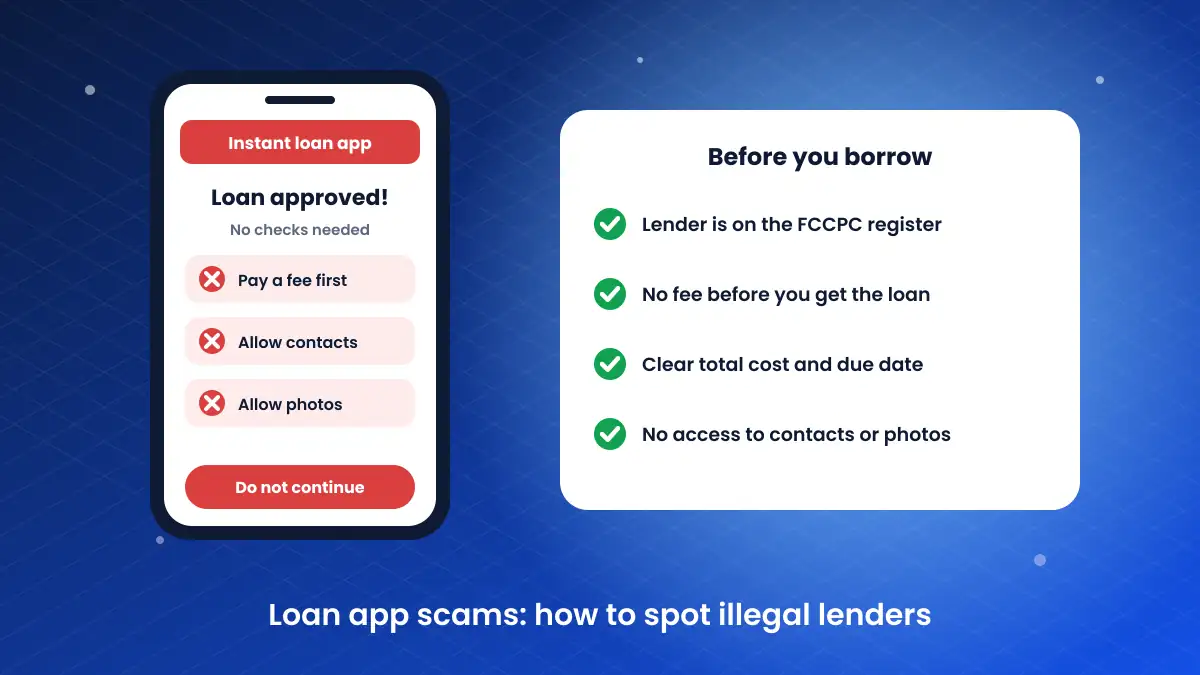
- Warning signs of loan app scams
- How to check if a loan app is approved
- Protect your phone data before you borrow
- What to do if a loan app harasses you
- How to borrow more safely
- Common loan app scams and how they work
- Frequently asked questions
- Key takeaways on loan app scams
What are loan app scams?
In simple terms, loan app scams are schemes that use a lending app, or a fake one, to take your money or your data. They usually fall into three groups:
- Fake lenders. For example, the “lender” promises a loan but first asks for a processing, insurance, or activation fee. After you pay, the loan never arrives.
- Illegal lenders. These apps do lend money, but they are not registered. They often charge hidden fees, shorten repayment periods, and use your phone data to pressure you.
- Copycat apps. Similarly, some apps copy the name and look of a real lender, so you download the wrong one.
In each case, the scam works because the borrower needs money quickly and does not check who is behind the app.
How the new rules protect borrowers
Nigeria now has specific rules for digital lending. The FCCPC issued the Digital, Electronic, Online, or Non-Traditional Consumer Lending Regulations, 2025, which took effect on 21 July 2025, according to the FCCPC. In short, the rules cover unsecured loans offered through apps, websites, and other digital channels.
Under the regulations, lenders must register with the FCCPC. They must also show clear loan terms before you accept, and they cannot give you a loan you did not actively agree to. In addition, Techpoint Africa reports that the rules prohibit lenders from accessing borrowers’ contact lists, call logs, and photos. Lenders that break the rules face heavy fines, and their directors can be disqualified.
The deadline for lenders to register passed on 5 January 2026. Soon after, the FCCPC began enforcement and removed operators that had not completed registration from its published register, Nairametrics reported. However, the list changes as lenders are approved or removed, so always check the current version.
Warning signs of loan app scams
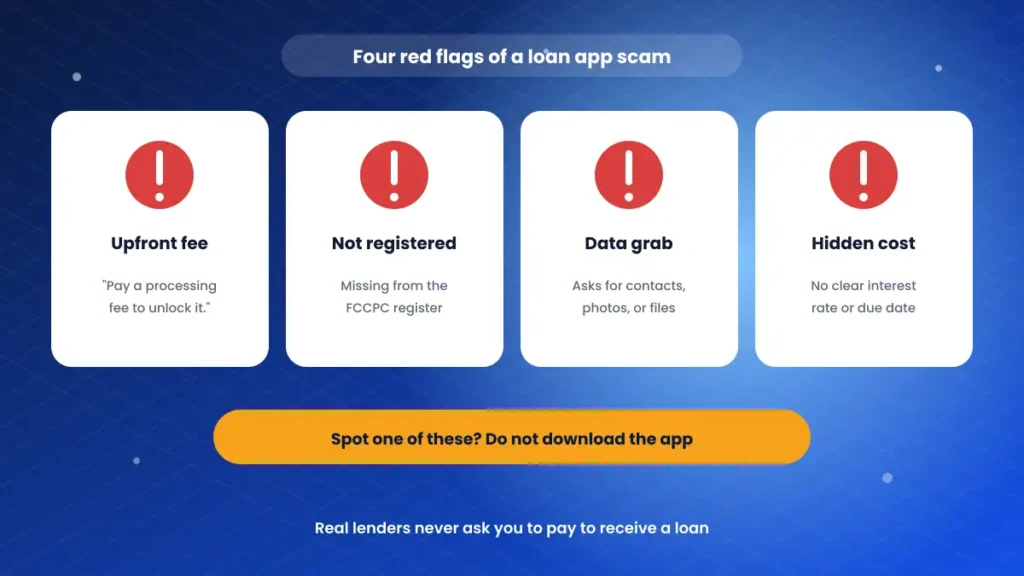
Look out for these red flags before you download any lending app:
| Red flag | Why it matters |
|---|---|
| It asks for a fee before paying the loan | Approved lenders deduct charges from the loan or add them to repayment; an upfront fee is a classic scam |
| It is not on the FCCPC register | An unregistered lender is operating outside the rules |
| It wants your contacts, photos, or call logs | The regulations prohibit lenders from accessing this data |
| It hides the interest rate or total cost | You cannot compare the loan, and the cost may be far higher than it looks |
| It promises “no checks” or guaranteed approval | Real lenders still assess whether you can repay |
| It contacts you first by SMS, WhatsApp, or social media | Fraudsters often advertise loans through unsolicited messages |
| It has no clear company name, address, or support channel | You have nowhere to complain if something goes wrong |
In particular, treat an upfront fee as a stop sign. A genuine lender does not need you to send money in order to receive money.
How to check if a loan app is approved
Next, follow these steps before you accept any digital loan:
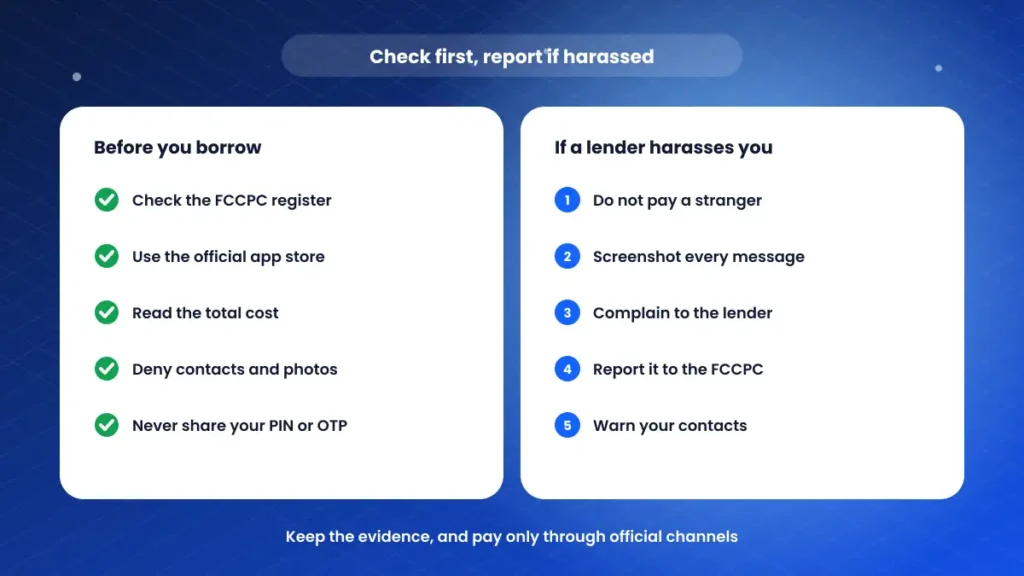
- Find the full company name. First, open the app’s store listing or website, and note the registered company name, not just the brand name.
- Check the FCCPC register. Then go to the official FCCPC website, open its list of approved digital lenders, and search for the company and the app name.
- Download from the official store only. After that, install the app from the Google Play Store or Apple App Store, and check that the developer name matches the company on the register.
- Read the loan terms. Before you accept, look for the amount you will receive, the total you will repay, the due date, and any fees.
- Review the permissions. Finally, if the app asks for your contacts, photos, or files, decline and delete it.
If the app is missing from the register, do not borrow from it, even if its reviews look good. Reviews can be faked, and a missing listing means the lender may be operating illegally.
Protect your phone data before you borrow
Your phone holds far more than your contacts. So, before and after you borrow, take these steps:
- Check app permissions. On Android, open Settings, then Apps, choose the loan app, and tap Permissions. On iPhone, open Settings, then Privacy and Security. Turn off access to contacts, photos, files, and the microphone.
- Never share your PIN, password, or one-time password. A lender does not need these to give you a loan.
- Protect your BVN. Lenders may verify your identity, but share your BVN only inside an approved app. Our guide to what a BVN is explains why it matters.
- Use a strong screen lock and two-step verification. As a result, someone who picks up your phone cannot open your banking or loan apps.
For wider habits, see our guide on how to protect your bank account online.
What to do if a loan app harasses you
If a lender threatens you, insults you, or messages your contacts, you have options. The rules ban harassment in debt recovery. Take these steps:
- Stay calm, and do not pay a stranger. First, do not send money to a new account because a caller says it will stop the messages.
- Collect evidence. Next, take screenshots of messages, call logs, and any posts about you, with dates and phone numbers.
- Complain to the lender in writing. Then send a short message that names the problem and asks them to stop. Techpoint reports that lenders must resolve complaints within 24 hours, or 48 hours for complex cases.
- Report to the FCCPC. After that, email lenderstaskforce@fccpc.gov.ng with the app name, the company name, and your evidence. The FCCPC lists this address for reports of unregistered lenders, unfair interest rates, and privacy violations.
- Warn your contacts. Similarly, tell family and colleagues that messages about you may arrive, and ask them not to engage.
- Revoke permissions, then remove the app. Finally, once you have saved your loan records, turn off the app’s permissions and uninstall it.
If anyone threatens your safety, report it to the police as well. In addition, if you still owe a genuine debt, keep a record of every payment, and pay only through the lender’s official channels.
How to borrow more safely
Not every digital loan is a scam. Many approved lenders and banks offer fair digital credit. Even so, these habits help:
- Borrow only what you can repay on time. Late fees and rollovers can turn a small loan into a large debt.
- Compare the total cost. Check the total you will repay, not only the amount you receive.
- Try your bank first. Many banks now offer small loans inside their apps, and our guide to embedded finance explains how loans appear in other apps too.
- Avoid several loans at once. Taking a new loan to repay an old one is a common debt trap.
Common loan app scams and how they work
To make the warning signs real, here is how a few common loan app scams play out:
| Scam | How it works | What to do |
|---|---|---|
| Processing fee scam | A “lender” approves you instantly, then asks for a fee before paying out | Refuse, block the number, and report it |
| Copycat app | A fake app uses a real lender’s name and logo | Check the developer name against the FCCPC register |
| Recovery agent scam | A caller claims you owe money and demands payment to a new account | Check your loan in the official app, and pay only there |
| Data-shaming lender | An illegal app messages your contacts to embarrass you into paying | Collect evidence and report it to the FCCPC |
Our guides on how to recognise a phishing message and authorised push payment fraud explain the same tricks in other forms.
Frequently asked questions
How do I know if a loan app is legit in Nigeria?
Check that the lender appears on the current FCCPC register of approved digital lenders, download the app from an official store, and confirm that the developer name matches the registered company.
Is it illegal for a loan app to message my contacts?
The FCCPC regulations ban harassment and abusive recovery practices, and they prohibit lenders from accessing borrowers’ contact lists. If an app messages your contacts, collect evidence and report it to the FCCPC.
Should I pay a fee before receiving a loan?
No. An upfront processing, insurance, or activation fee is one of the most common signs of loan app scams. Genuine lenders take their charges from the loan or add them to your repayment.
Can I report an illegal loan app?
Yes. Email lenderstaskforce@fccpc.gov.ng with the app name, the company name, and screenshots. You can also report the app inside the Google Play Store or Apple App Store.
Do I still have to repay a loan from an unregistered lender?
The answer depends on your situation, so get advice from a lawyer or the FCCPC. Meanwhile, keep records of what you borrowed and paid, and never pay into an account that is not the lender’s official one.
Key takeaways on loan app scams
- Check every lender against the current FCCPC register before you borrow.
- Never pay an upfront fee to receive a loan.
- Deny access to your contacts, photos, and files, because approved lenders are not allowed to use them.
- Read the total cost and the due date before you accept.
- If a lender harasses you, save the evidence, and report it to the FCCPC.
Want to stay safer online? Read our guides on SIM swap fraud and how to secure your WhatsApp account, or browse all our cybersecurity guides.