Open a bank account, apply for a loan, or sign up for a fintech app in Nigeria, and you will be asked for your BVN. It is one of the most important numbers you own, yet many people are not sure what it does or who can see it. This guide explains what a BVN is, how it protects you, how to get and check yours, how it links to your NIN, and how to keep it safe from scammers.
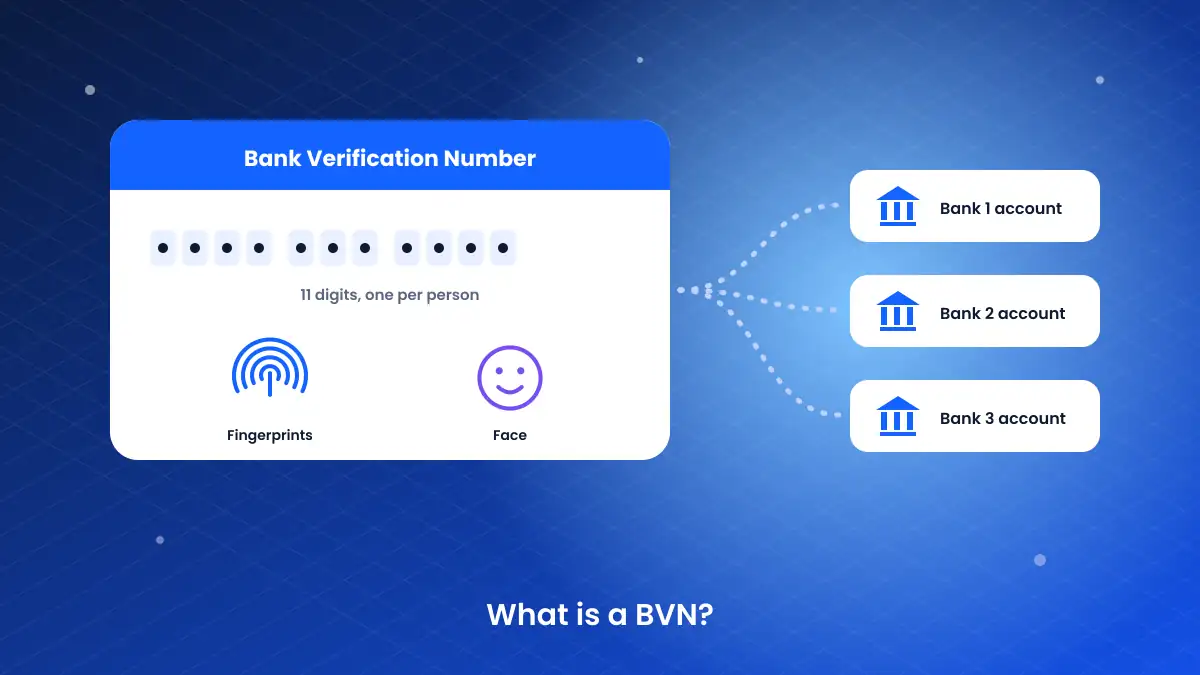
Quick answer: A BVN, or Bank Verification Number, is an 11-digit number linked to your fingerprints and face. The Central Bank of Nigeria (CBN) introduced it so that every bank customer has one identity across all banks, and the Nigeria Inter-Bank Settlement System (NIBSS) manages the database. You get one by enrolling once at any bank. To check yours, dial *565*0# from the phone number linked to it. Never share it with callers who also ask for your PIN or one-time password.
In this guide
- What is a BVN?
- How the Bank Verification Number protects you
- How it differs from your NIN
- How to get a BVN
- How to check your BVN
- Linking your NIN to your bank accounts
- Who can see your banking identity data?
- How to keep your BVN safe
- How to update your details
- Frequently asked questions
- Key takeaways on the BVN
What is a BVN?
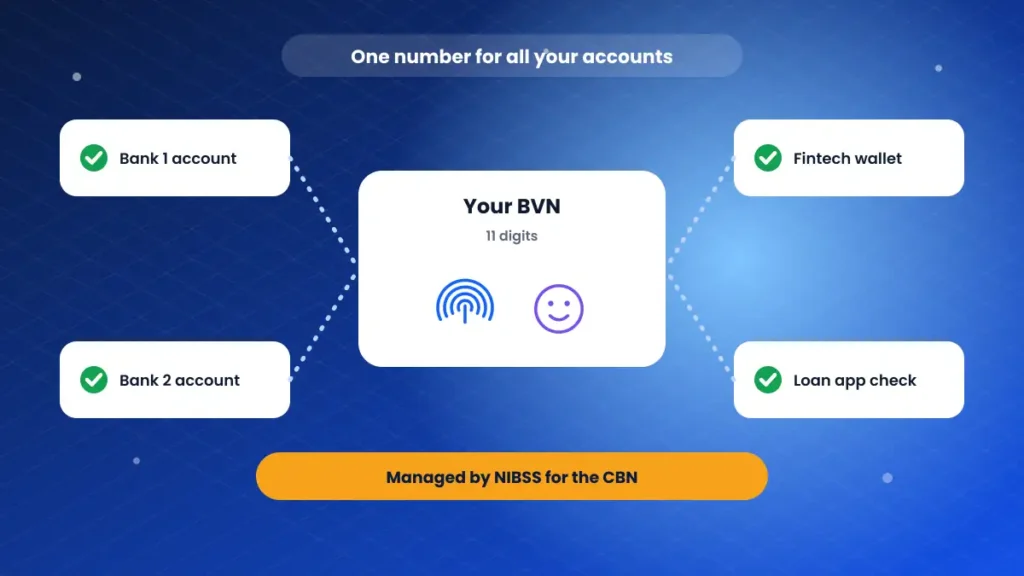
A BVN is a unique 11-digit number that identifies you in the Nigerian banking system. When you enrol, the bank captures your fingerprints and a photo of your face. As a result, your identity is tied to your body, not just to a card or a name.
The number then links to every account you hold in any Nigerian bank. So, whether you bank with one bank or five, you have only one Bank Verification Number. The CBN and the Bankers’ Committee introduced the system in 2014.
NIBSS, the company that also runs instant bank transfers, keeps the database. In July 2025, the Federal High Court in Abuja confirmed that NIBSS has the legal power to manage it, according to Nairametrics.
How the Bank Verification Number protects you
The system is not just paperwork. It protects customers in several ways:
- One identity across banks. Because your biometrics are on record, it is harder for someone to open an account in your name with fake documents.
- Fewer fake accounts. Fraudsters cannot easily create many accounts under different names, because their fingerprints would match.
- A watch-list for fraud. Banks can flag the identity of a confirmed fraudster, which makes it harder for them to keep banking.
- Faster checks. Banks and licensed apps can confirm who you are quickly, so you can open accounts and get loans with less paperwork.
For example, if someone receives money by mistake and refuses to return it, banks can watch-list them, as our guide on how to reverse a failed transfer explains.
How it differs from your NIN
People often confuse the two numbers. Here is how they compare:
| Feature | BVN | NIN |
|---|---|---|
| Full name | Bank Verification Number | National Identification Number |
| Who manages it | NIBSS, for the CBN | The National Identity Management Commission (NIMC) |
| What it is for | Banking and financial services | National identity for all purposes |
| How you get it | Enrol at a bank | Enrol at a NIMC centre or approved agent |
| Length | 11 digits | 11 digits |
In short, the NIN proves who you are as a Nigerian resident, while the BVN proves who you are to banks. Today, many accounts need both. Your phone line needs your NIN too, so learn how to link NIN to SIM.
How to get a BVN
You only need to enrol once in your life. To get your number:
- Visit a bank branch. First, go to any commercial bank, even if you do not yet have an account there.
- Fill in the enrolment form. Next, give your name, date of birth, address, and phone number.
- Show a valid ID. Then, present an accepted form of identification, such as your NIN slip, passport, or driver’s licence.
- Capture your biometrics. After that, the bank takes your fingerprints and a photo of your face.
- Receive your number. Finally, your 11-digit number arrives by SMS, often within a day.
Use a phone number you will keep for years, because banks use it to reach you. If you change your number later, update it with your bank.
How to check your BVN
If you forget your number, the quickest way to find it is by phone. According to Kuda’s guide, you should:
- Use the right phone number. First, pick the phone number you gave when you enrolled.
- Dial *565*0#. Next, dial the code from that number.
- Read the result. Then, your 11-digit number appears on the screen.
A small fee may apply. If you no longer have that phone number, visit your bank with a valid ID instead.
Linking your NIN to your bank accounts
The CBN now requires most accounts to carry both numbers. In a circular dated 1 December 2023, it ordered banks to restrict Tier 1 accounts and wallets that had neither number from 1 March 2024, according to BusinessDay. It also said Tier 2 and Tier 3 individual accounts must have both.
If your account is restricted, you may not be able to withdraw or transfer money until you link it. To link your numbers, use your bank’s app, its self-service website, or a branch. The steps differ between banks, so follow your own bank’s instructions.
Who can see your banking identity data?
Banks and licensed fintech apps can check your details, but they need your permission first. Since 31 March 2023, NIBSS has used a consent system called iGree, according to Mondaq. Here is how it works:
- An app asks NIBSS to check your number.
- NIBSS sends a one-time password to your registered phone number.
- You approve the request, and only then does the app see your details.
So, if you get a consent request you did not start, do not approve it. Our guide to open banking in Nigeria explains how consent works for other kinds of financial data.
How to keep your BVN safe
Your number on its own cannot empty your account. However, scammers use it to sound like your bank and to trick you into giving away more. Follow these rules:
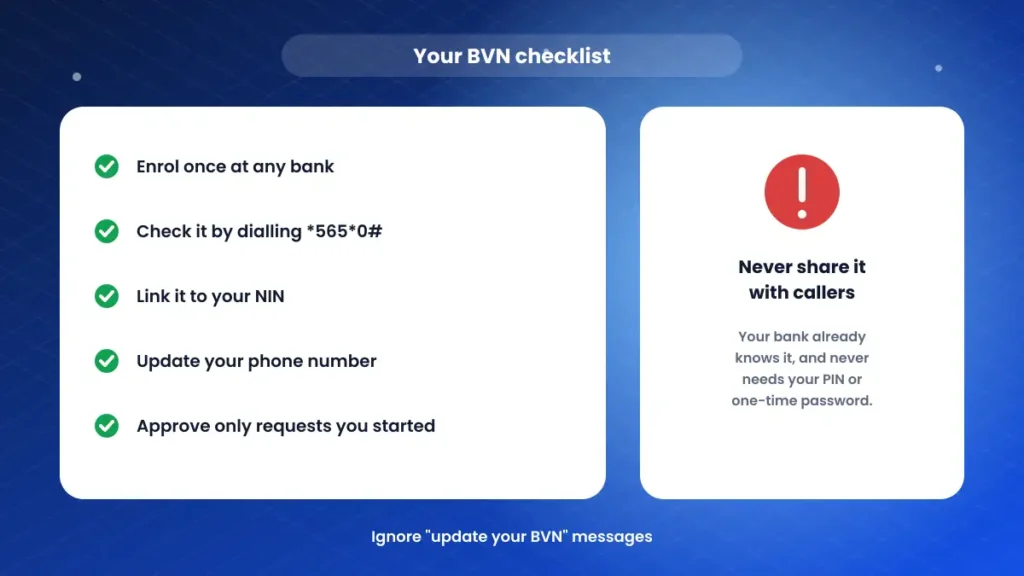
- Never share it with callers. Your bank already knows your number, so it has no reason to ask for it by phone.
- Ignore “BVN update” messages. Texts or emails saying your account will be blocked unless you “update your BVN” are a common scam.
- Never share your PIN or OTP. No real bank staff will ask for your BVN together with a PIN or one-time password.
- Protect your SIM. Your number is linked to your phone, so our guide on how SIM swap fraud works explains how to keep it safe.
Our guides to recognising a phishing message and how to protect your bank account online cover more safety habits.
How to update your details
Sometimes your details need to change, for example after marriage or if your date of birth was recorded incorrectly. In that case, visit your bank with your ID and any supporting documents, such as a marriage certificate. Changes to names and dates of birth are checked carefully, and some may need a sworn statement or a newspaper notice. Ask your bank which documents it needs before you go.
Frequently asked questions
Is a BVN the same as an account number?
No. Your account number identifies one account, while the Bank Verification Number identifies you across all your accounts.
Can I enrol twice?
No. Each person should have only one. Because the system checks fingerprints, a second enrolment is usually caught and rejected.
Can someone steal money with only my BVN?
Not on its own. However, scammers use it with other details, such as your PIN or OTP, so keep all of them private.
Why do fintech apps ask for it?
Most licensed apps ask for it to confirm your identity. Only give it to apps you trust, and approve the consent request only if you started it.
What happens if I do not link my BVN and NIN?
Your bank may restrict your account. Link both numbers through your bank’s app, website, or a branch.
Key takeaways on the BVN
- A BVN is an 11-digit number linked to your fingerprints and face.
- It connects all your Nigerian bank accounts to one identity.
- Enrol once at any bank, and check your number by dialling *565*0# from your registered phone.
- Link it to your NIN, because the CBN restricts accounts without the required numbers.
- Never share it with callers, and never share your PIN or OTP with anyone.
Want to learn more about banking in Nigeria? Read our guides to what fintech is and what digital banking is, or browse all our digital explained guides.