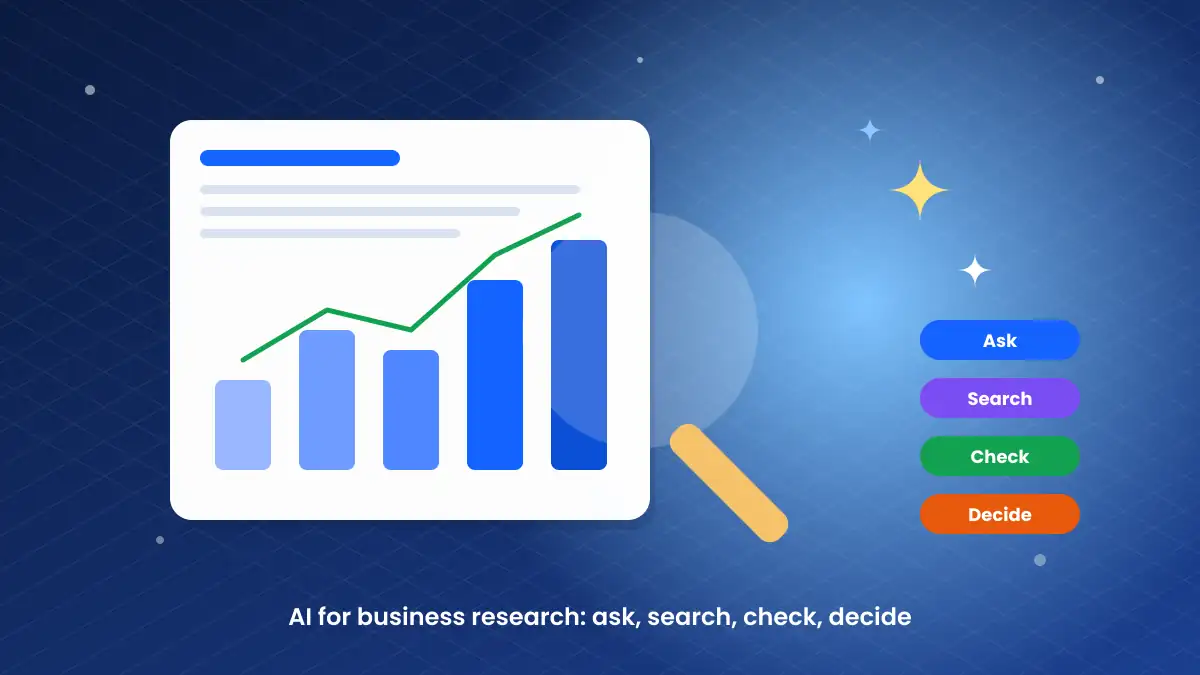
Before you open a shop, launch a product, or change your prices, you need answers. Who will buy? What do competitors charge? Is demand growing? Using AI for business research can get you a solid first answer in an hour instead of a week. This guide shows how to use AI for business research step by step, which free tools to use, and how to check the results before you spend money on them.
Quick answer: To use AI for business research, start with one clear question, then use an AI search tool with sources, such as Perplexity, ChatGPT search, or Gemini, to gather facts. Run a deep research report for a wider overview, check every key figure against the source, and add your own data from customers and sales. AI speeds up research, but you still make the decision.
In this guide
- What AI can and cannot do for business research
- The best free AI tools for business research
- How to use AI for business research, step by step
- Useful prompts for common research jobs
- How to check AI research results
- Keep your business data safe
- Frequently asked questions
- Key takeaways on AI for business research
What AI can and cannot do for business research
AI is a fast research assistant, not an oracle. It reads and summarises far more than you could in a day, but it can also be confidently wrong. So it helps to know its strengths before you rely on it.
| Task | AI is good at | Watch out for |
|---|---|---|
| Finding sources | Searching many websites and linking to them | Old pages, blogs repeating each other |
| Summarising | Turning long reports into key points | Missing details that matter to you |
| Comparing competitors | Listing prices, products and reviews in a table | Prices that changed since the page was saved |
| Market size | Pointing you to official statistics | Invented figures with no source |
| Customer insight | Grouping survey answers and reviews into themes | Treating a few loud reviews as the majority |
| Local detail | General patterns in Nigerian markets | Street-level facts it cannot know |
In short, AI for business research works best when you give it a narrow question and check what it brings back.
The best free AI tools for business research
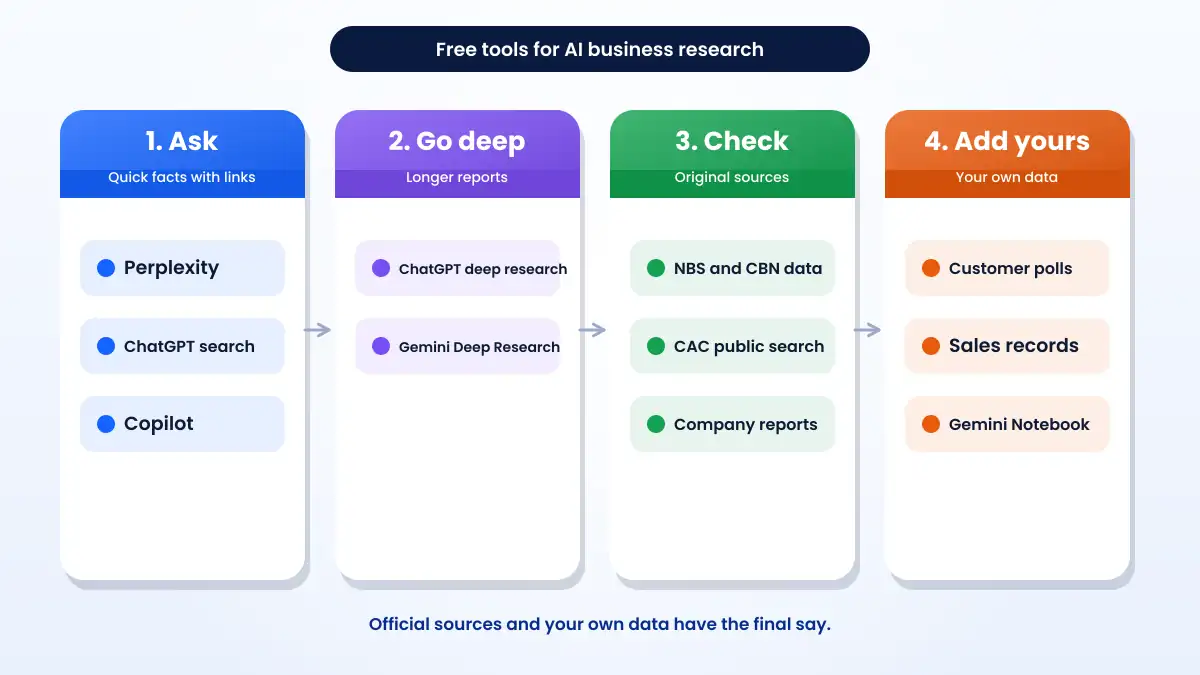
You do not need a paid plan to start. These free tools cover most research jobs:
| Tool | Best for | Free plan in brief |
|---|---|---|
| Perplexity | Quick answers with source links | Unlimited basic searches, about 5 Pro searches a day |
| ChatGPT (search and deep research) | Broad questions and longer reports | Search included; a few lightweight deep research tasks a month |
| Google Gemini (Deep Research) | Detailed reports from many websites | Deep Research available, within free usage limits |
| Gemini Notebook | Questions about your own documents | Free, with limits on notebooks and sources |
| Microsoft Copilot | Web answers with sources inside Edge and Windows | Free with a Microsoft account |
Free limits change often. For example, Perplexity’s free plan gives about five Pro searches a day, while its Pro plan costs $20 a month. Similarly, OpenAI gave free ChatGPT users five lightweight deep research tasks a month when it opened the feature to them. Google also lets free users run Gemini Deep Research within the free usage limits. For a wider list of free tools, see our guide to the best free AI tools for small businesses.
How to use AI for business research, step by step
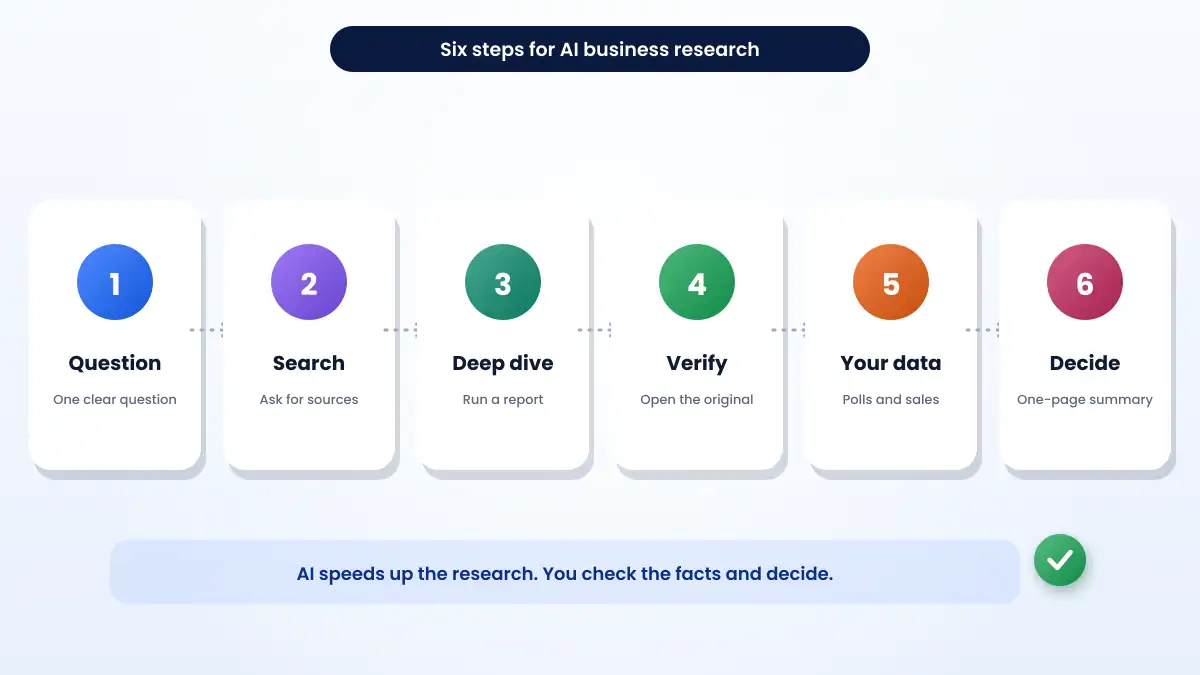
Follow these six steps for any research question, from a new product to a new branch.
Step 1: Write one clear research question
Vague questions get vague answers. So turn “Is catering a good business?” into “Is there enough demand for a ₦3,500 lunch delivery service for office workers in Ikeja, and who already offers it?” A clear question tells the AI where to look and tells you when you have enough.
Step 2: Gather facts with an AI search tool
Next, ask the question in Perplexity, ChatGPT with search, or Gemini. Ask for sources every time. For example: “List the main lunch delivery services for offices in Ikeja, Lagos. For each, give the price range and a link to where you found it.”
Then open the links. If a tool cannot show where a fact came from, treat that fact as a guess.
Step 3: Run a deep research report for the big picture
When you need a wider view, use ChatGPT Deep Research or Gemini Deep Research. These tools read dozens of pages and write a structured report. For example: “Write a short report on the office lunch delivery market in Lagos: customer types, typical prices, delivery models, main risks, and recent trends. Cite every source.”
A report like this usually takes a few minutes. Because free plans limit these runs, save them for your most important questions.
Step 4: Check key figures against sources
This is the step most people skip. For any number you plan to use, find the original. Good Nigerian sources include the National Bureau of Statistics, the Central Bank of Nigeria, and company annual reports. When a report is long, our guide on how to summarise documents with AI shows how to pull out the key figures quickly. To confirm that a supplier or competitor is a registered business, use the free CAC public search, which shows the registered name, address, and RC number.
Also check the date. A price from 2023 can be far off today, especially after recent inflation. And before you pay a new supplier you found online, read our guide on how to identify a fake website.
Step 5: Add your own data
The best research mixes outside facts with what your own customers tell you. Run a short WhatsApp poll or Google Form, then paste the anonymous answers into ChatGPT and ask: “Group these 40 answers into the five most common themes, and count how many answers fall into each theme.”
You can also analyse your sales records. Our guide on how to use ChatGPT for Excel analysis shows how, step by step.
Step 6: Summarise and decide
Finally, ask the AI to pull everything together: “Using the notes below, write a one-page summary with the opportunity, the main competitors, the price customers will accept, the three biggest risks and what I still need to check.” Then read it critically. The decision, and the money, are yours. If you decide to open a shop, create a Google Business Profile so local customers can find it.
Useful prompts for common research jobs
Copy these prompts and change the details in brackets:
| Research job | Prompt to try |
|---|---|
| Competitors | “List [type of business] in [area] with their prices, opening hours, and online reviews. Give a link for each.” |
| Customer needs | “What do customers most often complain about with [product] in Nigeria? Use reviews and forum posts, and cite them.” |
| Pricing | “What do [similar products] cost in [city] today? Show the price, the seller, and the date for each.” |
| Suppliers | “Find suppliers of [item] in [state]. Include contact pages and any CAC registration details you can find.” |
| Rules and permits | “What permits does a [type of business] need in [state]? Link to the official government source.” |
| Trends | “How has demand for [product] changed in Nigeria over the last two years? Use statistics with sources.” |
Asking for sources in every prompt is the single habit that makes AI for business research reliable.
How to check AI research results
Even good tools make mistakes. So watch for these warning signs:
- Exact figures with no link. A precise number such as “the market is worth ₦2.3 trillion” needs a source you can open.
- Old information. Ask for the date of every price and statistic, then confirm it.
- One source repeated. Several blogs quoting the same unnamed survey still count as one weak source.
- Answers that match what you hoped. If the result seems too good, ask the AI for the strongest case against the idea.
- Names that do not exist. Search for each company or report yourself before you rely on it.
A simple rule helps: check any fact that would change your decision.
Keep your business data safe
Business research often involves private information. Do not paste customer names, phone numbers, bank details, or confidential contracts into an AI tool. Remove personal details from survey answers first. Where a tool allows it, turn off the setting that uses your chats to train its models. This protects your customers and keeps you in line with Nigeria’s Data Protection Act 2023.
Frequently asked questions
Is AI for business research accurate?
It is accurate enough for a first draft, but not for final decisions. Always open the sources and confirm the figures that matter.
Which free AI tool is best for business research?
Perplexity is the quickest for answers with sources. For longer reports, use ChatGPT Deep Research or Gemini Deep Research within their free limits.
Can AI tell me the size of my market in Nigeria?
It can point you to official statistics and industry reports. However, local market size is often not published, so combine AI findings with your own customer survey.
Can AI replace a market research firm?
For small decisions, it often can. For large investments, use AI to prepare, then consider a professional study or a pilot test with real customers.
Do I need to pay for AI research tools?
Usually not. Free plans cover most small-business research, and you can upgrade one tool if you hit its limit every day.
Key takeaways on AI for business research
- Start with one clear question, and ask for sources in every prompt.
- Use Perplexity or ChatGPT search for quick facts, and deep research tools for wider reports.
- Check every key figure against the source, and confirm suppliers with the CAC public search.
- Add your own customer and sales data, then decide for yourself.
Want more? Read our guides to the best free AI writing tools, AI tools for teachers, or browse all our AI and productivity guides.