Your salary lands in one bank, your savings sit in another, and your spending runs through a fintech app. However, each one knows only part of your financial life. Open banking changes that, because it lets you choose to share your bank data safely with other apps. This guide explains open banking in Nigeria, how the Central Bank of Nigeria (CBN) rules work, what data can be shared, and how to protect yourself.
Quick answer: Open banking in Nigeria lets you allow approved apps and banks to see your account data, or start payments, through secure connections called APIs. Nothing is shared without your clear consent, and you can cancel that consent at any time. The CBN set the rules in 2021 and 2023, and it is rolling the system out in phases.
In this guide
- What is open banking?
- How open banking works in Nigeria
- The CBN’s open banking rules
- What data can open banking share?
- What open banking in Nigeria means for you
- Your rights and consent
- Risks of open banking and how to stay safe
- What open banking means for businesses
- Frequently asked questions
- Key takeaways on open banking in Nigeria
What is open banking?
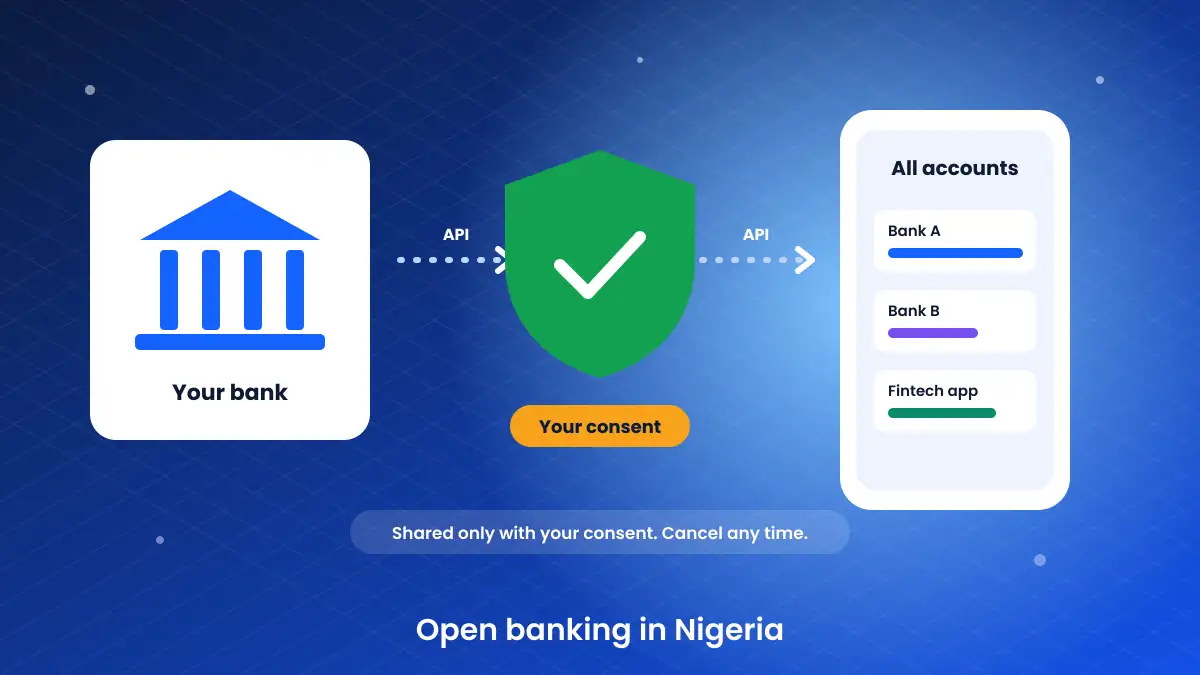
Open banking is a system that lets banks share customer data and services with other licensed companies, but only when the customer agrees. In practice, the sharing happens through APIs, which are secure digital doorways between two systems. Our guide to what an API is explains how they work.
Today, if a loan app wants to know your income, it may ask for a PDF bank statement or even your internet banking password. By contrast, open banking replaces those risky shortcuts with a standard, controlled connection. As a result, your bank sends only the data you approved to an app it can verify, for a purpose you can see.
In short, open banking treats your financial data as yours. Banks hold it, but you decide who else may use it.
How open banking works in Nigeria
A typical open banking request follows six steps:
- You ask an app for a service. For example, a budgeting app that shows all your accounts in one place.
- The app asks for your consent. Next, it explains what data it needs, why, and for how long.
- You confirm with your bank. Then your bank checks it is really you, usually with a code or a fingerprint.
- The bank shares the data through an API. Above all, it sends only what you approved, and nothing more.
- The app delivers the service. For instance, it shows your combined balance or a spending summary.
- You stay in control. You can view or cancel the consent at any time, and the sharing stops.
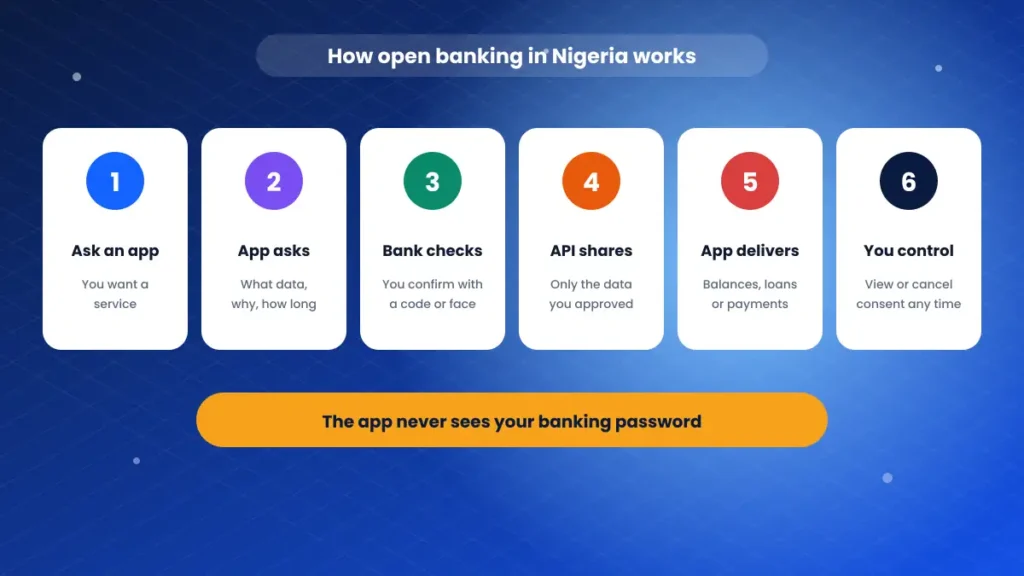
Importantly, you never give the app your banking password. That is the main safety gain over older methods.
The CBN’s open banking rules
In fact, Nigeria was the first country in Africa to publish a regulatory framework for open banking. Since then, the rollout has moved in stages:
| Date | Milestone |
|---|---|
| February 2021 | CBN issues the Regulatory Framework for Open Banking |
| March 2023 | CBN issues the Operational Guidelines for Open Banking in Nigeria |
| August 2025 | An expected commercial launch was not officially confirmed |
| February 2026 | CBN commits to a phased rollout during 2026 |
| August 2026 | CBN sandbox opens a track for consent-based data sharing |
The 2023 guidelines name three groups. API providers share data or services, API consumers receive them, and customers own the data and give consent, according to a summary by law firm Aelex. In addition, an Open Banking Registry lists every approved participant, so only registered companies can take part.
Still, the timing has slipped before. In August 2025, Techpoint Africa reported that the expected launch had passed without official confirmation. Later, a June 2026 BusinessDay analysis described a phased rollout through 2026 after the CBN’s February 2026 policy commitment. So, check with your bank or app to see which open banking services are live for you.
What data can open banking share?
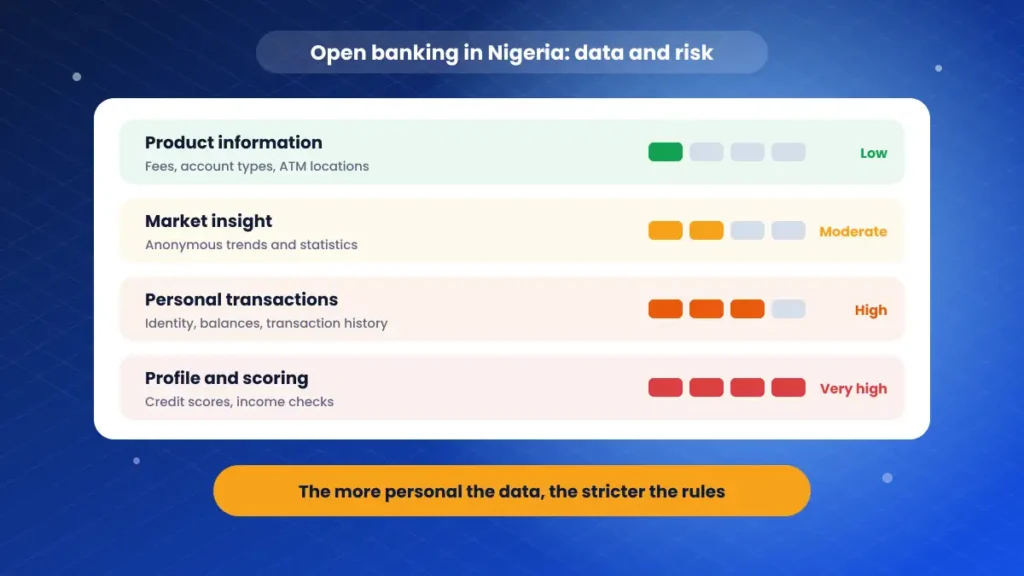
Of course, not all data carries the same risk, so the rules sort it into four categories:
| Category | Examples | Risk level |
|---|---|---|
| Product information and service touchpoints | Account types, fees, branch and ATM locations | Low |
| Market insight | Anonymous trends and statistics | Moderate |
| Personal information and financial transactions | Your identity details, balances and transaction history | High |
| Profile, analytics and scoring | Credit scores and income assessments | High and sensitive |
Similarly, participants sit in risk tiers. According to a technical review by WSO2, licensed banks and payment companies can reach all four categories, while newer firms in the CBN sandbox get narrower access. In other words, the more sensitive the data, the stricter the checks on who may receive it.
What open banking in Nigeria means for you
Once services are live, open banking can make everyday money tasks easier:
- See all your accounts in one app. For instance, a budgeting app can pull balances from several banks.
- Get faster, fairer loans. This is because lenders can check your real income and spending instead of asking for paper statements.
- Pay directly from your account. Apps can start a bank transfer with your approval, without card details. This is often called pay by bank.
- Switch more easily. Also, comparing products and moving to a better offer takes less paperwork.
- Build a credit history. Regular income and bill payments can count, even without a credit card.
For example, a trader with no payslip could share six months of transaction history with a lender in minutes. As a result, the lender sees steady sales and can offer a loan the trader might not get otherwise.
Your rights and consent
Under the CBN guidelines, customer consent is the only basis for sharing your information. That gives you clear rights:
- You choose. Data moves only after you approve a specific request with a stated purpose.
- You can see and cancel. Every consent must be visible to you, and you can withdraw it at any time.
- Consent expires. According to WSO2’s review, consent must be renewed every year, or after 180 days without use, and protected with multi-factor authentication.
- You can complain. Providers must tell you how to complain when you sign up. If they do not resolve it, you can escalate to the CBN’s Consumer Protection Department.
On top of that, your data is protected by Nigeria’s data protection law, which every participant must follow.
Risks of open banking and how to stay safe
Open banking is designed to be safer than sharing passwords, but you still need care:
- Use only licensed apps. Check that an app is regulated, and avoid any app that asks for your internet banking password.
- Share the minimum. Similarly, approve only the data an app truly needs, for the shortest time.
- Review your consents. Then cancel access for apps you no longer use.
- Keep strong login security. Turn on two-factor authentication for your bank and every linked app.
- Watch for fake consent requests. Scammers may copy a bank’s screen to trick you, so start any request from the official app, not a link.
For more everyday habits, read how to protect your bank account online.
What open banking means for businesses
First, for fintechs and banks, open banking replaces dozens of separate integrations with one common standard. For small businesses, it promises quicker loans based on real sales data, easier reconciliation, and new ways to accept payments straight from customers’ accounts. Our guide to what fintech is explains how these companies work with banks.
Frequently asked questions
Is open banking live in Nigeria now?
Partly. It is rolling out in phases. The CBN committed to a phased rollout during 2026, so availability depends on your bank and the apps you use.
Do I have to use open banking?
No. After all, open banking only works when you choose to share your data. If you never give consent, nothing changes for you.
Will apps see my banking password?
No. With open banking, you approve access at your bank, and the app receives only the data you agreed to share, never your password.
Can I stop sharing my data?
Yes. Furthermore, you can view and cancel any consent at any time, and the app’s access ends.
Is open banking the same as digital banking?
No. Digital banking means using your own bank’s app or website. Open banking lets other approved apps connect to your bank, with your permission. See our guide to what digital banking is for the difference.
Key takeaways on open banking in Nigeria
- Open banking lets approved apps access your bank data or start payments, only with your consent.
- The CBN issued the framework in 2021 and operational guidelines in 2023, and it is rolling out in phases.
- Data is grouped by risk, and the most sensitive data has the strictest controls.
- You can view and cancel any consent, and you never share your banking password.
- Use licensed apps, share the minimum, and review your consents regularly.
Want to see where payments are heading next? Read our guide to agentic commerce, or browse all our digital payments guides.