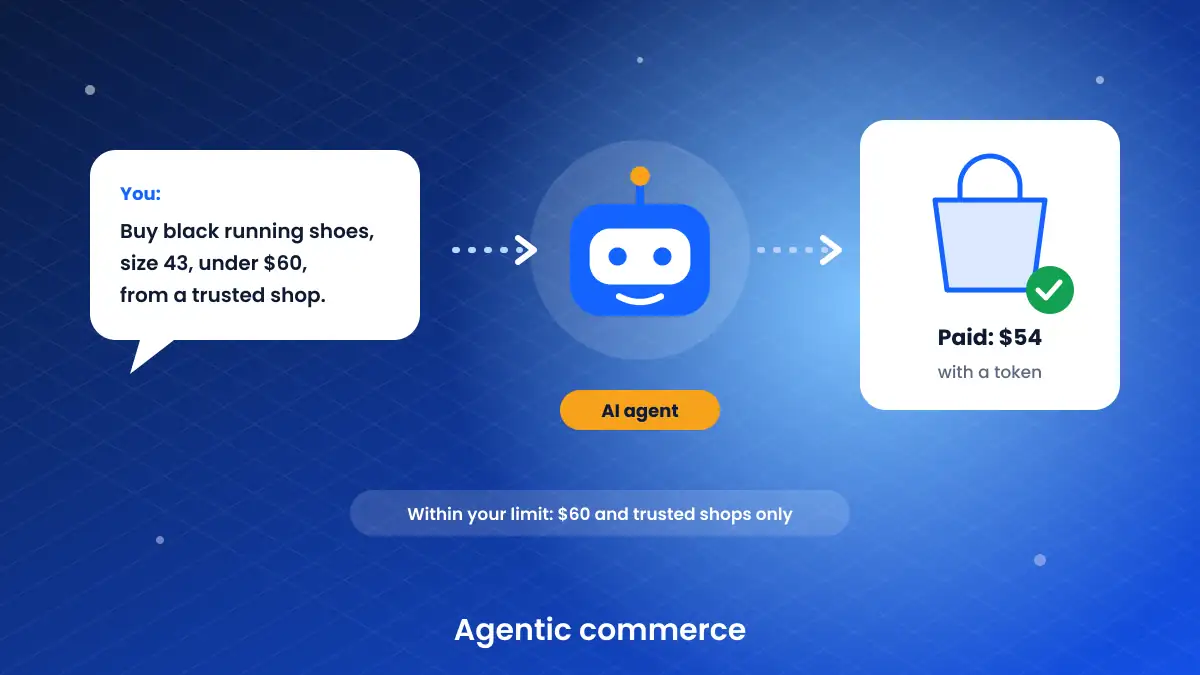
Imagine telling an app, “Find me a pair of black running shoes in size 43 under $60, and buy them.” A few minutes later, the order is placed, paid for, and on its way, and you never opened a shopping website. That is agentic commerce. This guide explains what agentic commerce is, how AI agents pay safely, who is building it, and what it means for shoppers and businesses in Nigeria.
Quick answer: Agentic commerce is shopping in which an AI agent searches, chooses, and pays for something on your behalf, within limits you set. Instead of your card number, the agent uses a special payment token and a signed record of your permission. Visa, Mastercard, Google, OpenAI, and Stripe launched the first systems in 2025, and banks across Africa are now testing them.
In this guide
- What is agentic commerce?
- How agentic commerce works
- Who is building agentic commerce?
- Why tokens and mandates keep agentic commerce safe
- Benefits and risks of agentic commerce
- Agentic commerce in Nigeria and Africa
- How to use AI shopping agents safely
- What agentic commerce means for small businesses
- Frequently asked questions
- Key takeaways on agentic commerce
What is agentic commerce?
Agentic commerce, sometimes called agentic payments, is the use of AI agents to complete purchases for people. In other words, an AI agent is software that can take actions, not just answer questions. So, rather than showing you ten products, it compares them, picks one that fits your rules, and pays for it.
Ordinary online shopping needs you at every step. You search, add to cart, type your card details, and confirm. By contrast, agentic commerce moves most of those steps to the agent, while you set the goal and the limits.
In practice, agents work at three levels:
- Assist: the agent finds and compares products, but you still check out yourself.
- Buy with approval: the agent prepares the order, and you confirm it with a tap or your fingerprint.
- Buy within limits: the agent pays on its own, as long as the purchase stays within the rules you set in advance.
For now, most services sit at the first two levels. The third is where the new payment rules really matter.
How agentic commerce works
Behind the scenes, a purchase by an AI agent follows six steps:
- You give a goal and limits. For example, “black running shoes, size 43, under $60, from a trusted shop.”
- The agent records your permission. This becomes a signed digital mandate, which is proof of what you allowed.
- The agent shops. It searches merchants, compares prices and delivery, and chooses an item.
- The agent pays with a token. It uses a payment token, not your real card number, and the token only works for that purchase or merchant.
- The merchant and card network check the agent. They confirm the agent is genuine and that the purchase matches your mandate.
- Your bank approves, and you get a confirmation. The payment goes through normal card authorisation, and you receive an alert as usual.
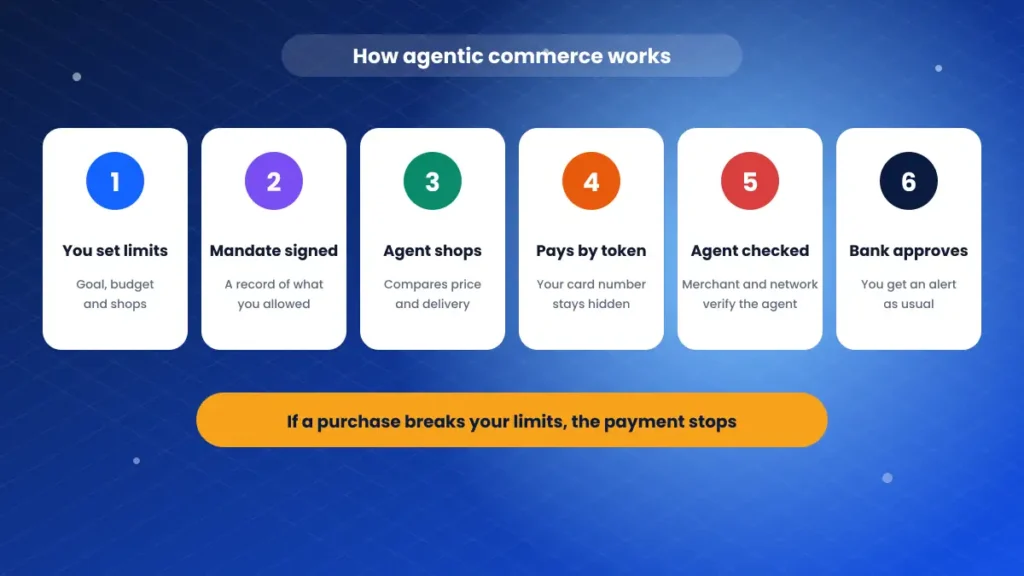
If any step fails, for example, the price is above your limit, the payment stops. That is how agentic commerce keeps you in control even when you are not watching.
Who is building agentic commerce?
The biggest payment and AI companies all launched agentic commerce projects in 2025:
| Company | Project | What it does |
|---|---|---|
| Visa | Visa Intelligent Commerce (April 2025) | Lets AI agents find and buy for shoppers, within limits each user sets |
| Mastercard | Agent Pay (April 2025) | Builds payments into recommendations on AI chat platforms |
| Agent Payments Protocol, or AP2 (September 2025) | An open standard for signed “mandates” that prove what a user allowed, backed by over 60 organisations | |
| OpenAI and Stripe | Instant Checkout and the Agentic Commerce Protocol (September 2025) | Lets people buy from Etsy sellers inside ChatGPT, paid with a single-use token |
According to TechCrunch, Visa’s partners include Anthropic, Microsoft, OpenAI and Stripe, while Mastercard’s early partners include Microsoft, IBM and Checkout.com. Google says its AP2 protocol works with cards, real-time bank transfers and stablecoins. Meanwhile, Stripe’s Shared Payment Token lets ChatGPT start a payment without seeing the buyer’s card details, and each token is limited to one merchant and one cart total.
Why tokens and mandates keep agentic commerce safe
In fact, two ideas make agentic commerce safer than handing your card to a robot.
First, tokens replace your card number. A token is a stand-in number that only works in a narrow situation, such as one merchant, one amount, or one agent. So, if a token leaks, it is almost useless to a thief. Your digital wallet already uses the same idea, as our guide to what a digital wallet is explains.
Second, mandates record your permission. A mandate is a signed digital note that says what the agent may buy, how much it may spend, and for how long. As a result, if a dispute arises, there is clear proof of what you did and did not allow.
On top of that, your bank still checks every payment, just as it does for a normal card payment. Our guide to card authorisation explains that check.
Benefits and risks of agentic commerce
Like any new payment method, agentic commerce brings clear gains and real risks:
| Benefits | Risks |
|---|---|
| Saves time on routine purchases | The agent may misread what you wanted |
| Finds better prices and deals | Fake “AI shopping” apps can steal card details |
| Can reorder essentials automatically | Unclear rules on who pays for an agent’s mistake |
| Uses tokens, not your real card number | Small sellers without online catalogues may be left out |
| Keeps a signed record of your permission | Too much trust can lead to overspending |
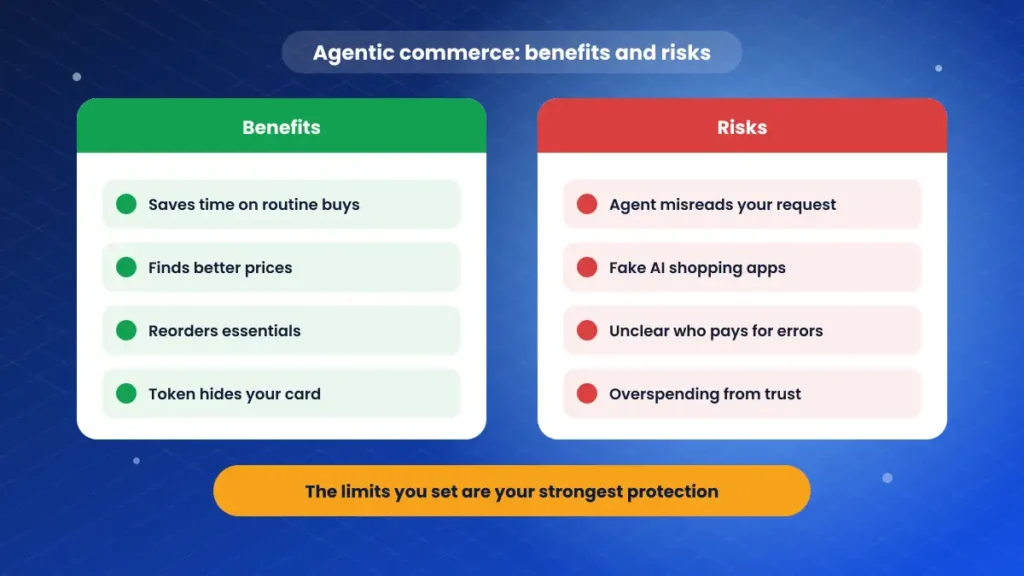
Above all, the liability question matters. Card networks are still writing rules on who pays when an agent buys the wrong item, so check the terms of any service before you let it spend.
Agentic commerce in Nigeria and Africa
Agentic commerce is arriving in Africa, but slowly. In May 2026, Visa launched an Agentic Ready programme across Central and Eastern Europe, the Middle East and Africa, so banks can test agent-initiated payments in a controlled setting. Its 34 early partners included banks in Egypt and South Africa, although no Nigerian bank was named.
Still, Nigeria has some strengths. Instant bank transfers through NIBSS are already a daily habit, and many people use AI tools. However, a Daily Trust analysis points out real barriers: many Nigerians pay by transfer rather than card, connectivity is patchy, and many sellers run their shops through WhatsApp catalogues that an AI agent cannot read.
Experts also expect a gradual start. Payments consultancy Glenbrook, for instance, expects agent-made payments to stay a limited channel in 2026, even as AI agents become common for finding products.
How to use AI shopping agents safely
If you try an AI shopping agent, follow these habits:
- Start with “buy with approval”. Let the agent prepare orders, but confirm each payment yourself at first.
- Set tight limits. Choose a low spending cap, a short time window, and a list of trusted shops.
- Use a separate card. A virtual or prepaid card with a small balance limits any loss.
- Only use official apps. Download apps from known companies and official app stores. Fake AI apps are a growing scam, as our guide to deepfake scams explains.
- Keep alerts and 2FA on. Debit alerts show every payment, and two-factor authentication protects the account the agent uses.
- Review your mandates. Check which agents can spend for you, and cancel any you no longer use.
What agentic commerce means for small businesses
Meanwhile, for merchants, AI agents become a new kind of customer. An agent cannot read a blurry photo of a price list, so businesses that want agent sales need clear, structured product details:
- A proper online catalogue with names, prices, sizes, and stock levels.
- A payment gateway that supports tokens and modern checkout, as our guide to what a payment gateway is explains.
- Clear policies on delivery, returns and refunds, written so software can find them.
In short, the basics of good online selling also prepare a business for agentic commerce. Our guide on how to accept online payments is a good place to start. To use agents inside your own business, see our guide to AI agents for small business.
Frequently asked questions
Is agentic commerce available in Nigeria?
Not widely yet. The main services launched first in the US, and Visa’s 2026 testing programme for Africa did not name a Nigerian bank. However, global AI tools may still offer agent shopping features to Nigerian users with international cards.
Does an AI agent see my card number?
In the new systems, no. The agent uses a token that works only for a specific merchant, amount, or purpose, so your real card number stays hidden.
Who pays if the agent buys the wrong thing?
It depends on the service and the card network rules, which are still developing. That is why you should start with orders you approve yourself and read the terms carefully.
Is agentic commerce the same as a chatbot?
No. A chatbot answers questions. An AI agent takes actions, such as placing an order and paying for it, within the permissions you give it.
Can agents pay by bank transfer?
Some standards allow it. Google’s AP2, for example, supports real-time bank transfers and stablecoins as well as cards. Our guide to stablecoin payments explains how stablecoins move money.
Key takeaways on agentic commerce
- Agentic commerce means AI agents search, choose, and pay for things on your behalf.
- Tokens hide your real card number, and signed mandates record exactly what you allowed.
- Visa, Mastercard, Google, OpenAI, and Stripe all launched agentic commerce systems in 2025.
- Africa is testing it, but transfers, connectivity, and informal shops slow adoption in Nigeria.
- Start with orders you approve, set tight limits, and use only official apps.
Want to understand the payment systems behind it? Browse our digital payments guides, or read what fintech is.