Sending money from Lagos to Accra or Nairobi has long been slow and costly. Often, the payment first turns into US dollars, passes through banks outside Africa, and then turns into the other local currency. A newer network was built to change that. It lets banks move money between African countries in local currencies, usually within minutes. This guide explains what PAPSS is, how it works, how to use it in Nigeria, what it costs, and its limits.
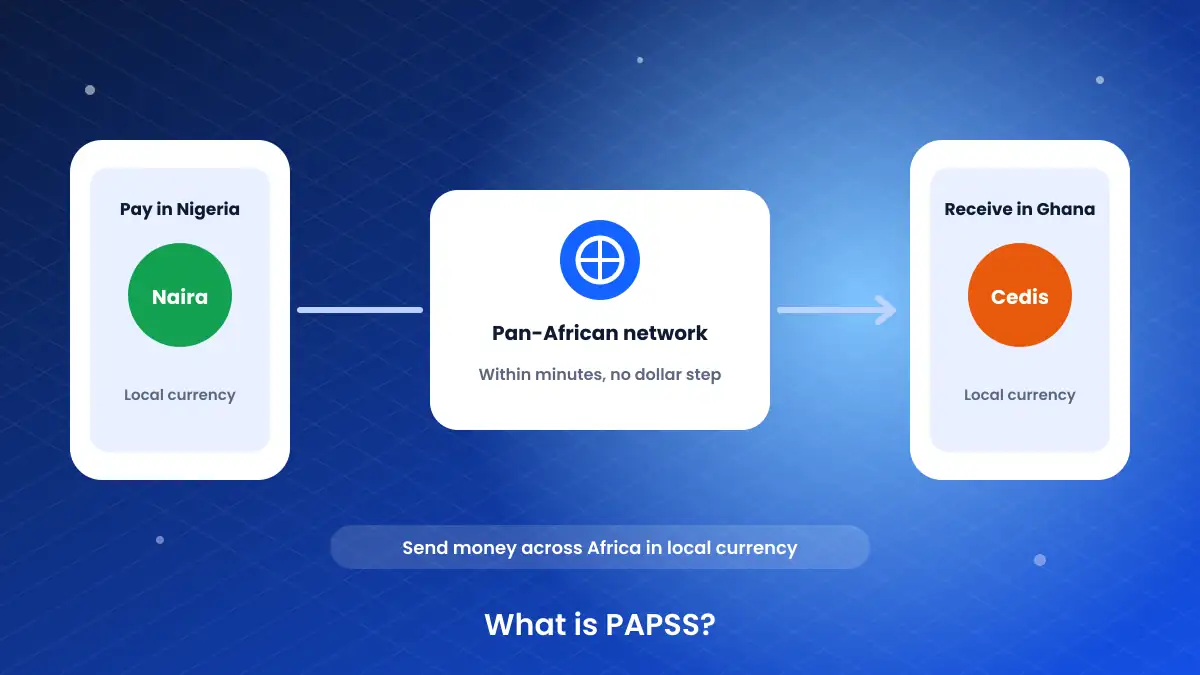
Quick answer: PAPSS, the Pan-African Payment and Settlement System, is a network that lets people and businesses send money between African countries in their own currencies. You pay in naira from a connected Nigerian bank, and the recipient gets cedis, shillings, or another local currency. The network says payments arrive within 120 seconds. Afreximbank created it, and it went live in January 2022. Over 20 Nigerian banks are connected.
In this guide
- What is PAPSS?
- How cross-border payments worked before
- How PAPSS works
- The old route vs. the new one
- Which countries are connected?
- How to use PAPSS in Nigeria
- What PAPSS costs
- Benefits for people and businesses
- Limits and challenges
- Staying safe with cross-border payments
- Frequently asked questions
- Key takeaways on PAPSS
What is PAPSS?
PAPSS stands for the Pan-African Payment and Settlement System. It is a payment network that connects central banks, commercial banks, and payment companies across Africa. In simple terms, it lets a bank in one African country pay a bank in another without first converting the money into a foreign currency.
Afreximbank, the African Export-Import Bank, created it with support from the African Union, according to its About Us page. The aim is to make trade easier under the African Continental Free Trade Area (AfCFTA), which is cutting barriers to trade between African countries.
The system began as a pilot in the six countries of the West African Monetary Zone, including Nigeria and Ghana. It then launched publicly on 13 January 2022.
How cross-border payments worked before
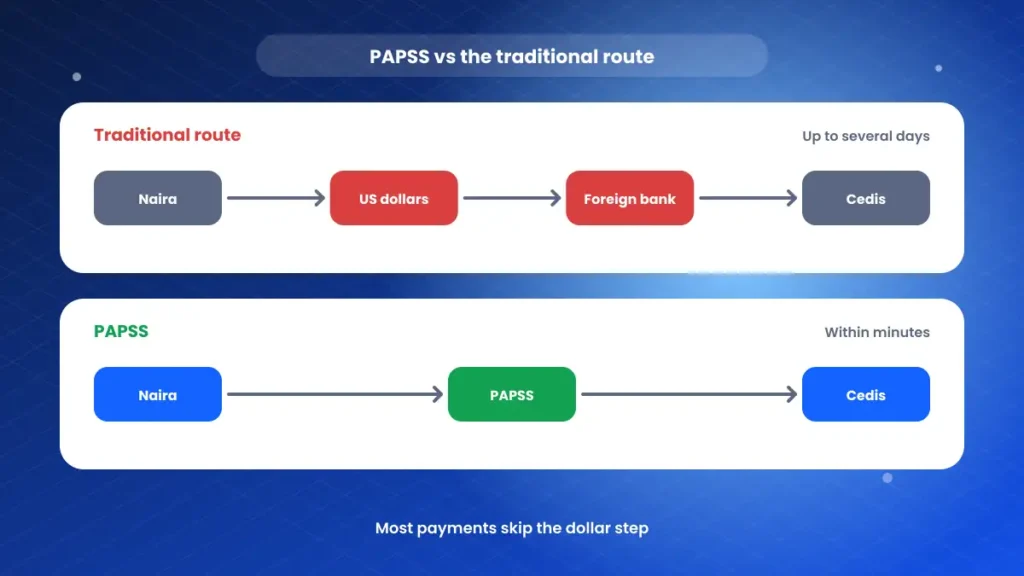
Before this network, a payment from Nigeria to Ghana often took a long route:
- Convert to dollars. First, your bank turned the naira into US dollars.
- Go through correspondent banks. Next, the money passed through banks abroad, often in the US or Europe.
- Convert again. Finally, the receiving bank turned the dollars into cedis.
Each step added fees, exchange rate costs, and delays of up to several days. In addition, it needed scarce US dollars, which many African businesses find hard to get. Our guide to how bank transfers work explains the difference between local and international transfers.
How PAPSS works
The system works behind your bank’s app. A typical payment follows five steps:
- You start the payment. First, you choose PAPSS in your bank’s app, online banking, or at a branch, and pay in naira.
- Your bank sends the instruction. Next, it passes the payment on through Nigeria’s central bank connection.
- The network checks and routes it. Then, it validates the payment, runs compliance checks, and sends it to the other country.
- The recipient gets local currency. After that, the receiving bank credits the account in its own currency.
- Central banks settle later. Finally, at the end of the day, the system works out what each country owes the others, and central banks settle only the difference.
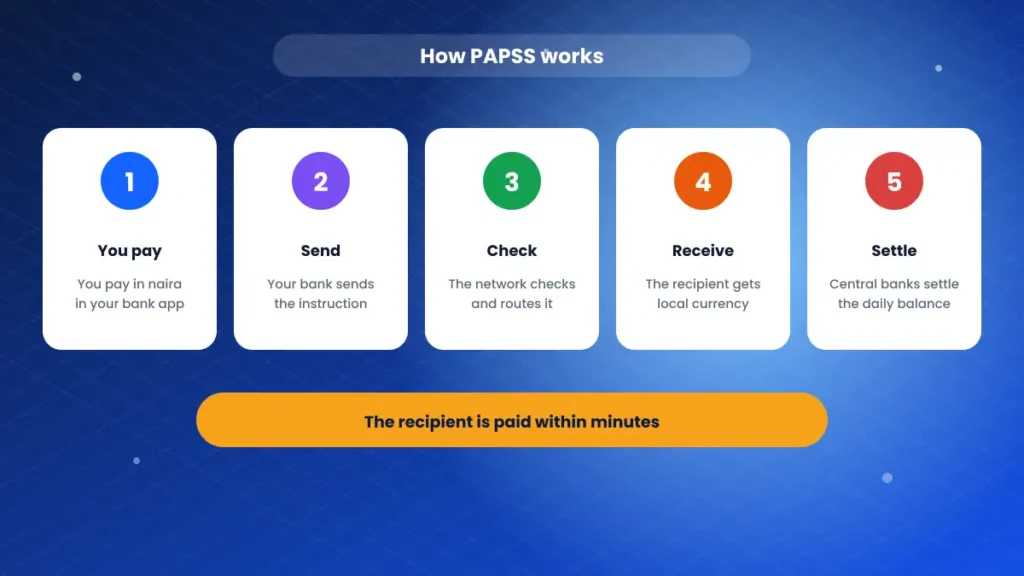
That last step is the key idea, called net settlement. Instead of moving dollars for every payment, it adds up all the payments between countries and settles only the balance. Afreximbank acts as the settlement agent, according to Wikipedia’s summary.
The old route vs the new one
Here is how the two routes compare:
| Feature | Traditional route | PAPSS |
|---|---|---|
| Currency used | Usually converted through US dollars | Local currency to local currency |
| Banks involved | Several, often outside Africa | Your bank, central banks, and the recipient’s bank |
| Typical speed | Up to several days | Up to 120 seconds, PAPSS says |
| Need for US dollars | Yes | Mostly no, apart from the final daily balance |
| Who can receive | Almost any country | Only connected banks in live countries |
Which countries are connected?
The network is growing, but figures differ between sources. In March 2026, TechCabal reported that it was live in 19 countries, with more than 160 commercial banks and more than 15 national switches connected, in its four-year review. In October 2026, Ethiopia’s central bank also joined, CNBC Africa reported.
From Nigeria, PAPSS lists Ghana, Sierra Leone, Liberia, Gambia, Guinea, Kenya, Rwanda, Uganda, Zambia, Malawi, Zimbabwe, and Djibouti as destinations, according to its Nigeria page. It also lists Algeria, Comoros, Egypt, Morocco, and Tunisia as coming soon. However, South Africa was still outside the network as of October 2026.
How to use PAPSS in Nigeria
PAPSS lists 22 connected Nigerian banks, including Access Bank, Ecobank, Fidelity Bank, First Bank, Stanbic IBTC, Sterling Bank, UBA, Wema Bank, and Zenith Bank. To send money:
- Check your bank. First, confirm that your bank offers PAPSS and whether it works in the app or only at a branch.
- Get the recipient’s details. Next, collect their full name, bank, account number, and country.
- Choose PAPSS. Then, select PAPSS as the transfer type and enter the amount in naira.
- Check the rate and fee. After that, review the exchange rate and charges before you confirm.
- Keep the reference. Finally, save the transaction reference in case you need to trace the payment.
There are also monthly limits without extra documents. Individuals and traders can send up to the naira equivalent of $2,000 a month, while businesses can send up to $5,000. Above that, your bank will ask for supporting documents.
What PAPSS costs
The network describes its fees as competitive but does not publish a fee table. Instead, each bank sets its own charges and exchange rate. Some banks say their charges are much lower than a traditional international wire, but we could not verify this independently. Moreover, fees change over time, and regulators can change the rules on charges, so ask your bank for the current fee and rate before you send. Our bank charges calculator can help you compare costs.
Benefits for people and businesses
The new route offers several advantages over the old one:
- Speed. Most payments arrive within minutes rather than days.
- Local currencies. You pay in naira, and the recipient gets their own currency.
- Less need for dollars. As a result, businesses do not need to buy foreign currency for every payment.
- Easier trade. Small traders can pay suppliers in other African countries more easily.
- Currency exchange. In addition, a currency marketplace launched in 2025 now lets African currencies be exchanged directly, without going through the dollar.
Limits and challenges
Even so, the system still has gaps:
- Not every bank or country. Both you and the recipient need a connected bank in a live country.
- Low awareness. Many people still do not know the service exists, according to TechCabal.
- Uneven rollout. Some banks offer it only at branches, not in their apps.
- Limits and paperwork. Larger payments need documents, and some countries add their own caps.
- Mobile money. Wallet-to-wallet transfers, such as between Ghana and Nigeria, were still in a pilot stage in early 2026.
Staying safe with cross-border payments
Scammers often target cross-border payments because they are harder to reverse. So, follow these habits:
- Use your bank’s official app or branch. Never use a link sent by a stranger.
- Confirm the recipient. Call a known number to check the account details before you pay a new supplier.
- Be wary of urgency. A request to pay “today, before the price goes up” is a common trick.
Our guide to authorised push payment fraud explains how these scams work.
Frequently asked questions
What does PAPSS stand for?
It stands for the Pan-African Payment and Settlement System. Afreximbank created it to support trade between African countries.
How long does a transfer take?
According to the network, payments are processed within a maximum of 120 seconds. However, bank checks or missing details can cause delays.
Can I send money to South Africa with PAPSS?
Not yet. South Africa was not part of the network as of October 2026. Check the network’s website for the latest list of countries.
Is PAPSS a cryptocurrency or a CBDC?
No. It is a payment network between banks, using ordinary local currencies. Our guides to stablecoin payments and what a CBDC is explain those other options.
Do I need a domiciliary account to use PAPSS?
No. You pay in naira from a normal account at a connected bank.
Key takeaways on PAPSS
- PAPSS lets people and businesses send money between African countries in local currencies.
- It avoids converting most payments into US dollars, and payments usually arrive within minutes.
- Central banks settle only the daily balance, with Afreximbank as the settlement agent.
- In Nigeria, PAPSS lists 22 connected banks, with monthly limits of $2,000 for individuals and $5,000 for businesses without extra documents.
- Check your bank’s fees, exchange rate, and the destination country before you send.
Want to learn more about how money moves? Read our guides to ISO 20022 and what a payment switch is, or browse all our Digital Explained guides.