Sending money abroad through a bank or a transfer company can take days and cost several dollars in fees. Meanwhile, a growing number of people and businesses move “digital dollars” across borders in minutes instead. These are stablecoins, and stablecoin payments are now one of the biggest trends in payments. This guide explains what stablecoin payments are, how they work, where they help, the risks, and what Nigeria’s rules say.
Quick answer: Stablecoin payments use digital tokens that track a stable asset, usually the US dollar, to send money over a blockchain. You turn local money into stablecoins, send them to someone’s digital wallet, and they turn them back into cash. Transfers can settle in minutes, but the rules are still developing, so use only regulated platforms.
In this guide
- What are stablecoin payments?
- How stablecoin payments work
- Why stablecoin payments are growing
- Stablecoin payments vs bank transfers
- Risks of stablecoin payments
- Stablecoin rules in the US
- Stablecoin payments in Nigeria
- How to use stablecoin payments safely
- Frequently asked questions
- Key takeaways on stablecoin payments
What are stablecoin payments?
A stablecoin is a type of cryptocurrency designed to keep a steady value. Most stablecoins aim to stay worth exactly $1 because the issuer holds cash and short-term government bonds to back each coin. By contrast, prices of coins such as bitcoin can rise or fall sharply in a day.
Stablecoin payments simply use these coins to move money. For example, a freelancer abroad can get paid in a dollar stablecoin, or a business can pay a supplier in another country. Because the coins live on a blockchain, transfers run day and night, including weekends. Our guide to what blockchain technology is explains how these shared records work.
There are a few main types:
| Type | What backs it | Examples |
|---|---|---|
| Fiat-backed | Cash and short-term government bonds | USDT, USDC, cNGN |
| Commodity-backed | Gold or other assets | Gold-backed tokens |
| Crypto-backed | Other cryptocurrencies, with extra cover | DAI |
| Algorithmic | Computer rules, with little or no reserve | Mostly failed or banned |
In practice, almost all stablecoin payments use fiat-backed coins, especially those tied to the US dollar.
How stablecoin payments work
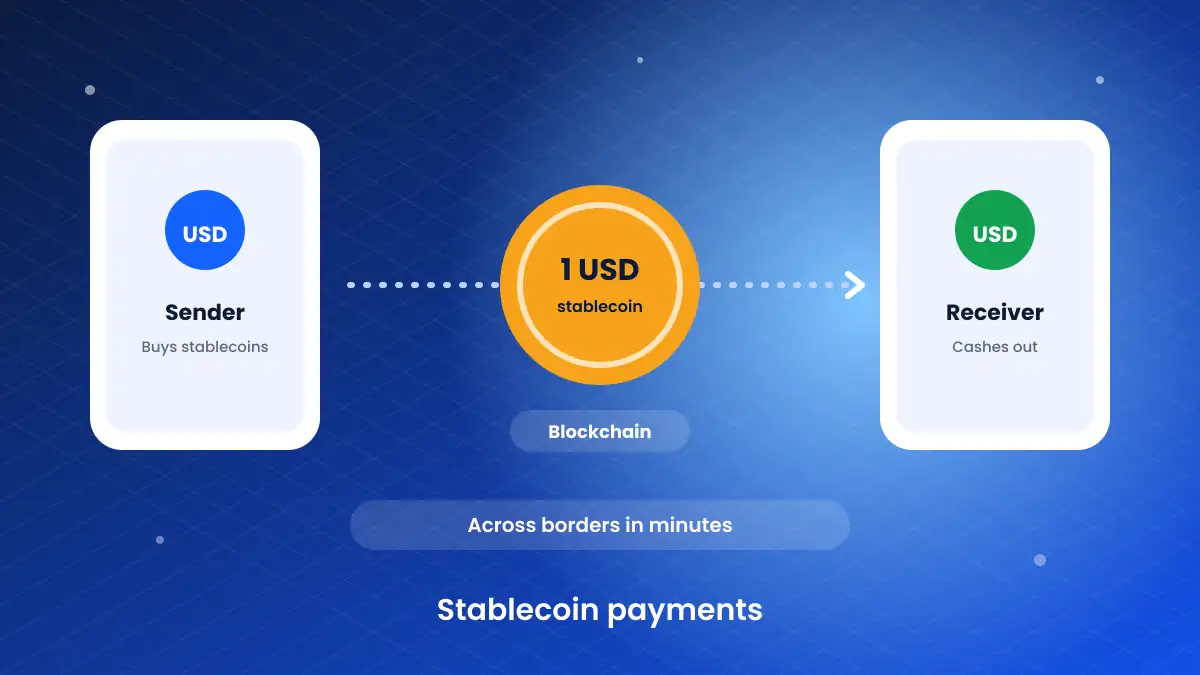
A typical cross-border stablecoin payment has five steps:
- Buy stablecoins. First, you swap local money for stablecoins on a regulated exchange or payment app. This step is called the on-ramp.
- Choose the network. Next, you pick the blockchain to send on. The sender and the receiver must use the same one.
- Send to a wallet address. Then, you send the coins to the receiver’s wallet address, a long string of letters and numbers.
- The blockchain confirms it. After that, the network records the transfer, usually within minutes.
- Cash out. Finally, the receiver keeps the coins or swaps them for local money. This step is called the off-ramp.
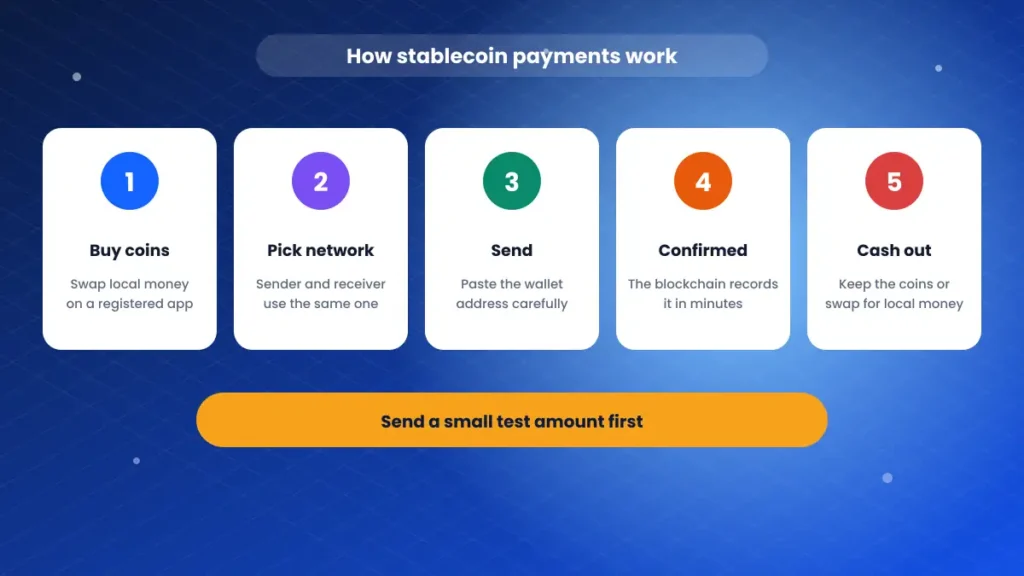
Importantly, a blockchain transfer cannot be reversed. So, if you send coins to the wrong address or the wrong network, you will usually lose them. Always copy addresses carefully and send a small test amount first.
Why stablecoin payments are growing
Stablecoins have grown quickly. For instance, their total value reached about $300.9 billion in October 2026, Cointurk reported using data from the RWA Foundation. Tether’s USDT made up 61% of the supply.
Several reasons explain this growth:
- Speed. Transfers settle in minutes, even at weekends, instead of days.
- Lower costs. By comparison, sending money to sub-Saharan Africa through traditional channels cost about 8.37% on average in 2024, according to World Bank figures reported by North Africa Post.
- Access to dollars. Where local currencies lose value, people use dollar stablecoins to hold and move value.
- Clearer rules. The US passed its first stablecoin law in July 2025, as explained below.
Africa is a big part of this story. Sub-Saharan Africa recorded $205 billion in crypto transactions between July 2024 and June 2025, up about 52%, according to Chainalysis figures reported by Ecofin Agency. Nigeria led the region with over $92.1 billion, and stablecoins are widely used for business payments.
Stablecoin payments vs bank transfers
Here is how stablecoin payments compare with a traditional international bank transfer:
| Feature | International bank transfer | Stablecoin payment |
|---|---|---|
| Speed | One to five working days | Usually minutes |
| Opening hours | Banking days only | Any time, every day |
| Reversible | Sometimes, through your bank | No, once confirmed |
| Protection | Bank and regulator protections | Depends on the platform |
| Rules | Well established | Still developing |
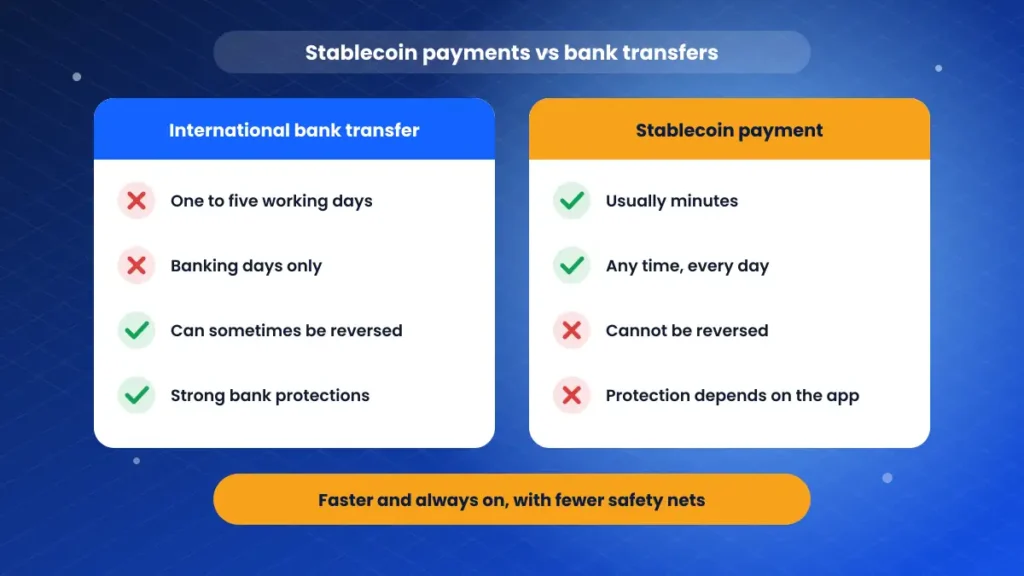
In short, stablecoins win on speed, while banks still win on protection. Our guide to how bank transfers work explains the bank side in more detail.
Risks of stablecoin payments
Stablecoins are not bank deposits, so you should understand the risks before you use them:
- Losing the peg. A stablecoin can briefly fall below $1. For example, USDC fell below 87 cents in March 2023 after its issuer revealed $3.3 billion in reserves at the failed Silicon Valley Bank, CNBC reported. It recovered soon after.
- Issuer risk. Your coins are only as safe as the reserves behind them. Therefore, prefer coins that publish regular reserve reports.
- Platform risk. If an exchange or app fails, you may lose access to your coins.
- No reversals. Mistakes and fraud are hard to undo.
- Scams. Fraudsters often ask for payment in stablecoins or promise high returns. Read our guide to deepfake scams to spot fake calls and videos.
- Changing rules. Regulators are still writing the rules, and they can change what platforms may offer.
This guide explains how stablecoins work. It is not investment advice, so speak to a licensed adviser before you put money into any digital asset.
Stablecoin rules in the US
The US signed the GENIUS Act into law on 18 July 2025. According to a Congressional Research Service summary, issuers must hold at least $1 of approved reserves, such as cash and short-term Treasury bills, for every $1 of stablecoins. They must also publish regular reports on their reserves and disclose how holders can redeem coins. However, regulators were still writing detailed rules as of August 2026.
Stablecoin payments in Nigeria
Nigeria’s rules are developing quickly, so check the latest position before you act:
| Date | Milestone |
|---|---|
| August 2024 | cNGN, a naira stablecoin, joins the SEC’s regulatory incubation programme |
| February 2025 | cNGN launches |
| March 2025 | The Investments and Securities Act 2025 treats digital assets as securities |
| July 2026 | President Tinubu creates a CBN-led Virtual Asset Council |
| August 2026 | The SEC proposes new rules for stablecoins |
First, cNGN is a naira stablecoin backed by naira reserves, according to BusinessDay. Unlike the eNaira, a private company issues it, not the CBN.
Next, in July 2026, an executive order created the Virtual Asset Council, chaired by the CBN, with the SEC and the Nigeria Revenue Service as vice chairs. Under the order, the SEC covers assets that count as securities, while the CBN covers payment, settlement, and custody services for other virtual assets.
Then, on 20 August 2026, the SEC proposed rules that would require naira-backed stablecoins to hold 100% reserves and foreign currency-backed ones 120%. They would also ban algorithmic and reserve-less stablecoins, and foreign stablecoins would need SEC recognition. These rules were still proposals at the time of writing.
How to use stablecoin payments safely
If you decide to use stablecoins, follow these steps to reduce your risk:
- Use a registered platform. Check that the exchange or app is registered with the SEC or covered by the CBN’s sandbox.
- Protect your account. Turn on two-factor authentication and never share your recovery phrase.
- Check the network. Make sure you and the receiver use the same blockchain.
- Send a test amount. Send a small amount first, then the rest once it arrives.
- Keep records. Save the transaction ID, the date, and the amount for your own records and for tax.
- Avoid promises of high returns. Moreover, never send stablecoins to someone you met only online.
Our guide on how to identify a fake website can also help you avoid copycat exchanges.
Frequently asked questions
Are stablecoin payments legal in Nigeria?
Nigeria does not ban them. The SEC regulates digital assets that count as securities, and the CBN oversees payment services for other virtual assets. However, the rules are still being finalised, so use registered platforms only.
Is a stablecoin the same as the eNaira?
No. The CBN issues the eNaira as a digital form of the naira. In contrast, private companies issue stablecoins such as cNGN, USDT, and USDC. Our guide to what a CBDC is explains what happened to the eNaira.
Can a stablecoin lose value?
Yes, briefly. For example, USDC fell below 87 cents in March 2023 before recovering. A stablecoin with weak reserves could lose value for good.
Do I need a bank account to use stablecoins?
Not always, but you usually need one to buy stablecoins or cash them out. Most regulated platforms link to a bank account or a card.
Are stablecoins good for paying bills at home?
Not yet for most people. In fact, very few shops and billers in Nigeria accept them. They are most useful for cross-border payments, such as freelance income and supplier payments. For payments between African countries, many banks now also offer PAPSS, which uses local currencies.
Key takeaways on stablecoin payments
- Stablecoin payments use digital tokens, usually tied to the US dollar, to move money over a blockchain.
- Transfers can settle in minutes, at any time, but they cannot be reversed.
- Stablecoins totalled about $300.9 billion in October 2026, and Nigeria leads Africa in crypto use.
- The US passed the GENIUS Act in 2025, and Nigeria’s SEC proposed stablecoin rules in August 2026.
- Use registered platforms, check the network, send a test amount, and watch for scams.
Want to see how other payment trends are changing money? Read our guides to network tokenisation and open banking in Nigeria, or browse all our digital payments guides.