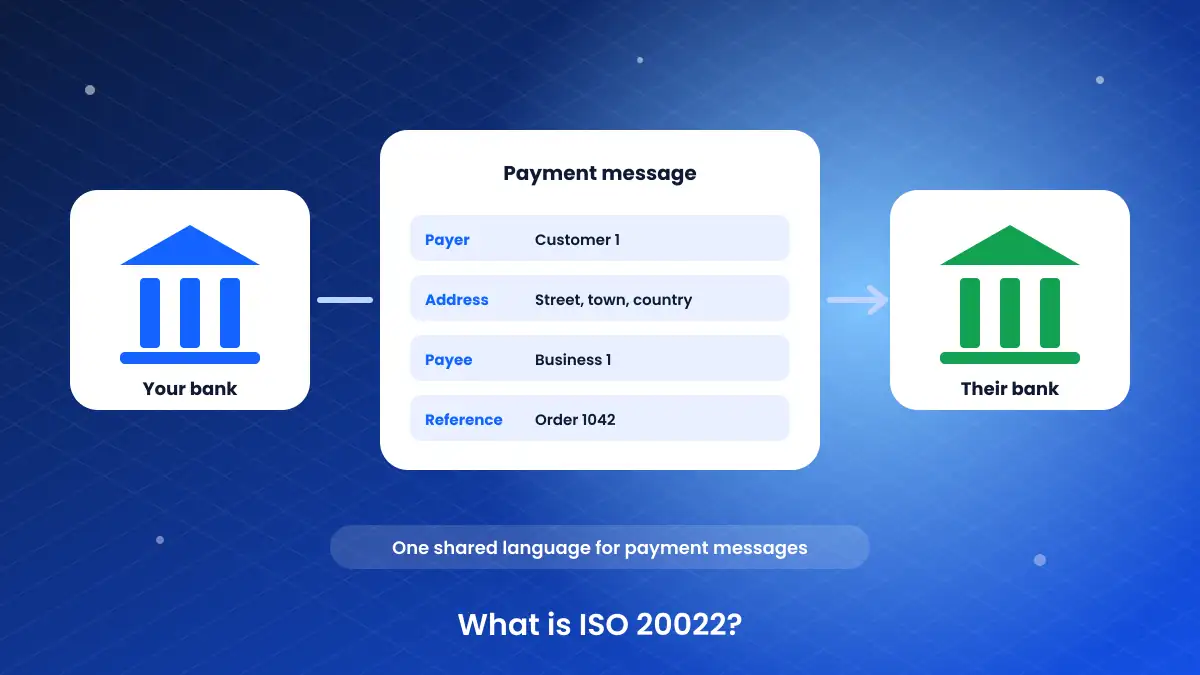
Every time you send money, your bank sends a message to another bank. That message says who is paying, who is being paid, how much, and why. Yet for decades, banks used several older message formats, with short, free-text fields that often lost details along the way. Now most of the world’s payment systems have moved to one shared standard, called ISO 20022. This guide explains what ISO 20022 is, how it works, what changed in Nigeria and worldwide, and what it means for you and your business.
Quick answer: ISO 20022 is a global standard for the messages that banks and payment systems send to each other. It uses clearly labelled fields for names, addresses, account details, and payment references, so more information travels with each payment. Swift moved cross-border payments to ISO 20022 in November 2025, and the CBN told Nigerian banks and payment companies to use it for all payment messages by 31 October 2025. For most people, the change happens behind the scenes.
In this guide
- What is ISO 20022?
- What the new standard replaces
- How ISO 20022 works
- Old formats vs the new standard
- Who has switched?
- ISO 20022 in Nigeria
- What ISO 20022 means for you
- What ISO 20022 means for businesses
- Frequently asked questions
- Key takeaways on ISO 20022
What is ISO 20022?
ISO 20022 is an international standard for financial messages. The International Organization for Standardization (ISO) publishes it, which is where the name comes from. In simple terms, it is a shared language that lets banks, payment systems, and businesses exchange payment information in the same way.
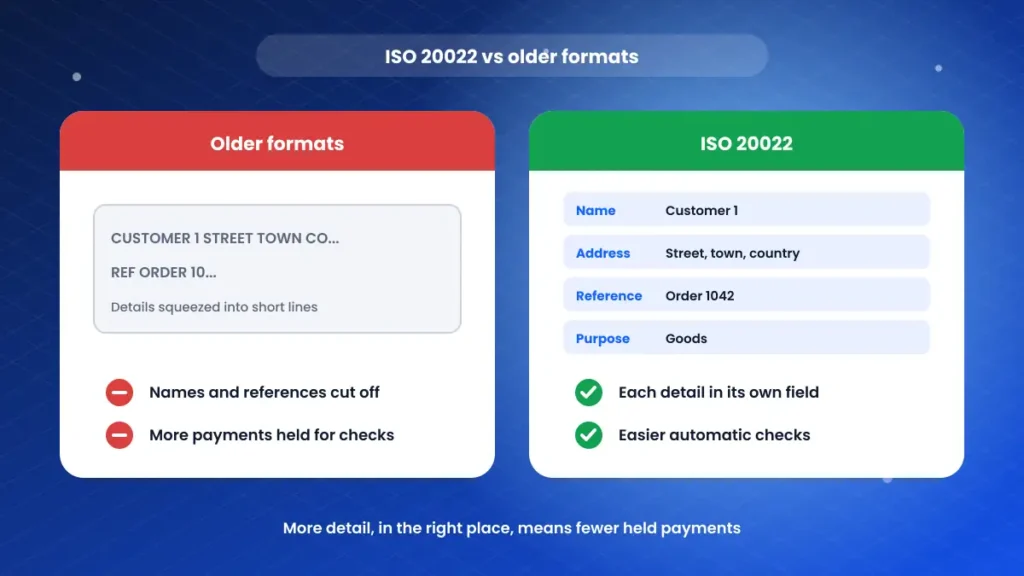
Think of it like a standard form. Under older formats, a payment message was a bit like a note with a few short boxes, where details were squeezed in or cut off. By contrast, ISO 20022 is a longer form with a separate, labelled box for each detail, such as the payer’s name, street, town, and country.
Since every system reads the same labels, computers can process payments with fewer mistakes. The Bank of England describes it as a common international format that lets more information travel with each payment, in a more structured way, in its CHAPS announcement.
What the new standard replaces
Before this standard, banks used several older formats:
- SWIFT MT messages. These carried most international bank transfers for decades. Many fields were short free-text lines.
- Local formats. Many countries built their own formats for domestic transfers.
- Card formats. Card payments use a separate standard, ISO 8583, which is not part of this change.
As a result, a payment often passed through several formats on its way. Worse still, each conversion could shorten a name, drop an address, or cut off the payment reference. In other words, details went missing. Our guide to how bank transfers work explains the journey a payment takes.
How ISO 20022 works
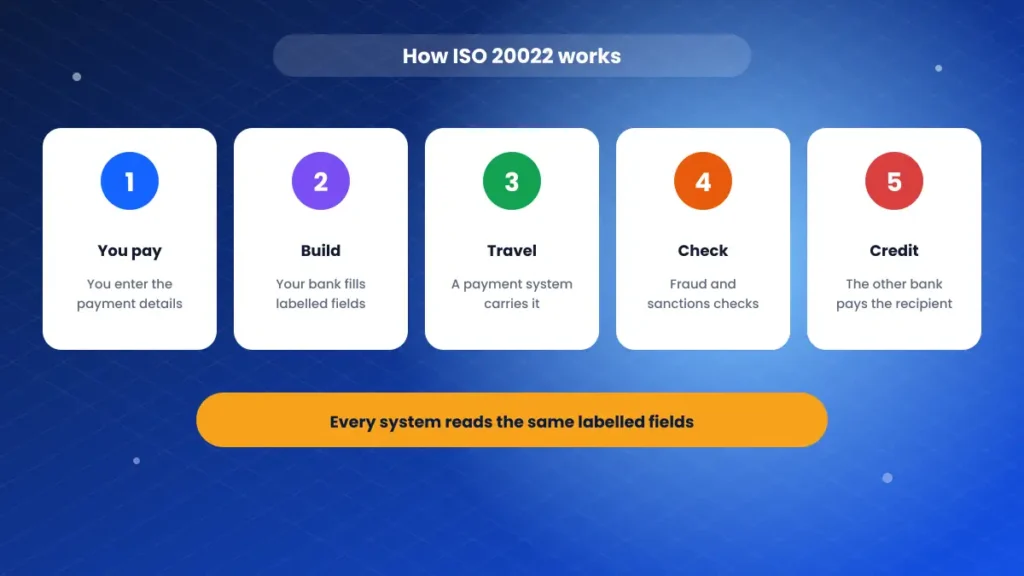
From your side, nothing looks different. Behind the scenes, a typical transfer follows five steps:
- You send a payment. First, you enter the amount, the recipient, and a reference in your banking app.
- Your bank builds the message. Next, it puts each detail into its own labelled field.
- The message travels. Then, a payment system, such as NIBSS in Nigeria or SWIFT abroad, carries it to the other bank.
- Checks run automatically. After that, systems read the fields to screen for fraud and sanctions.
- The receiving bank credits the account. Finally, it reads the same fields, pays the recipient, and passes on the reference.
In addition, messages come in families. Each one has a short code:
| Message family | What it is for | Example |
|---|---|---|
| pain | Messages between a customer and its bank | A business asks its bank to make payments |
| pacs | Messages between banks | One bank sends a customer’s transfer to another |
| camt | Statements and account reports | A bank reports what came in and went out |
Fortunately, you do not need to learn these codes. Still, a bank or software provider may mention them when your business connects its accounting system to its bank.
Old formats vs. the new standard
In practice, here is how the change looks:
| Feature | Older formats | ISO 20022 |
|---|---|---|
| Names and addresses | Free-text lines, often shortened | Separate fields for name, street, town, and country |
| Payment reference | Short, often cut off | Longer and structured |
| Purpose of payment | Often missing | Can be shown with a standard code |
| Automatic checks | Harder, so more payments are held for review | Easier, because systems know where each detail is |
| Used by | Older systems | SWIFT, Fedwire, CHAPS, and Nigeria’s payment systems |
Who has switched?
Most major payment systems have now moved to the standard:
- The UK. The Bank of England moved CHAPS, its high-value payment system, on 19 June 2023.
- The United States. The Fedwire Funds Service moved in July 2025, the Federal Reserve announced. It settles more than $4.7 trillion a day on average.
- Cross-border payments. SWIFT ended the period when its old and new formats ran side by side on 22 November 2025. By March 2026, over 98% of payment instructions on SWIFT used the new format, according to a SWIFT update.
However, the work is not finished. SWIFT had planned to stop accepting unstructured addresses in international payments in November 2026. In August 2026, though, it deferred that change and said it would announce a new timeline later, according to IBANforge’s tracker. So, ask your bank which address format it needs.
ISO 20022 in Nigeria
In August 2025, the CBN told banks, microfinance banks, mobile money operators, switches, and other payment companies to use the standard for all domestic and international payment messages. The deadline was 31 October 2025, according to Nairametrics.
The same circular said messages must carry accurate details, such as payer and payee identifiers and merchant and agent identifiers. It also required POS terminals to be geo-tagged, so each payment shows where the terminal is. According to the report, the aim is fewer errors, better fraud detection, and faster cross-border payments. Within Africa, our guide to PAPSS explains another way banks now speed up cross-border payments.
We could not find a public CBN update confirming that every institution met the deadline. Even so, the direction is clear. Our guides to what a payment switch is and how POS transactions work explain where these messages travel.
What ISO 20022 means for you
For everyday transfers, you will not see the format itself. Even so, it can affect you in a few ways:
- Fewer held payments. Clearer details mean fewer international payments stopped for manual checks.
- Better fraud checks. Richer data helps banks spot unusual payments. Our guide to AI fraud detection explains how banks use it.
- More accurate details needed. For international transfers, your bank may ask for the recipient’s full address, including town and country.
- Clearer references. Longer references are more likely to arrive in full.
However, the standard does not set what you pay. Transfer fees depend on your bank and the payment system. Moreover, fees change over time, and regulators can change the rules on charges, so check your bank’s current rates.
What ISO 20022 means for businesses
For businesses, the main gain is therefore better data. Here is how to make the most of it:
- Collect full details. First, store each supplier’s or customer’s full name and structured address, especially for international payments.
- Use clear references. Next, give every payment a unique reference, so you can match it later.
- Ask your bank about formats. Then, check whether your bank’s bulk payment and statement files now use the new format.
- Update your software. After that, make sure your accounting or payroll software can read the new files.
- Match payments automatically. Finally, use the richer data to match money received with what you expected.
For example, Business 1 receives dozens of transfers a day. With full references in each statement line, its accounting software can match most of them automatically. Our settlement reconciliation calculator can help with the rest.
Frequently asked questions
What does ISO 20022 stand for?
ISO is the International Organization for Standardization, while 20022 is the number of the standard. It covers financial messages, mainly for payments.
Is ISO 20022 a cryptocurrency?
No. It is a message standard used by banks and payment systems. Some websites claim certain cryptocurrencies are “ISO 20022 coins”, but no coin needs to follow the standard. Be wary of anyone who uses the term to sell crypto. Our guide to blockchain technology explains how crypto works.
Will my transfers be faster?
It can help, because fewer payments are held for manual checks as a result. However, speed still depends on the payment system and the banks involved.
Do I need to do anything as a customer?
Usually not. For international transfers, however, give your bank the recipient’s full name and address when asked.
Does it apply to card payments?
Not yet. Card networks still mostly use a separate standard, ISO 8583. Our guide to card settlement explains how card payments are paid out.
Key takeaways on ISO 20022
- ISO 20022 is a global standard for payment messages, with separate labelled fields for each detail.
- It replaces older formats that often shortened or lost names, addresses, and references.
- SWIFT, Fedwire, and CHAPS have moved to it, and the CBN set a 31 October 2025 deadline for Nigerian payment companies.
- It can mean fewer held payments, better fraud checks, and clearer references.
- Businesses gain the most by collecting full details, using clear references, and updating their software.
Want to understand more about how money moves? Read our guides to pay by bank and what an API is, or browse all our Digital Explained guides.