Most of the money you use every day is already digital. Your bank balance, your wallet balance, and the transfer you sent this morning are all numbers on a screen. However, almost none of that money is issued by the central bank itself. A central bank digital currency, or CBDC, changes that. Nigeria launched one of the first, the eNaira, in 2021. This guide explains what a CBDC is, how it works, how it differs from a stablecoin or mobile money, which countries use one, and what has happened to the eNaira.
Quick answer: A CBDC is a digital form of a country’s currency, issued and backed by its central bank. It is legal tender, like notes and coins, but it lives in a digital wallet. Most central banks are studying the idea, yet only a few have launched one for the public. Nigeria’s eNaira, launched in October 2021, struggled to attract users. In June 2026, the CBN said it would reposition the eNaira for government payments and cross-border use.
In this guide
- What is a CBDC?
- How a CBDC works
- Retail vs wholesale digital currency
- How it compares with other digital money
- Which countries have a CBDC?
- What happened to the eNaira?
- Benefits of a CBDC
- Risks and concerns
- What a CBDC means for you
- Frequently asked questions
- Key takeaways on CBDCs
What is a CBDC?
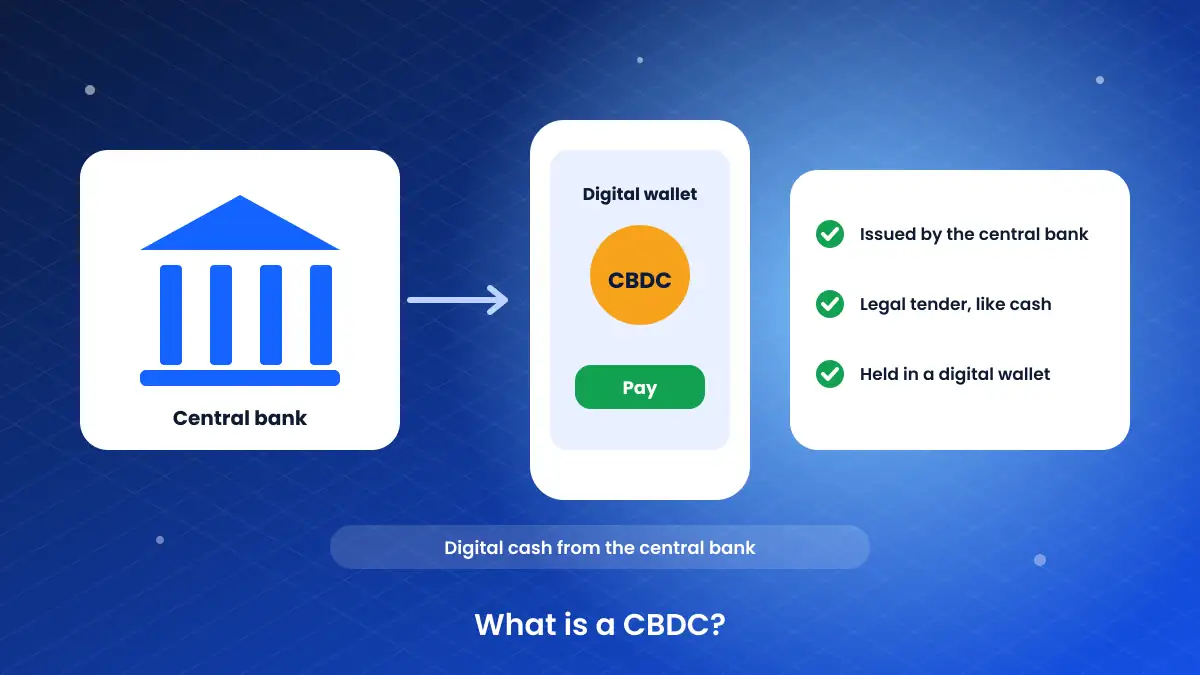
A central bank digital currency is money in digital form that a central bank issues directly. In Nigeria, that central bank is the Central Bank of Nigeria (CBN). So, one eNaira was designed to be worth exactly one naira, because both are issued by the same institution.
The key difference is who owes you the money. When you keep money in a commercial bank, the bank owes you that amount. By contrast, a CBDC is a direct claim on the central bank, just like cash. In other words, it is digital cash rather than a digital bank balance.
For that reason, a CBDC is not a cryptocurrency. Its value does not rise and fall with demand, and no private company or anonymous network issues it. Our guide to what fintech is explains the wider world of digital money services.
How a CBDC works
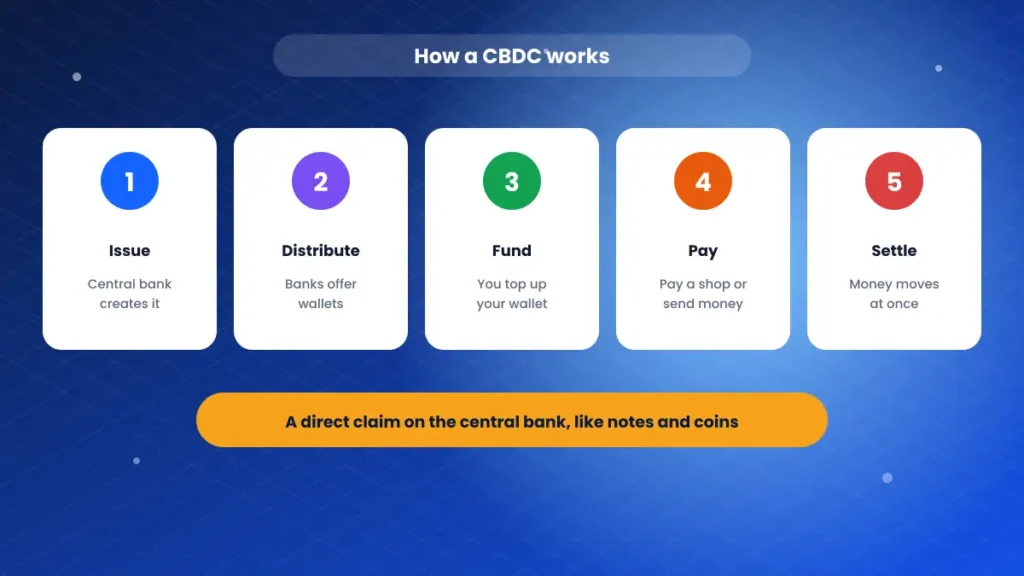
Each country designs its own system, but most retail versions follow five steps:
- The central bank issues it. First, the central bank creates the digital currency, one for one with the physical currency.
- Banks and providers distribute it. Next, licensed banks or payment providers offer wallets to the public, so the central bank does not serve customers directly.
- You fund a wallet. Then, you open a wallet in an app and move money into it from your bank account.
- You pay or send money. After that, you pay a shop or send money to another wallet, often by QR code or phone number.
- The payment settles at once. Finally, the money moves straight from one wallet to another, with no wait for bank settlement.
Some designs also work offline, or through USSD codes on basic phones. The eNaira, for example, offered a USSD option, so people without smartphones could use it.
Retail vs wholesale digital currency
There are two main types:
- Retail. Designed for the public, so people and businesses can hold it and pay with it. The eNaira is a retail CBDC.
- Wholesale. Used only between banks and financial institutions to settle large payments between them.
Most people only notice the retail type. Even so, wholesale projects are more common in testing. According to the Bank for International Settlements (BIS), wholesale work is, on average, at a more advanced stage than retail work, in its 2024 survey of central banks.
How it compares with other digital money
A CBDC looks similar to other kinds of digital money on your phone. Here is how they differ:
| Feature | CBDC | Bank balance | Stablecoin | Mobile money or wallet |
|---|---|---|---|---|
| Who issues it | The central bank | Your commercial bank | A private company | A licensed provider |
| Whose promise backs it | The central bank | Your bank | The issuer’s reserves | The provider and its partner bank |
| Legal tender | Yes | No, but it is a claim to naira | No | No |
| Runs on a blockchain | Sometimes | No | Yes | No |
So, the central bank’s backing is what makes a CBDC different. Our guides to stablecoin payments and what a digital wallet is explain the other two options in more detail.
Which countries have a CBDC?
Interest is widespread, but launches are rare. In a 2024 survey, 91% of 93 central banks said they were exploring a retail CBDC, a wholesale CBDC, or both, the BIS reported.
Only a few retail versions are fully live, however. Central Banking describes the eNaira as one of only three in operation worldwide, in its report on the eNaira’s repositioning. They include:
- The Bahamas. The Sand Dollar launched in October 2020, according to IFC Review.
- Nigeria. The eNaira launched in October 2021, the first in Africa.
- Jamaica. JAM-DEX launched in July 2022.
Elsewhere, China’s e-CNY has been in pilot since 2019. By the end of November 2025, it had processed 3.48 billion transactions worth about $2.3 trillion, Caixin reported. From January 2026, banks may also pay interest on e-CNY wallet balances.
Meanwhile, the European Central Bank is preparing for a possible digital euro. It says a pilot could begin in mid-2027 and issuance could follow by 2029, if EU lawmakers pass the necessary law in 2026, according to an ECB blog post.
What happened to the eNaira?
The eNaira launched with big hopes, but few people used it. Here is a short timeline:
- October 2021. First, the CBN launched the eNaira as Africa’s first CBDC.
- 2022 to 2023. Next, take-up stayed low. IMF data from 2023 suggested only about 0.5% of Nigerians used it, with most wallets inactive, according to a Yahoo Finance report.
- September 2025. Then, reports said the eNaira wallet website no longer loaded and the app had disappeared from app stores. The CBN made no public statement at the time, The New Narrative reported.
- October 2025. After that, the CBN and other regulators set up a working group to study a framework for an official stablecoin.
- June 2026. Finally, the CBN’s Payments System Vision 2028 said it would reposition the eNaira, rather than abandon it.
Under that plan, the CBN wants to use the eNaira for government payments, such as salaries, pensions, and welfare payments, and for cross-border payments, according to ITEdgeNews. The CBN admitted that adoption had been slow. It blamed weak stakeholder engagement, among other reasons, TechCabal reported.
So, the eNaira has not been withdrawn, but there is no clear date for a relaunch. Before you download any eNaira app, check the CBN’s official website, because fake apps often copy official names.
Benefits of a CBDC
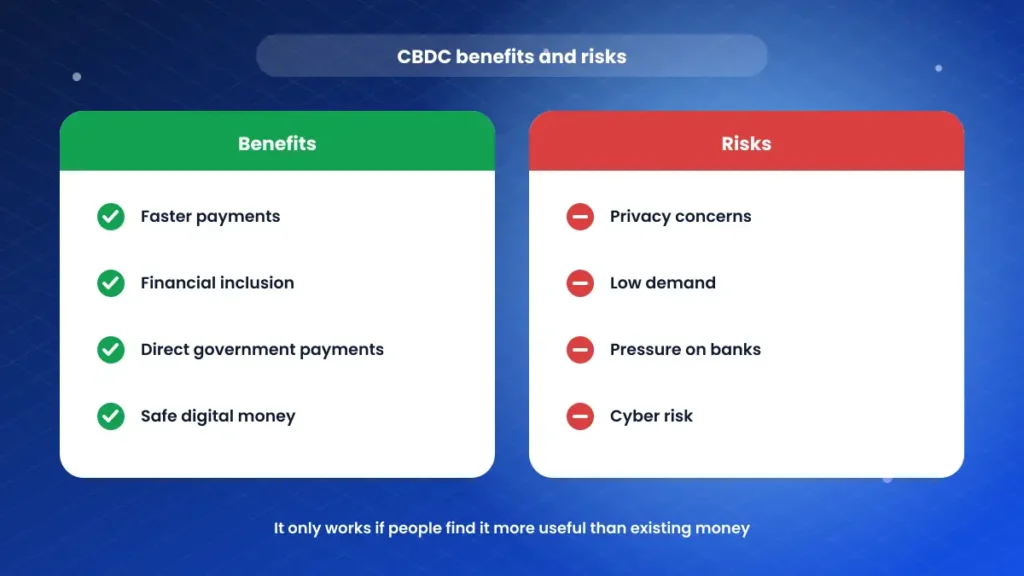
Central banks give several reasons for issuing digital currency:
- Faster payments. Money can move from wallet to wallet at once.
- Financial inclusion. People without a bank account could hold a wallet, sometimes on a basic phone.
- Cheaper government payments. Governments can send salaries, pensions, or welfare payments directly to wallets.
- Cross-border use. Some projects aim to make sending money between countries quicker.
- Safe digital money. Because the central bank issues it, it carries no risk of the issuer going bust.
Risks and concerns
However, CBDCs also raise real concerns:
- Privacy. A central bank could, in theory, see more about how people spend. Therefore, design choices on data matter.
- Low demand. If people are happy with bank transfers and wallets, they may see little reason to switch, as the eNaira showed.
- Pressure on banks. If many people moved savings from banks into a CBDC, banks could have less money to lend.
- Cyber risk. A national payment system is an attractive target for criminals.
- Exclusion. People without phones, or with weak network signal, may struggle to use it.
What a CBDC means for you
For now, a CBDC makes little difference to most people in Nigeria. You can keep paying by transfer, card, or wallet as normal.
If the CBN relaunches the eNaira for government payments, you might receive a salary, pension, or benefit into a CBDC wallet. In that case, use only the official app, protect it with a strong PIN, and never share a one-time password. Our guide on how to protect your bank account online covers the same safety habits.
Meanwhile, bank transfers already move money quickly. Our guide to how bank transfers work explains what happens behind them.
Frequently asked questions
Is a CBDC the same as cryptocurrency?
No. A central bank issues a CBDC, and its value matches the national currency. Cryptocurrencies, such as Bitcoin, have no central issuer, and their prices change all the time.
Is the eNaira still available?
The CBN has not withdrawn the eNaira. However, reports in 2025 said its wallet website and app were unavailable, and in June 2026 the CBN said it would reposition the eNaira for government and cross-border payments. Check the CBN’s website for its current status.
Is a CBDC the same as a stablecoin?
No. A private company issues a stablecoin and backs it with reserves. A central bank issues a CBDC directly, and it is legal tender.
Does a CBDC use blockchain?
Sometimes. Some CBDCs use a type of blockchain, while others use a central database. Our guide to blockchain technology explains how it works.
Will a CBDC replace cash?
Not yet. Most central banks describe a CBDC as an addition to cash, not a replacement for it.
Key takeaways on CBDCs
- A CBDC is digital money issued directly by a central bank, and it is legal tender like cash.
- Retail CBDCs are for the public, while wholesale CBDCs are for banks.
- Most central banks are exploring the idea, but only a few retail CBDCs are fully live.
- Nigeria’s eNaira, launched in 2021, saw little use, and the CBN now plans to reposition it for government and cross-border payments.
- The main concerns are privacy, low demand, pressure on banks, and cyber risk.
Want to understand the rest of the digital money system? Read our guides to what digital banking is and open banking in Nigeria, or browse all our Digital Explained guides.