When your card payment says “Approved”, the shop has not been paid yet. The money moves later, in a process called card settlement. This guide explains what card settlement is, how it works step by step, how long it takes, what fees come out along the way, and what to do when the numbers do not match.
Quick answer: Card settlement is the stage where money actually moves after a card payment. First, the merchant’s bank (the acquirer) sends the day’s approved payments to the card network or switch in a clearing file. Next, the network works out what each bank owes, after fees. Then the issuing banks pay, the acquirers receive, and the acquirers pay the merchant, minus their charges. In Nigeria, many merchants receive card payments the next working day, but the timing depends on the provider.
In this guide
- What is card settlement?
- Authorisation vs clearing vs settlement
- How card settlement works, step by step
- Net settlement: why banks do not pay for every payment
- How long card settlement takes
- Fees deducted during settlement
- Why the settled amount can differ from the approved amount
- When settlement goes wrong
- For merchants: how to reconcile card settlement
- Frequently asked questions
- Key takeaways
What is card settlement?
Card settlement is the transfer of funds for card payments, from the cardholder’s bank to the merchant’s bank and then to the merchant.
A card payment happens in stages. During card authorisation, your bank approves the payment in seconds and puts a hold on the money. However, no money changes hands at that point. Card settlement completes the job: your bank releases the hold, posts the final debit, and pays what it owes.
So settlement answers the question merchants care about most: when will the money reach my account?
Authorisation vs clearing vs settlement
These three stages work together, but each has a different job:
| Stage | What happens | When |
|---|---|---|
| Authorisation | Your bank approves the payment and places a hold | In seconds, during the sale |
| Clearing | The acquirer sends the final details of approved payments to the network | Usually at the end of the day |
| Settlement | Banks pay each other, then the acquirer pays the merchant | Usually a day or more after the sale |
In short, authorisation is the promise, clearing is the paperwork, and settlement is the payment.
How card settlement works, step by step
Here is what happens after the terminal prints “Approved”:
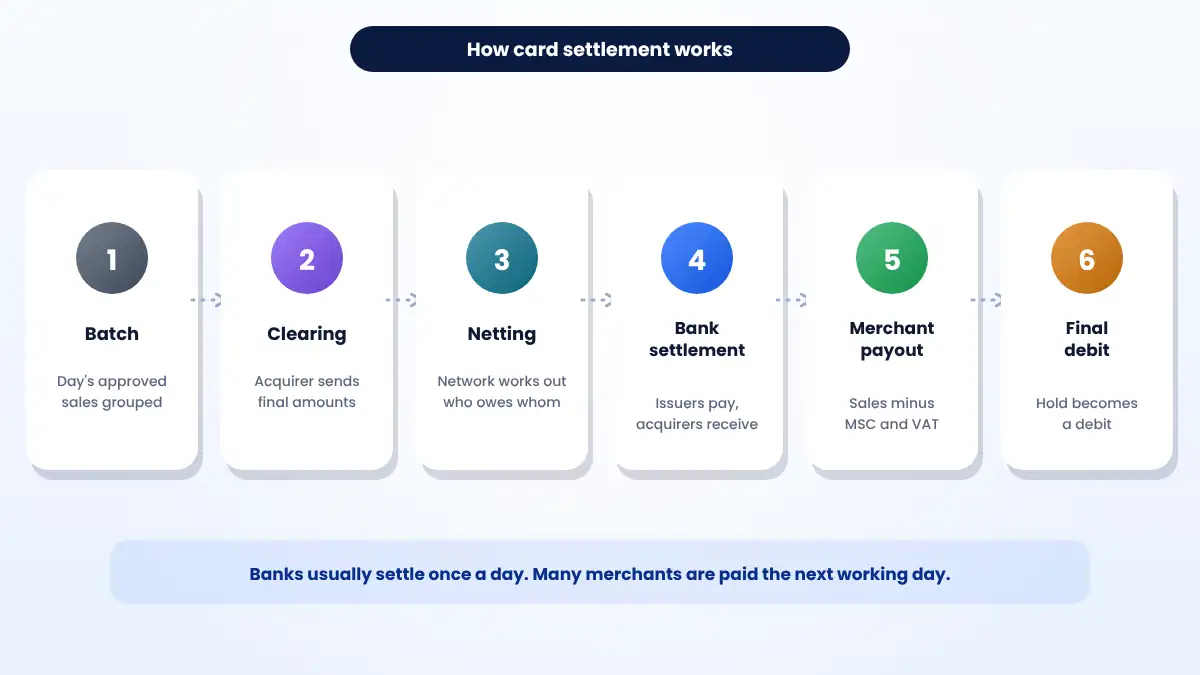
- The day’s payments are batched. POS terminals and checkout systems group the approved payments, often at the end of the business day.
- The acquirer sends a clearing file. The card acquirer or its payment processor sends the final amount of each payment to the card network or payment switch. This step is also called presentment.
- The network calculates net positions. Instead of moving money for every payment, the network adds up what each bank owes and is owed. It also deducts interchange and scheme fees.
- Banks settle. The issuing banks pay their net amounts, and the acquiring banks receive theirs, through settlement accounts at a settlement bank or the central bank.
- The acquirer pays the merchant. The acquirer credits the merchant’s account with the day’s sales, minus its charges.
- Your bank posts the final debit. At the same time, the card issuer turns the hold on your account into a final debit and releases any unused amount.
Net settlement: why banks do not pay for every payment
Thousands of card payments flow in both directions between banks every day. Moving money for each one would be slow and expensive. Therefore, card networks use net settlement: each bank pays or receives only the difference.
For example, suppose that on one day:
- Customers of Bank A spend ₦50 million at merchants that bank with Bank B.
- Customers of Bank B spend ₦30 million at merchants that bank with Bank A.
Without netting, the banks would make thousands of transfers worth ₦80 million in total. With netting, Bank A simply pays Bank B ₦20 million (before fees). As a result, banks need far less money moving through the system each day.
How long card settlement takes
Card networks usually settle between banks once a day. However, the time it takes for money to reach a merchant depends on several things:
- The provider’s payout schedule. Many acquirers and gateways in Nigeria pay merchants the next working day (often written as T+1, meaning the transaction day plus one). Some offer same-day or instant settlement, sometimes for an extra fee.
- Weekends and public holidays. Settlement runs on working days, so Friday’s sales may arrive on Monday.
- Cut-off times. A payment made after the daily cut-off joins the next day’s batch.
- Risk reviews. New merchants, unusual sales, or a high chargeback rate can lead a provider to hold funds for longer.
Meanwhile, the cardholder usually sees the final debit within a day or two. Our guide on how POS transactions work shows how this looks from the shop’s side.
Fees deducted during settlement
A merchant rarely receives the full amount of a sale. Several fees come out on the way:
- Interchange: paid by the acquirer to the issuing bank for each card payment. Its rate can depend on the merchant category code (MCC), which you can check with our MCC lookup.
- Scheme or switch fees: paid to the card network or switch for processing.
- Merchant service charge (MSC): what the acquirer charges the merchant. It usually covers the interchange and scheme fees plus the acquirer’s own margin.
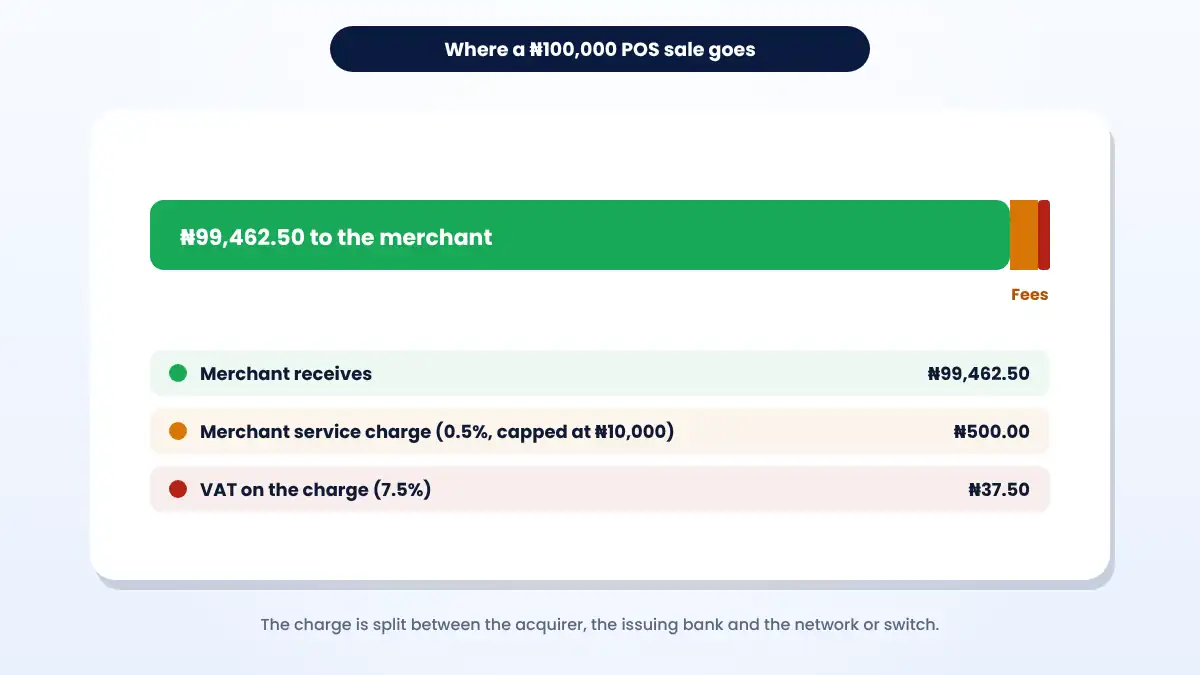
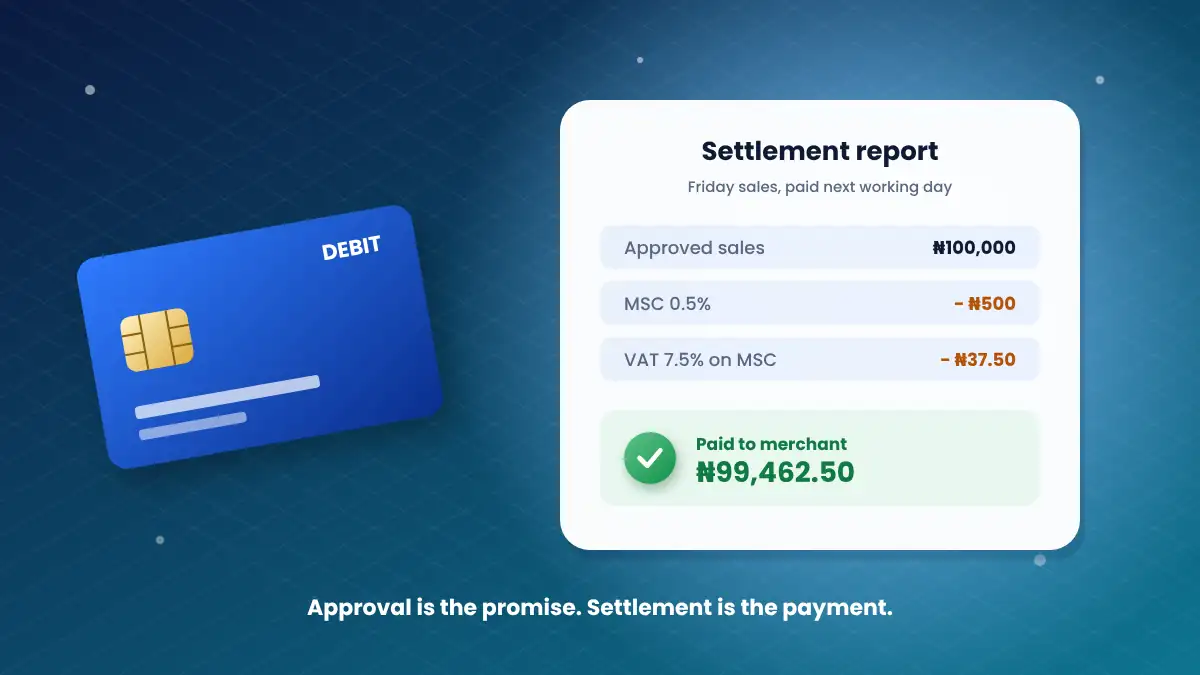
For local POS payments, the CBN Guide to Charges sets the MSC at 0.5% of the sale, capped at ₦10,000, and the merchant pays it. In addition, fees in Nigeria attract 7.5% VAT. Here is a worked example:
| Item | Amount |
|---|---|
| POS sale | ₦100,000 |
| MSC (0.5%) | ₦500 |
| VAT on MSC (7.5%) | ₦37.50 |
| Merchant receives | ₦99,462.50 |
Online payment providers often charge differently. To compare providers for your own sales, try our free payment processing fee calculator.
Why the settled amount can differ from the approved amount
Sometimes the amount that settles is not the amount you saw at the till. This is normal in several cases:
- Pre-authorisations. Hotels and car hire firms hold an estimate first and settle the final bill later.
- Tips and adjustments. In some countries, a restaurant adds the tip after approval.
- Partial reversals. If part of an order is cancelled, the merchant settles only the rest. Visa’s authorisation and reversal best practices ask merchants to reverse unused amounts within 24 hours.
- Currency conversion. For foreign payments, the exchange rate on the settlement day can differ from the rate shown at approval.
If a merchant never settles an approved payment, your bank eventually releases the hold, and the money returns to your available balance.
When settlement goes wrong
Most card payments settle without any problem. Still, a few issues come up often:
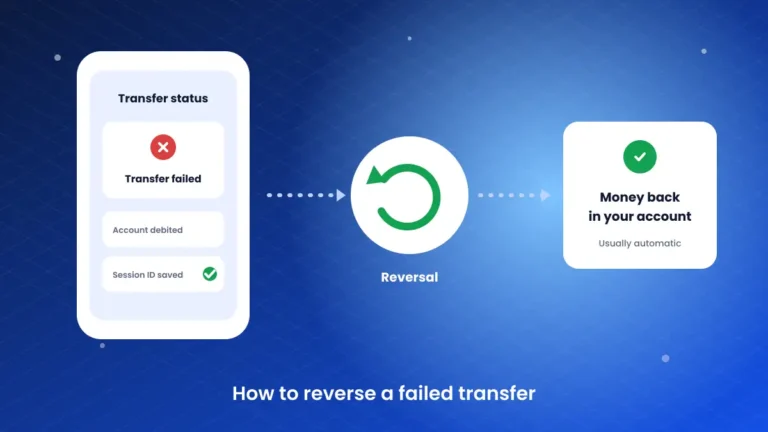
- You were debited, but the merchant did not receive the money. This usually means the payment failed after your bank placed a hold. CBN rules require reversals of failed or disputed POS and web payments within 72 hours, as our guide to failed POS transactions explains.
- A merchant’s payout is short or late. Fees, a weekend, a cut-off time, or a reversal may explain the gap. Check the provider’s settlement report line by line.
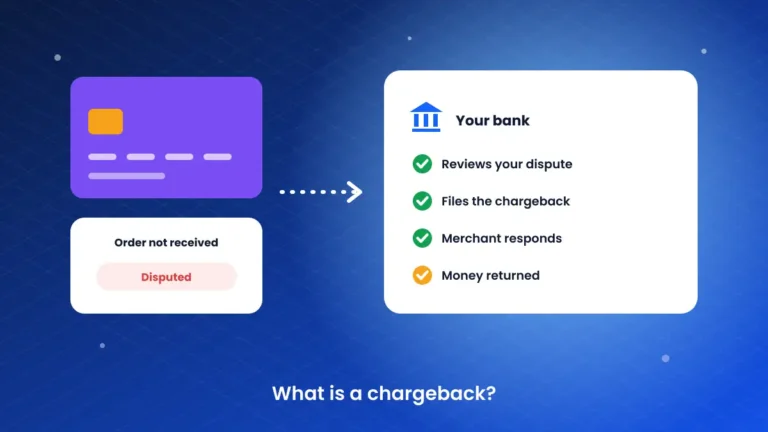
- A chargeback after settlement. A cardholder can dispute a payment after it settles. If the dispute succeeds, the acquirer takes the money back from the merchant. Our chargeback ratio calculator helps merchants track this risk.
For merchants: how to reconcile card settlement
Reconciliation means matching what you sold with what you received. Doing it daily catches problems early:
- Export your sales from the POS or checkout for the day.
- Download the settlement report from your acquirer or gateway.
- Match each payment by amount, date, and reference.
- Check that the fees match your agreed rate, including VAT.
- Follow up on missing or short payments within your provider’s dispute window.
Our free settlement reconciliation calculator does the arithmetic for you and shows any gap.
Frequently asked questions
Is card settlement the same as a bank transfer?
No. A bank transfer moves money between two accounts almost instantly, one payment at a time. Card settlement moves money for many card payments together, usually once a day, after netting.
Why did my account show a pending debit before the final debit?
The pending debit is the authorisation hold. It turns into a final debit when the merchant’s payment settles.
How long does card settlement take in Nigeria?
Banks usually settle with each other daily. Many merchants receive their money the next working day, but the exact timing depends on the provider, cut-off times, and public holidays.
Who pays the settlement fees?
The merchant pays the merchant service charge, plus VAT. Part of it goes to the acquirer, part to the issuing bank as interchange, and part to the network or switch.
Can a payment be reversed after settlement?
Yes, through a refund by the merchant or a chargeback by the cardholder’s bank. In both cases, the money flows back in a new transaction.
Key takeaways
- Card settlement is the stage where money actually moves after a card payment.
- Authorisation approves and holds the money, clearing sends the final details, and settlement pays the banks and the merchant.
- Card networks use net settlement, so each bank pays or receives only the difference.
- Many Nigerian merchants receive card payments the next working day, but providers differ.
- The merchant service charge and 7.5% VAT come out before the merchant is paid.
- Merchants should reconcile sales against settlement reports every day.