You have probably heard the word “blockchain” next to Bitcoin, crypto trading, or get-rich-quick promises. But the technology itself is much bigger than cryptocurrency. So, what is blockchain technology? This guide explains it in a simpler way, shows how a blockchain works step by step, compares it with a normal database, and looks at real uses beyond crypto, plus how to avoid the scams that borrow its name.
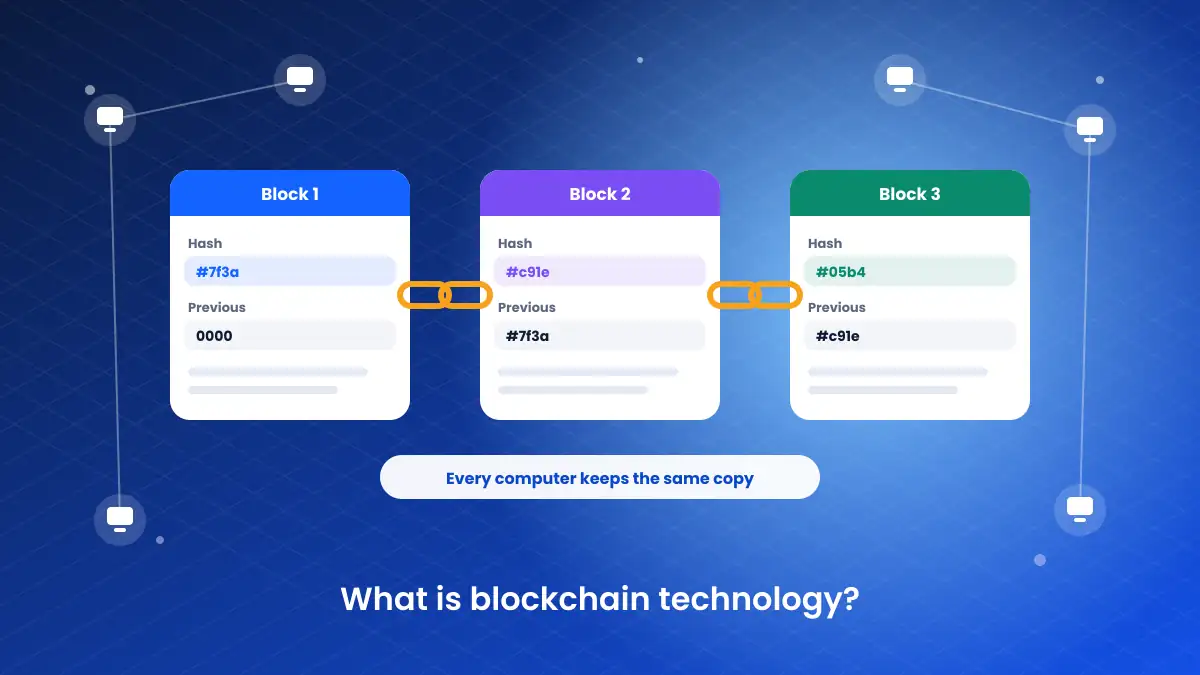
Quick answer: Blockchain technology is a way of recording information in a shared digital ledger that many computers keep at the same time. The system groups new records into “blocks” and links each block to the one before it with a unique code called a hash. Because every computer holds a copy, and changing one block would break the links after it, past records are very hard to alter in secret. Bitcoin was the first major use, but blockchains are also used for tracking goods, verifying certificates, and settling payments.
In this guide
- What is blockchain technology?
- How blockchain technology works
- Blockchain technology vs a traditional database
- Types of blockchains
- Uses of blockchain technology beyond cryptocurrency
- Blockchain and cryptocurrency
- Blockchain and crypto rules in Nigeria
- Benefits and limitations of blockchain
- How to avoid blockchain and crypto scams
- Frequently asked questions
- Key takeaways on what is blockchain technology
What is blockchain technology?
A blockchain is a type of digital record book, or ledger. Instead of one company keeping the only copy, many computers, called nodes, share the ledger. Each node holds the same records and checks new ones before adding them.
The US National Institute of Standards and Technology (NIST) puts it this way in its Blockchain Technology Overview: blockchains are tamper-evident and tamper-resistant digital ledgers, run in a distributed way and usually without a central authority such as a bank, company, or government.
To picture it, imagine a notebook that thousands of people have identical copies of. Whenever someone writes a new line, everyone checks it and adds it to their own copy. If one person later tries to rub out an old line, their notebook no longer matches the rest, so the change stands out at once.
How blockchain technology works
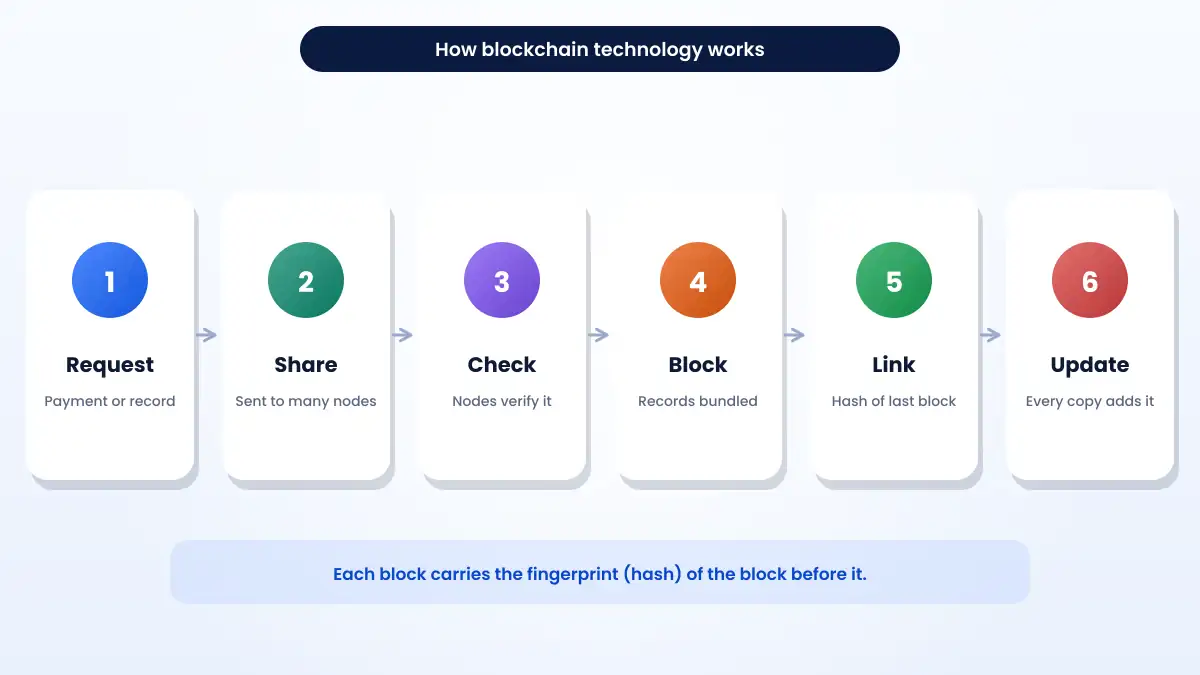
Here is what happens when someone adds a new record to a blockchain:
- Someone makes a request. For example, a person sends a payment or a company records that a shipment has left the warehouse.
- The network shares it. It passes the request to many nodes at once.
- Nodes check it. Each node confirms the request follows the rules, such as “the sender actually owns these funds”.
- Nodes build a block. They bundle valid requests together with a timestamp.
- The block joins the chain. Each block carries the hash of the block before it, which works like a digital fingerprint. As a result, the blocks form a chain.
- Every copy updates. Once the nodes agree- a step known as consensus- every copy of the ledger adds the new block.
Here are the main terms you will see:
| Term | What it means |
|---|---|
| Ledger | The full record of all transactions or entries |
| Block | A batch of records added at the same time |
| Hash | A unique code, like a fingerprint, worked out from a block’s contents |
| Node | Any computer that keeps a copy of the ledger |
| Consensus | The method nodes use to agree on which records are valid |
| Smart contract | A small program on a blockchain that runs automatically when set conditions are met |
| Wallet | An app that holds the keys you use to sign blockchain transactions |
Blockchain technology vs a traditional database
A blockchain is a special kind of database. However, it serves a different purpose. Our guide to what a database is explains the traditional side.
| Feature | Traditional database | Blockchain |
|---|---|---|
| Who controls it | One organisation | Shared across many nodes |
| Changing records | Admins can edit or delete | Very hard; you add new entries instead |
| Speed | Very fast | Slower, because nodes must agree |
| Trust | You trust the owner | Trust comes from the shared rules and copies |
| Cost | Usually cheaper to run | Often more expensive |
| Best for | Most business apps | Records shared by parties who do not fully trust each other |
In practice, most businesses do not need a blockchain. A normal database is faster and cheaper. Blockchain makes sense mainly when several organisations must share one record, and none of them should control it alone.
Types of blockchains
There are four main types:
- Public blockchains. Anyone can join, read the records, and take part. Bitcoin and Ethereum are well-known examples.
- Private blockchains. One organisation controls who can join. They suit internal record-keeping.
- Consortium blockchains. A group of organisations, such as several banks, run the network together.
- Hybrid blockchains. These mix private and public features, for example keeping data private but publishing proof that it has not changed.
Uses of blockchain technology beyond cryptocurrency
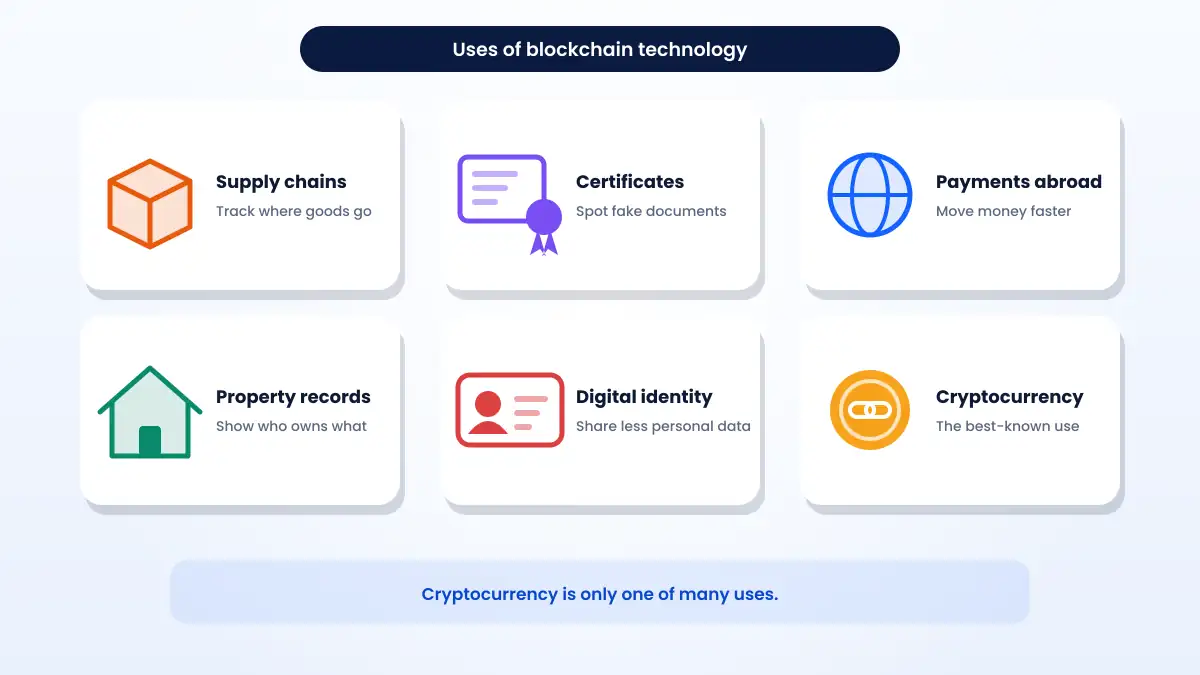
Cryptocurrency is only one use. Other examples include:
- Supply chains. Companies can track goods from farm or factory to shop, so buyers can check where a product came from.
- Certificates and records. Schools and training bodies can issue certificates that employers can verify online, which makes fake certificates easier to spot.
- Cross-border payments. Some services use blockchain to move money between countries faster than traditional routes. Some central bank digital currencies also use similar technology, as our guide to what a CBDC is explains.
- Land and property records. Several governments have tested blockchain registries to reduce disputes over who owns what.
- Digital identity. People could one day prove facts about themselves, such as their age, without sharing every personal detail.
- Smart contracts. For instance, an insurer could release a payout automatically when agreed conditions are met.
Blockchain and cryptocurrency
Blockchain and cryptocurrency go together, but they are not the same thing. A person or group using the name Satoshi Nakamoto described Bitcoin in a 2008 paper, and its network launched in 2009. Bitcoin uses a public blockchain to record who owns which coins.
Since then, thousands of other cryptocurrencies have appeared. Meanwhile, many companies use blockchain without any coins at all. In short, cryptocurrency is one product built on blockchain, much as email is one product built on the internet. Similarly, stablecoin payments use blockchains to move digital dollars across borders. In turn, blockchain is just one part of fintech, the wider world of financial technology.
Blockchain and crypto rules in Nigeria
The rules in Nigeria have changed in recent years:
- In February 2021, the Central Bank of Nigeria (CBN) told banks to close accounts linked to crypto trading.
- On 22 December 2023, the CBN issued new guidelines that allow banks to serve virtual asset service providers. However, banks themselves are still barred from holding or trading cryptocurrencies.
- On 25 March 2025, President Tinubu signed the Investments and Securities Act, 2025, which recognises digital assets as securities and gives the Securities and Exchange Commission (SEC) power to regulate them.
Rules can change again, so check the latest position with the CBN and SEC before you use any crypto service.
Benefits and limitations of blockchain
| Benefits | Limitations |
|---|---|
| Records are very hard to change in secret | Slower than a normal database |
| No single owner controls the data | Can be costly to run |
| Everyone with access sees the same record | Mistakes are hard to reverse |
| Works across organisations and borders | Some networks use a lot of energy |
| Smart contracts can automate agreements | Rules and regulations are still developing |
Also remember that a blockchain only protects what people record on it. If someone enters false information, the blockchain will store that false information faithfully.
How to avoid blockchain and crypto scams
Scammers often use words like “blockchain”, “AI trading” and “crypto” to sound modern and safe. For example, the CBEX platform, which promised a 100% return in 30 days, collapsed in April 2025, and many users could not withdraw their money. At the time, the SEC warned that any investment platform not registered with it is illegal.
Watch for these warning signs:
- Guaranteed or very high returns, such as doubling your money in weeks.
- Pressure to recruit others before you can withdraw.
- No SEC registration, or vague answers about who runs the company.
- Requests for your wallet recovery phrase or bank login. No genuine service needs them.
- Celebrity or influencer promotion in place of clear information.
Our guides on how to recognise a phishing message and how to protect your bank account online explain more ways to stay safe.
Frequently asked questions
Is blockchain the same as Bitcoin?
No. Blockchain is the technology, while Bitcoin is one cryptocurrency that uses it. Many blockchains have nothing to do with Bitcoin.
Can a blockchain be hacked?
Changing old records on a large public blockchain is extremely hard. However, attackers can break into the apps, exchanges, and wallets around it, or trick people into giving away their keys.
Is cryptocurrency legal in Nigeria?
The Investments and Securities Act, 2025 treats digital assets as securities and puts them under SEC regulation. Use only platforms registered with the SEC, and check the latest rules first.
Does my business need blockchain?
Probably not. Most small businesses are better served by a normal database or cloud app. Blockchain helps mainly when several parties must share a record that none of them controls.
Who controls a blockchain?
On a public blockchain, no single person or company does; the network follows shared rules. On a private blockchain, the organisation that runs it decides who can join.
Key takeaways on what is blockchain technology
- Blockchain is a shared digital ledger that many computers keep and check together.
- It groups records into blocks linked by hashes, so past entries are very hard to change in secret.
- It powers cryptocurrency, but it is also used for supply chains, certificates, and payments.
- Most businesses do not need it, because a normal database is faster and cheaper.
- In Nigeria, the SEC regulates digital assets, so avoid unregistered platforms and any promise of guaranteed returns.
Want more simple explanations? Browse all our Digital Explained guides, or learn what cloud computing is.