Every time you save your card on a shopping site, that site could keep your 16-digit card number. If hackers break in, they may steal it, and then they can use it anywhere. Network tokenisation fixes this problem, because it replaces your real card number with a stand-in that is useless to thieves. This guide explains what network tokenisation is, how it works, why the card schemes – Visa, Mastercard, Verve, and others are pushing it, and what it means for you.
Quick answer: Network tokenisation replaces your card number with a unique code, called a token, that the card network creates for one merchant or one device. If thieves steal the token, they cannot use it anywhere else. As a result, fraud falls, banks approve more payments, and saved cards keep working even after your bank replaces your card.
In this guide
- What is network tokenisation?
- How network tokenisation works
- Network tokens vs other tokens
- Why network tokenisation matters
- Why your card number is being replaced
- Network tokenisation in Nigeria
- What network tokenisation means for you
- What network tokenisation means for businesses
- Frequently asked questions
- Key takeaways on network tokenisation
What is network tokenisation?
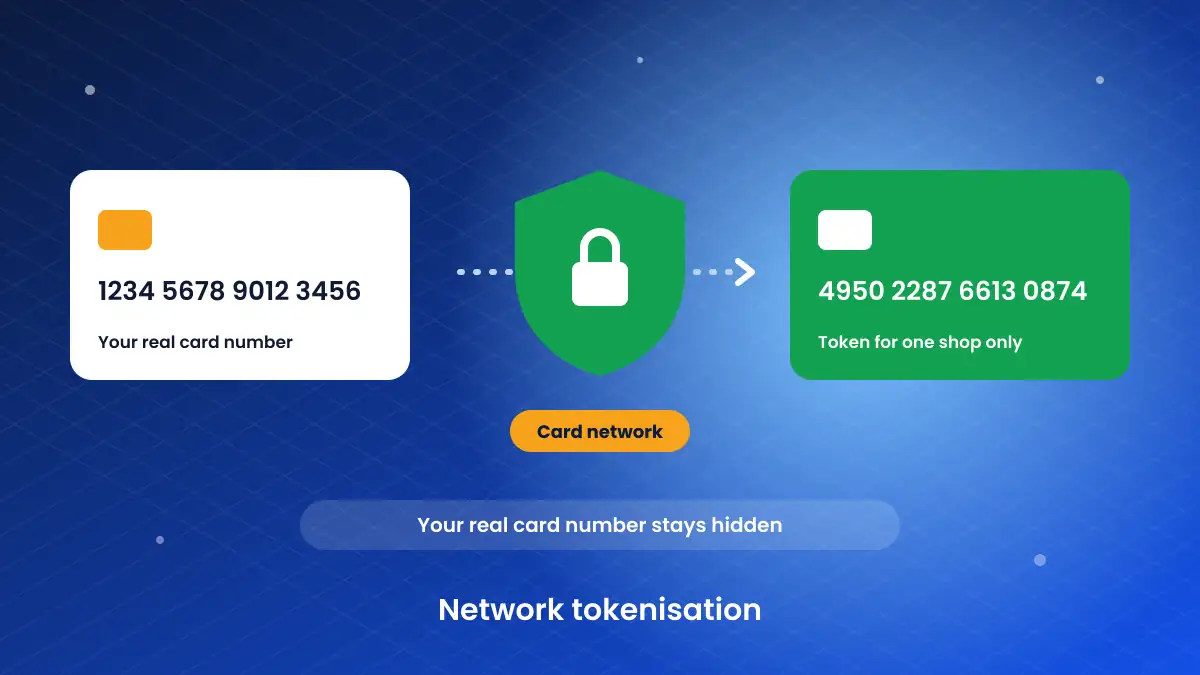
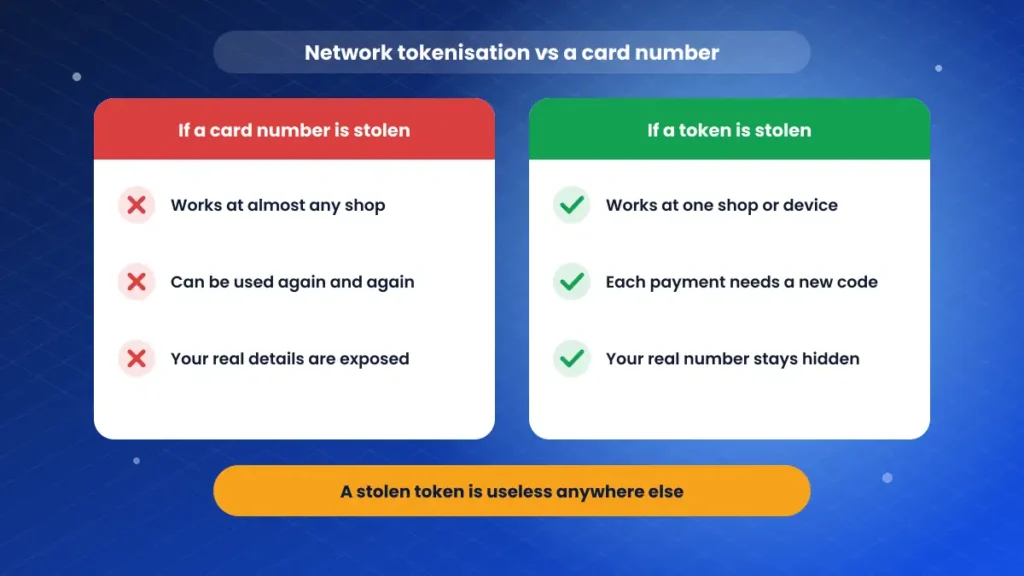
Network tokenisation is a security method in which the card network, such as Visa, Mastercard, or Verve, swaps your card number for a token. The token looks like a card number, but it only works in one place, such as one online shop, one phone, or one app.
Banks call your real card number the primary account number, or PAN. With network tokenisation, the merchant stores the token instead of the PAN. Therefore, a data breach at that merchant exposes tokens, not your real card details.
In short, the token stands in for your card, but only where you have chosen to use it.
How network tokenisation works
Behind the scenes, a tokenised payment follows five steps:
- You save your card. For example, you add it to a shopping site, an app, or a phone wallet.
- The network creates a token. Next, the card network, with your bank’s approval, issues a token tied to that merchant or device.
- The merchant stores the token. In other words, the shop never keeps your real card number.
- Each payment gets a one-time code. Then, every time you pay, the system creates a unique code called a cryptogram, so nobody can replay a copied payment.
- The network swaps the token back. Finally, the network turns the token into your real card number for your bank, which approves or declines the payment as usual.
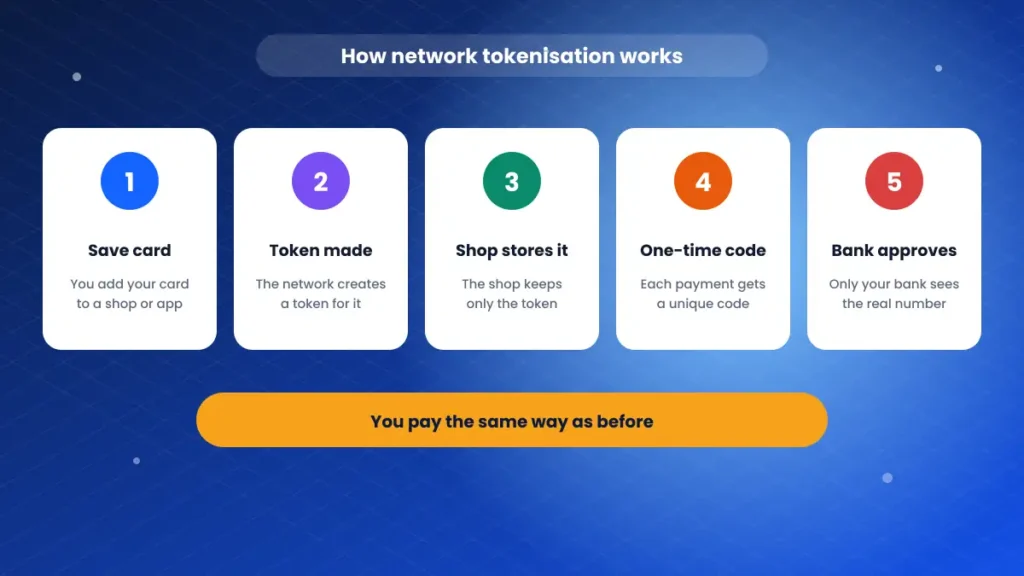
Importantly, you do not need to do anything new. Your bank and the merchant handle the setup, so you pay the same way as before.
Network tokens vs other tokens
Not every token is the same, so it helps to know the difference:
| Type | Who creates it | Where it works |
|---|---|---|
| Network token | The card network, such as Visa, Mastercard, or Verve | One merchant or one device, across any payment provider |
| Payment provider token | A payment gateway or processor | Only with that provider |
| Device token | The card network, through a phone wallet | Only on that phone or watch |
A payment provider token protects the merchant’s database, but the provider still holds your real card number. By contrast, the card network and your bank both recognise a network token, so it carries extra benefits, such as automatic updates. Our guide to what a payment gateway is explains where payment providers fit in.
Similarly, the phone wallets in our guide to what a digital wallet is use device tokens, so your phone never shares your real card number at the till.
Why network tokenisation matters
Network tokenisation brings four main benefits, for both shoppers and businesses:
- Less fraud. Stolen tokens are useless elsewhere. Visa says tokenisation can cut fraud by up to 60%.
- More approved payments. Banks trust token payments more, so fewer genuine payments fail. For instance, Visa reports an 8% rise in approval rates across Europe compared with plain card numbers.
- Saved cards that keep working. When your bank replaces an expired or lost card, the network can update the token automatically, so subscriptions do not fail.
- Faster checkout. Because the card is already saved securely, you can pay in one or two taps.
Our guide to why card transactions get declined explains other reasons a payment may fail.
Why your card number is being replaced
The card networks now want tokens to replace card numbers almost everywhere online:
| Year | Milestone |
|---|---|
| 2014 | Visa launches its token service |
| 2022 | Visa tokens outnumber physical Visa cards |
| June 2024 | Visa passes 10 billion tokens, used in 29% of its transactions |
| March 2025 | Mastercard aims to end manual card entry online in all markets by 2030 |
| March 2026 | Verve unveils its tokenisation solution in Lagos |
For example, Mastercard said in 2025 that more than 30% of its transactions worldwide were already tokenised, and it aims for 100% tokenisation by 2030. Likewise, Juniper Research forecasts that network tokens will secure 2.4 trillion transactions between 2026 and 2030.
Tokens also matter for new ways to pay. For instance, AI shopping assistants use them to pay without seeing your card number, as our guide to agentic commerce explains.
Network tokenisation in Nigeria
Nigeria is joining this shift. In March 2026, Verve, the card scheme owned by Interswitch, unveiled a tokenisation solution that replaces card details with device-bound tokens. It also creates a unique code for each payment, and it works across banking apps, online shops, and contactless terminals.
Then, in October 2026, Interswitch, Verve, and banks including GTBank, Wema Bank, and Providus promoted tokenised payments to cut fraud risk. According to Verve, a tokenised phone payment could take no more than two steps, confirmed with a fingerprint. Moreover, the banks said customers can pay with phones, rings, and watches at payment terminals.
So, check with your bank to see whether you can add your card to its app or a phone wallet. Our guide to contactless payment explains how tap-to-pay works.
What network tokenisation means for you
For most shoppers, network tokenisation works quietly in the background. Even so, a few habits help you get the most from it:
- Save cards only on trusted sites. Tokens protect saved cards, but you should still shop with businesses you know.
- Use phone wallets or your bank’s app. These use device tokens, so your card number stays hidden.
- Review saved cards. Also, remove cards from shops and apps you no longer use.
- Keep your phone locked. Use a PIN, fingerprint, or face unlock, because the phone holds your payment tokens.
- Watch for scams. Still, tokens cannot stop you from being tricked into sending money, so read our guide to deepfake scams.
What network tokenisation means for businesses
For online businesses, network tokenisation can mean fewer failed payments, fewer chargebacks, and less sensitive data to protect. Mastercard, for example, says food delivery company JustEatTakeaway.com saw chargebacks fall to half the level of manual card entry. Ask your payment provider whether it supports network tokens, and see our guide on how to accept online payments.
Frequently asked questions
Do I need to do anything to use network tokenisation?
No. Your bank, the card network, and the merchant set it up. In fact, you keep paying exactly as before.
Is a token the same as my card number?
No. A token looks similar, but it works only for one merchant or device. Therefore, it is useless if stolen.
Will my subscriptions stop when I get a new card?
Often, they will not. If the merchant uses network tokens, the network can update the token automatically when your bank replaces your card.
Does network tokenisation stop all fraud?
No. It protects your card details, but it cannot stop scams that trick you into approving a payment. For that reason, stay alert to suspicious calls and messages.
Is network tokenisation the same as encryption?
No. Encryption scrambles data, and anyone with the right key can unlock it. Tokenisation, on the other hand, replaces the data with a stand-in that has no value on its own.
Key takeaways on network tokenisation
- Network tokenisation replaces your card number with a token that works only for one merchant or device.
- A stolen token is useless elsewhere, so fraud falls and banks approve more genuine payments.
- Saved cards can update automatically when your bank replaces your card.
- Visa, Mastercard, and Verve are all pushing tokens, and Mastercard aims for 100% tokenisation by 2030.
- Tokens protect your card details, but you still need to watch for scams.
Want to understand the steps behind every card payment? Read our guide to what card authorisation is, or browse all our digital payments guides.