You tap Pay, and the screen says “Declined”. It is frustrating, especially when you know there is money in your account. This guide explains what a card declined message means, who actually decides, what each common reason means, and what to do next, whether you are paying online, at a POS terminal, at an ATM, or abroad.
Quick answer: Your card is refused when one party in the payment chain says no, and most of the time that party is your own bank (the card issuer). The most common reasons are not enough money, a wrong PIN, an expired card, a card that is not enabled for online or international use, a spending limit, or a fraud check. Read the message or code, fix the cause, and only then try again, because repeated attempts can lock your card.
In this guide
- Why was my card declined?
- The most common reasons banks decline a card
- Why banks decline a card online
- Card declined at a POS terminal or ATM
- Declined abroad, or a foreign card declined in Nigeria
- Soft vs hard declines: should you try again?
- Declined, but money was taken?
- How to avoid a declined card
- For merchants: reducing declines
- Frequently asked questions
- Key takeaways
Why was my card declined?
A card payment passes through several hands before you see “Approved” or “Declined”. Any of them can stop it, but they do not all stop it for the same reasons:
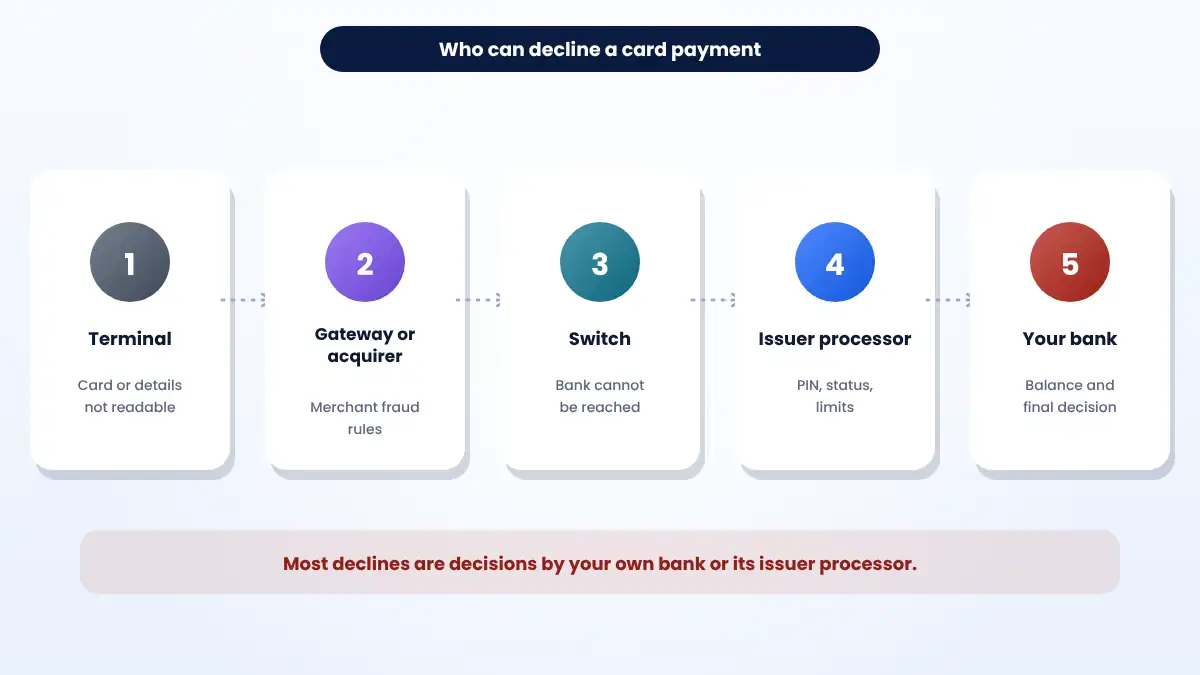
- The terminal or checkout page. It can reject a card it cannot read, a chip error, or a wrong expiry date before it sends anything.
- The payment gateway or acquirer. The merchant’s provider can block a payment if its own fraud rules do not like.
- The payment switch. A payment switch routes the request. If it cannot reach your bank, you may see “issuer or switch inoperative”.
- The issuer processor. Many Nigerian banks use a processor to check the PIN, the card status, and the limits on their behalf.
- Your bank. Finally, the card issuer checks your balance and decides.
In practice, most declines are issuer decisions. Therefore, the fastest fix usually starts with your own bank app, not the shop.
The most common reasons banks decline a card
Terminals and banks often show a two-digit response code. Here is what the common ones mean and what you can do. For any other code, look it up in our free payment response code decoder.
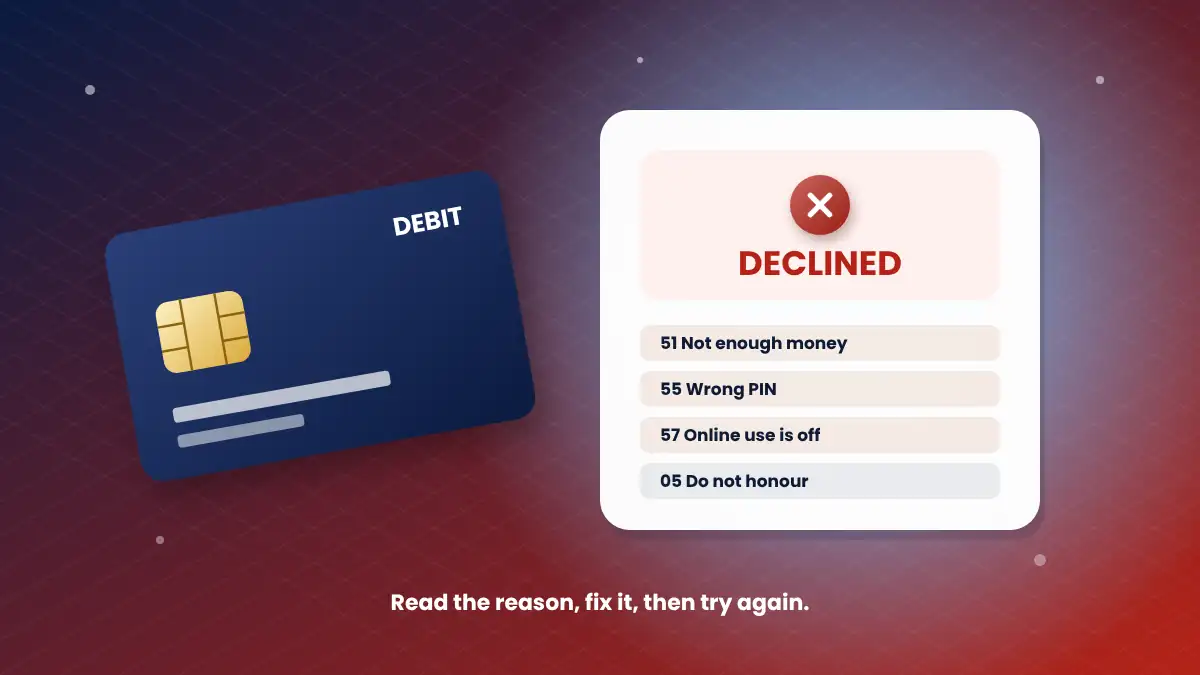
| Reason | Code you may see | What to do |
|---|---|---|
| Not enough money | 51 | Check your balance, including fees and VAT |
| Wrong PIN | 55 | Try once more, carefully |
| Too many wrong PINs | 75 | Stop, and ask your bank to reset the PIN |
| Expired card | 54 | Use your new card or request one |
| Not allowed for this card | 57 | Reach out to the issuer to allow the transaction |
| Over your limit | 61 or 65 | Wait, or raise the limit in your app |
| Restricted card | 62 | Call your bank |
| Suspected fraud | 59 | Confirm the payment with your bank |
| Do not honour | 05 | A general refusal, so call your bank |
| Wrong card number | 14 | Retype the number |
| Bank or switch down | 91 or 96 | Wait a few minutes, then try again |
Note that “do not honour” (05) is deliberately vague. Banks use it when they do not want to give the exact reason, often for a fraud or risk rule. Only your bank can tell you why. Our guide to AI fraud detection explains how these checks work.
Why banks decline a card online
Online payments fail for some extra reasons, because the card is not in your hand and the checks are different:
- The OTP or 3-D Secure check failed. Nigerian banks usually ask for a one-time code for online card payments. A wrong, late, or missing code means the bank declines the payment. Code 1A means the bank wants that extra check.
- Wrong details. A wrong card number, expiry date, or CVV is one of the most common causes. Check every digit.
- Online use is off. Many banking apps let you turn off web payments. If the setting is off, the bank refuses the payment, often with code 57.
- International limits on naira cards. Paying a foreign website in dollars uses your card’s international limit. For example, banks raised these limits in 2026. Legit.ng reported in September 2026 that GTBank allowed up to $40,000 a quarter and FirstBank $10,000 a quarter on naira cards. Limits differ by bank and change often, so check yours. A virtual dollar card is another option for foreign subscriptions.
- The merchant’s own rules. Some sites block cards from certain countries or flag a sudden large order.
If an online payment keeps failing, try our guide on how a payment gateway works to see where your card details go.
Card declined at a POS terminal or ATM
At a shop or an ATM, the usual causes are a chip read error, a wrong PIN, or a daily limit. For example, CBN rules cap contactless taps in Nigeria at ₦15,000 per transaction, so a bigger tap needs a PIN, as our guide to contactless payment explains. Likewise, a worn EMV chip card can fail to read.
For a full list of POS error messages and fixes, see our guide on why POS transactions fail.
Declined abroad, or a foreign card declined in Nigeria
Abroad, your bank may refuse a naira card because international use is off, you have reached your limit, or the foreign merchant’s bank flags an unusual payment. Before you travel, turn on international use and check your limits.
Nigerian terminals also used to decline foreign cards often. In December 2025, the CBN told banks and acquirers to make sure foreign cards work at ATMs, POS terminals and online, and to adjust fraud systems to “minimise false declines”, as The Guardian reported.
Soft vs hard declines: should you try again?
Not every decline is final. The payments industry splits them into two kinds:
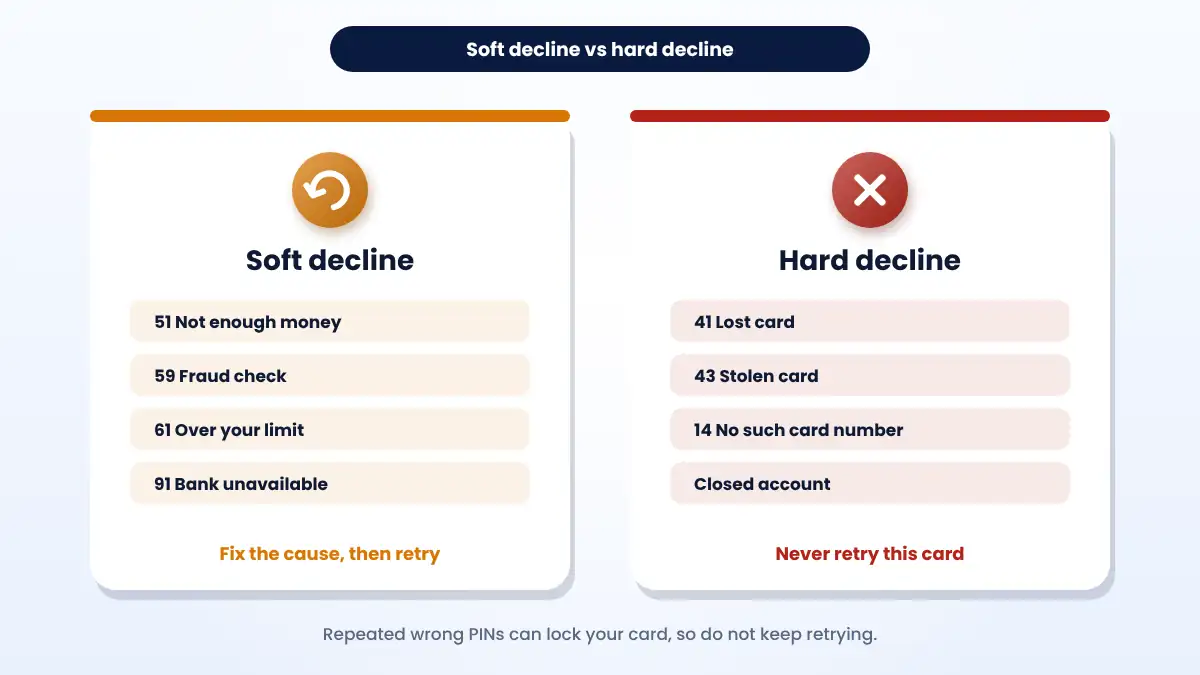
- Soft declines are temporary. Not enough money (51), a fraud check (59), or a bank that is down (91) can all change. Fix the cause, then try again.
- Hard declines are final for that card. The bank will never approve a lost or stolen card (41 or 43), a closed account, or a card number that does not exist (14), however often you try.
Card schemes also limit how often merchants may retry. For example, Visa’s rule allows no reattempts after a “never retry” decline and at most 15 reattempts in 30 days for the others, with fees above that, according to Payway.
As a cardholder, do not keep pressing Pay. Each wrong PIN counts, and three can lock your card. In addition, repeated tries can leave several holds on your account. Our guide on card authorisation holds explains how they are released.
Declined, but money was taken?
Sometimes the screen says Declined, yet your bank sends a debit alert. Usually, this is a temporary hold or a reversal that has not reached you yet. Do not pay again until you know what happened.
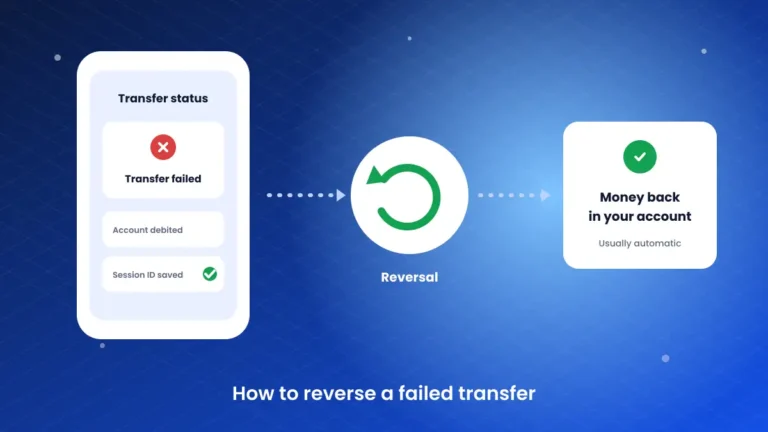
First, check whether the merchant actually received the money. If they did not, keep the receipt or the reference and ask your bank to reverse it. Our guide on failed POS transactions lists the CBN reversal timelines and how to escalate a complaint.
How to avoid a declined card
A few habits prevent most declines:
- Keep a small buffer. Leave room for fees, VAT, and exchange-rate changes on dollar payments.
- Check your card settings. Turn on the channels you need, such as web, POS, or international use, in your banking app.
- Know your limits. Daily and international limits differ by bank and card type.
- Update your details. Make sure your phone number is current so OTPs and alerts reach you.
- Renew early. Request a new card a few weeks before it expires.
- Tell your bank before big or foreign payments. This helps avoid a fraud block.
For merchants: reducing declines
Every decline is a lost sale, so it pays to handle them well. Show the customer a clear message instead of a code. Never retry a hard decline, and space out retries of soft declines. Also, support 3-D Secure so the bank trusts the payment, and check your gateway reports for patterns, such as one bank declining far more than others. Saving cards as network tokens can also lift approval rates, as our guide to network tokenisation explains. If you need to compare providers, our payment gateway vs payment processor guide explains who does what.
Frequently asked questions
Why does my bank decline my card when I have money?
The balance is only one check. Your bank may block the card for online or international use; it may be over a daily limit or expired, or a fraud rule may have caught it. Your banking app usually shows the reason.
What does “do not honour” mean?
It is code 05, a general refusal from your bank. The bank has declined the payment but has not said why, so only the bank can explain it.
Can I use my card again after a decline?
Yes, unless it was a hard decline such as a lost, stolen, or closed card. Fix the cause first, then try again.
Why do foreign websites decline my naira card?
Usually, international use is off, or you have used up your international limit. Check both in your banking app.
Does a declined card affect my credit score?
No. A decline is between you, the merchant, and your bank. It is not reported to a credit bureau.
Key takeaways
- Most declined card payments are decisions by your own bank or its issuer processor.
- The response code tells you why: 51 means not enough money, 55 a wrong PIN, 57 a blocked channel, and 05 a general refusal.
- Online declines often come from OTP failures, wrong details, or international limits.
- Soft declines can succeed later, while hard declines never will.
- Do not keep retrying: repeated wrong PINs can lock your card.
- If your bank debited you for a declined payment, ask it for a reversal.