Look at the front of your debit card, and you will see a small gold or silver square. That square is a computer chip, and it is the reason your card is an EMV chip card. This guide explains what an EMV chip card is, what the chip actually does when you pay, why it is much harder to copy than the old magnetic stripe, and what it cannot protect you from.
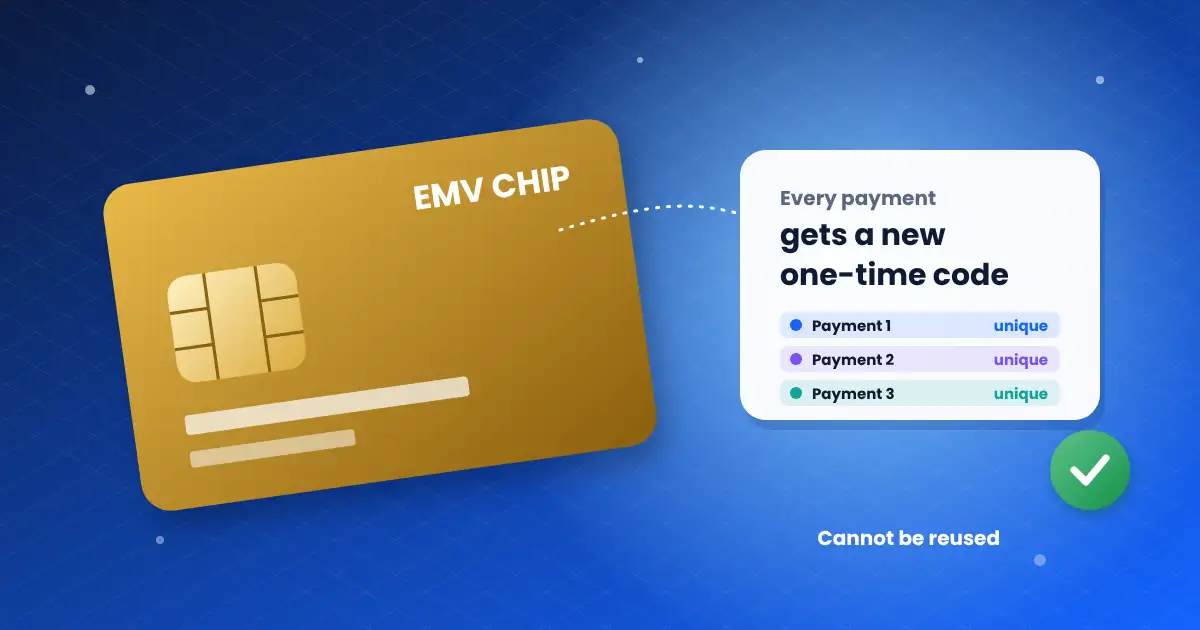
Quick answer: An EMV chip card is a payment card with a small computer chip that follows the global EMV standard. When you pay, the chip creates a one-time code, called a cryptogram, that your bank checks before it approves the payment. Because the code changes every time and the chip’s secret key never leaves the card, criminals cannot copy a chip the way they copied magnetic stripes. In Nigeria, the CBN told banks to stop issuing new magnetic stripe cards from April 2009.
In this guide
- What is an EMV chip card?
- What is inside the chip?
- How an EMV chip card works when you pay
- EMV chip card vs magnetic stripe
- Why EMV chip cards are hard to clone
- What a chip card does not protect you from
- EMV chip cards in Nigeria
- What to do if your card’s chip stops working
- How to use your EMV chip card safely
- Frequently asked questions
- Key takeaways
What is an EMV chip card?
An EMV chip card is a debit, credit, or prepaid card that carries a microchip built to the EMV standard. EMV stands for Europay, Mastercard and Visa, the three companies that wrote the first version of the rules. Today, EMVCo, a body owned by the major card schemes, manages the standard.
The chip is not just a storage space. It is a tiny computer with its own processor, memory, and secret keys. In other words, it can run checks and do maths, which a magnetic stripe cannot do.
Most Verve, Mastercard and Visa cards issued in Nigeria are EMV chip cards. Many of them are also contactless, which means the same chip can talk to a terminal by radio when you tap. Our guide to contactless payment explains how tapping works.
What is inside the chip?
Each EMV chip card carries a small set of data and keys that the bank loads during card issuance:
- The payment application: the program that runs the payment steps, identified by an AID such as Visa or Verve.
- Card details: the card number, expiry date, and a copy of the stripe data, with a different security value.
- Secret keys: unique keys that only your card and your bank’s security systems know. The chip never sends these keys out.
- Counters: a transaction counter that goes up by one with every payment, plus the number of PIN tries left.
- Rules from your bank: for example, which ways of checking your identity the card accepts and where it can be used.
You never see this data, but every payment you make uses it.
How an EMV chip card works when you pay
When you insert your card at a POS terminal or ATM, the terminal and the chip run a short conversation. Here is what happens, in simple steps:
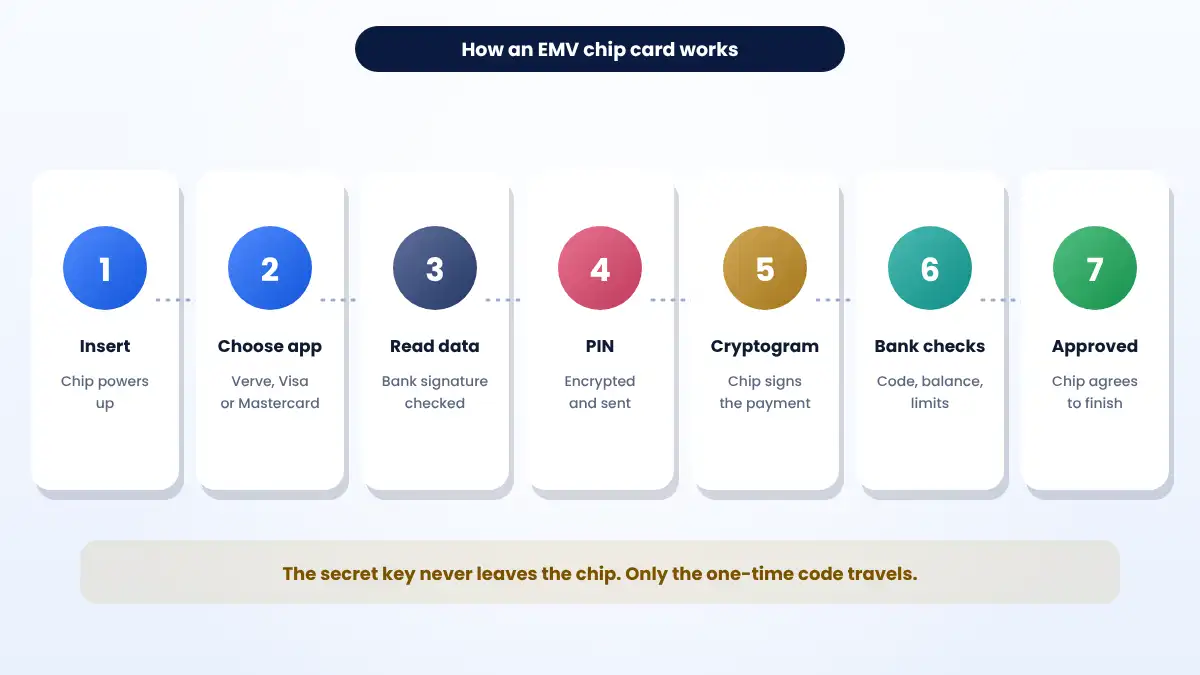
- You insert the card. The terminal powers up the chip through the gold contacts.
- They agree on the app. The terminal picks the payment application, for example, Verve or Visa.
- The terminal reads the card data. It also checks that your bank signed the data.
- You enter your PIN. Most Nigerian banks check the PIN online, so the terminal encrypts it and sends it to them.
- The chip creates a cryptogram. It signs the amount, date, a random number, and other details with its secret key. This code is called an ARQC.
- Your bank checks the code. The request travels through a payment switch to your bank, which recalculates the code and checks your balance.
- The bank replies, and the chip agrees. The card checks the bank’s reply and gives its final approval.
All of this usually takes two or three seconds. Moreover, you can find each technical term above in our free EMV glossary, with its tag and a plain-English definition.
EMV chip card vs magnetic stripe
Before chips, cards relied only on the magnetic stripe on the back. The stripe holds the same data every time, so anyone who reads it once can copy it. The chip works differently:
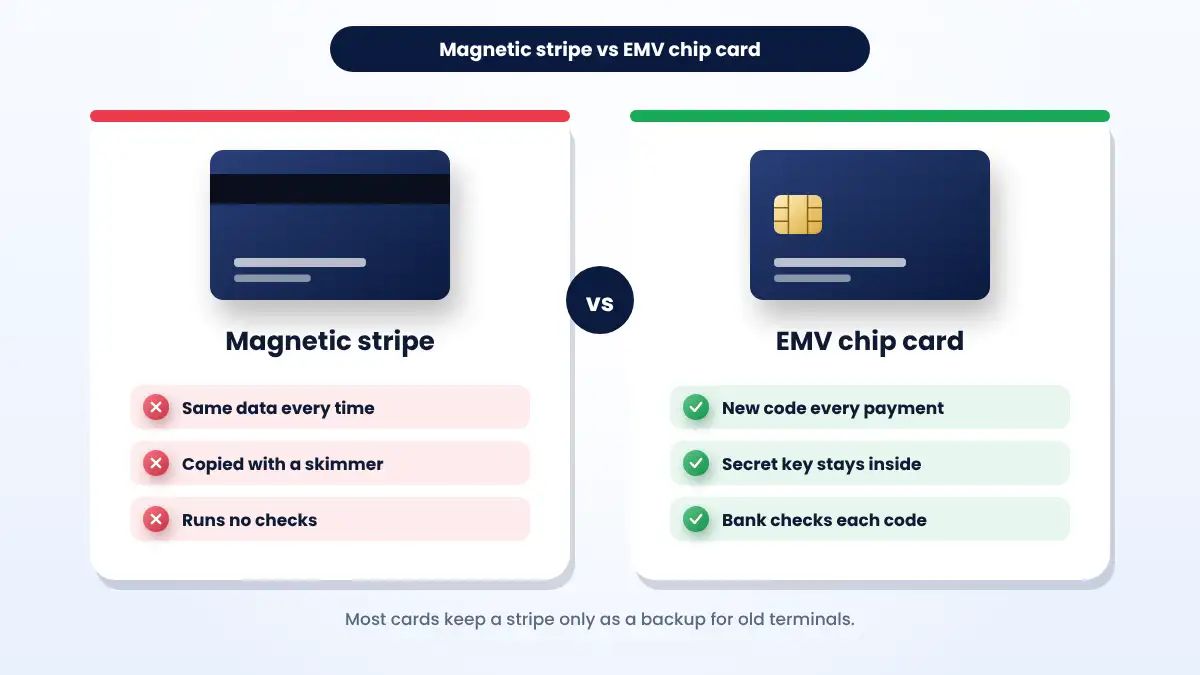
| Feature | Magnetic stripe | EMV chip card |
|---|---|---|
| What it holds | Fixed card data | Data, secret keys, and a small program |
| Code for each payment | Same data every time | A new cryptogram every time |
| Can it be copied? | Yes, with a cheap skimmer | Not in practice, because the key never leaves the chip |
| Checks it can run | None | PIN tries, limits, bank’s signature |
| Proof for the bank | Weak | Strong, because the bank checks the code |
| Still used for | Backup at old terminals | Almost every in-person payment |
Most cards still carry a stripe so that they work at older terminals abroad. In Nigeria, magstripe transactions are declined by default by virtually all the issuer processors by CBN rule. A card’s service code tells a terminal that the card has a chip, so the terminal should ask for the chip first.
Why EMV chip cards are hard to clone
Card cloning used to be common, because a skimmer at an ATM could copy a stripe in seconds. An EMV chip card blocks this in three ways:
- The secret key stays inside. The chip uses its key to sign payments but never sends the key to the terminal, so there is nothing to copy.
- Every code is single-use. Each cryptogram includes the amount, a random number, and the transaction counter. Therefore, a copied code is useless for the next payment.
- Stripe data from the chip does not work. The chip’s copy of the stripe uses a different security value. As a result, data stolen from a chip payment fails if a criminal writes it onto a fake stripe card.
In addition, the bank can see if a card’s counter jumps or repeats, which is a sign of fraud. This is why EMV is now the global norm: EMVCo reports that 97% of card-present transactions worldwide used EMV chips in the twelve months to the fourth quarter of 2025, according to its deployment statistics.
What a chip card does not protect you from
An EMV chip card protects in-person payments very well. However, it cannot stop every kind of fraud:
- Online payments: when you shop online, the chip is not used. Instead, the website asks for your card number, expiry date, and CVV, so an OTP and good habits matter more.
- Tricks and scams: if someone convinces you to share your PIN, OTP, or card details, the chip cannot help. NIBSS data reported by ITEdge News names social engineering as the most common fraud technique in 2025.
- Shoulder surfing: a stolen card plus a PIN someone saw you type can still be used.
- Fallback to the stripe: if a terminal claims it cannot read the chip and swipes instead, the payment is weaker. Many banks decline these swipes for this reason.
For everyday protection, follow our guide on how to protect your bank account online, and learn how to recognise a phishing message.
EMV chip cards in Nigeria
Nigeria moved to chip cards early compared with many countries. In a circular dated 27 February 2009, the CBN told all banks and card issuers to stop issuing new magnetic stripe cards from 1 April 2009. Banks then withdrew old stripe cards as they expired.
The move followed earlier delays. For example, SecureIDNews reported in July 2009 that the deadline had already been extended four times. Since then, chip and PIN has become the normal way to pay at POS terminals and ATMs in Nigeria.
Today, most Nigerian banks also check chip payments online rather than letting the chip approve them offline. As a result, almost every chip payment you make goes to your bank for a decision, which our guide to how POS transactions work explains step by step.
What to do if your card’s chip stops working
A chip can stop working if the card bends, gets wet, or wears out. Signs include “Card read error”, “Chip error”, or a terminal that keeps asking you to insert the card again. Here is what to do:
- Clean and retry. Wipe the gold contacts gently with a soft, dry cloth, and then insert the card fully.
- Try another terminal. One faulty reader is common, so a second try often works.
- Do not let the cashier swipe repeatedly. A stripe swipe on a chip card is often declined, and repeated tries can lock the card.
- Request a replacement. If the chip fails at several terminals, ask your bank for a new card. Most banks let you do this in their app.
If a payment fails but you are debited, keep the receipt and follow the steps in our guide to failed POS transactions.
How to use your EMV chip card safely
A few habits make your chip card even safer:
- Insert, do not swipe. Always use the chip, or tap, when the terminal allows it.
- Cover your PIN. Shield the keypad with your hand, even when no one seems to be watching.
- Keep the card in sight. Do not let a cashier take it away from you.
- Turn on alerts. Then you will spot an unknown payment at once.
- Set limits. Use your banking app to set daily limits and to switch off online or foreign use if you do not need it.
- Block a lost card fast. Call your bank or block the card in the app straight away.
Frequently asked questions
What does EMV stand for?
EMV stands for Europay, Mastercard and Visa, the companies that created the standard. Today, EMVCo manages it, and card schemes such as Verve use it too.
Is every chip card an EMV chip card?
For payment cards, almost always yes. Bank cards from Verve, Mastercard and Visa use the EMV standard, so terminals around the world can read them.
Can an EMV chip card be cloned?
Not in practice. The chip’s secret key never leaves the card, and each payment uses a new code. However, criminals can still steal card details online or trick you into sharing your PIN or OTP.
Why does my card still have a magnetic stripe?
The stripe is a backup for older terminals, especially abroad. Many banks decline stripe payments on chip cards, so always insert the card when you can.
Why do I still need a PIN with a chip card?
The chip proves the card is genuine, while the PIN proves you are the cardholder. Together, they stop most in-person fraud.
Key takeaways
- An EMV chip card has a small computer chip that follows the global EMV standard.
- The chip creates a new cryptogram for every payment, and your bank checks it before approving.
- Because the secret key never leaves the chip, chip cards cannot be cloned like magnetic stripes.
- The chip does not protect online payments or stop scams, so protect your PIN, OTP, and card details.
- Nigerian banks stopped issuing magnetic stripe cards in April 2009.
- If your chip fails, try another terminal and then ask your bank for a replacement.