A POS terminal is a separate device that a shop has to buy or rent, charge, and carry around. But what if the phone already in your pocket could do the same job? That is the idea behind SoftPOS. This guide explains what SoftPOS is, how it works, how it compares with a regular POS terminal, where it stands in Nigeria, and how to use it safely.
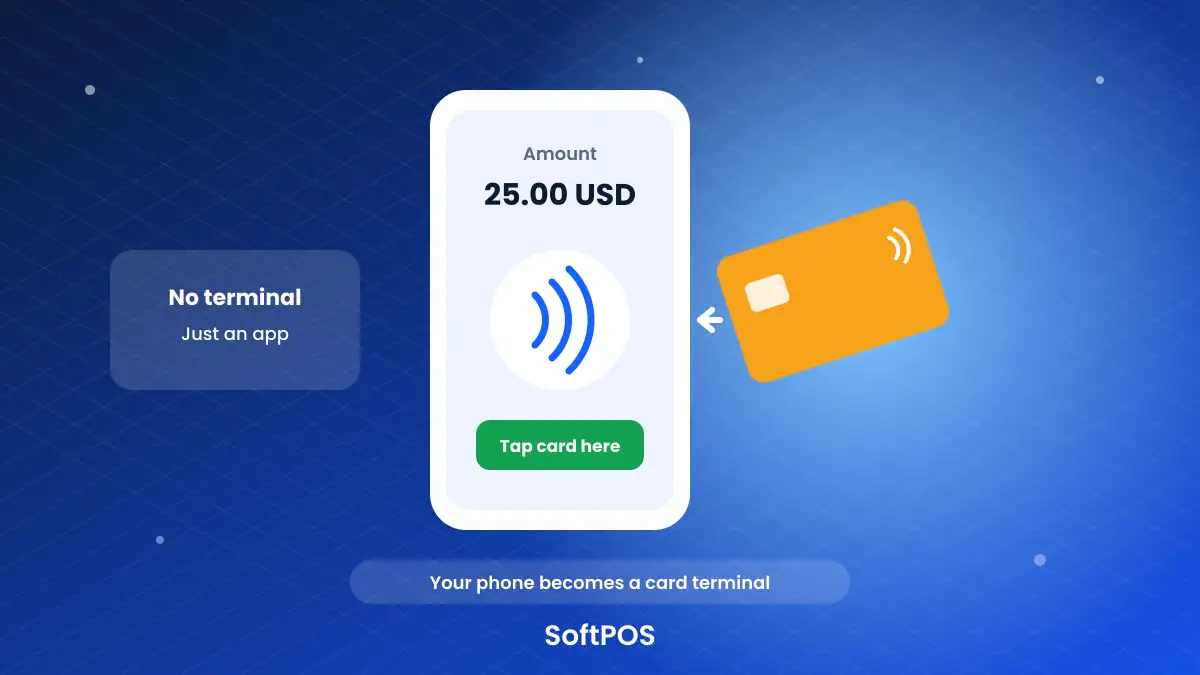
Quick answer: SoftPOS, short for software point of sale, is an app that turns an ordinary smartphone with NFC into a card terminal. Customers tap a contactless card or phone on the back of the merchant’s phone to pay. There is no extra hardware to buy, but both the phone and the customer’s card must support contactless payments.
In this guide
- What is SoftPOS?
- How SoftPOS works
- What you need to use SoftPOS
- SoftPOS vs a traditional POS terminal
- Why SoftPOS is growing
- SoftPOS in Nigeria
- Benefits and limits of SoftPOS
- How to use SoftPOS safely
- Frequently asked questions
- Key takeaways on SoftPOS
What is SoftPOS?
SoftPOS is software that lets a merchant accept card payments on a normal phone or tablet. Also, the card industry calls these everyday devices commercial off-the-shelf, or COTS, devices. Visa, which calls its version Tap to Phone, describes it as turning a smartphone into a POS device “simply by downloading an app”.
By contrast, a traditional POS terminal is dedicated hardware built only for payments. Our guide to how POS transactions work in Nigeria explains the usual process step by step.
In short, it moves the POS terminal from a separate box into an app.
How SoftPOS works
A typical payment follows five steps:
- Open the app. First, the merchant opens the app and enters the amount.
- Tap to pay. Next, the customer taps a contactless card, phone, or watch on the back of the merchant’s phone.
- Read the card securely. Then, the phone’s NFC chip reads the card, and the app encrypts the data straight away.
- Ask the bank. After that, the payment goes to the card network and the customer’s bank, which approves or declines it.
- Confirm the sale. Finally, the app shows the result and can send the customer a digital confirmation.
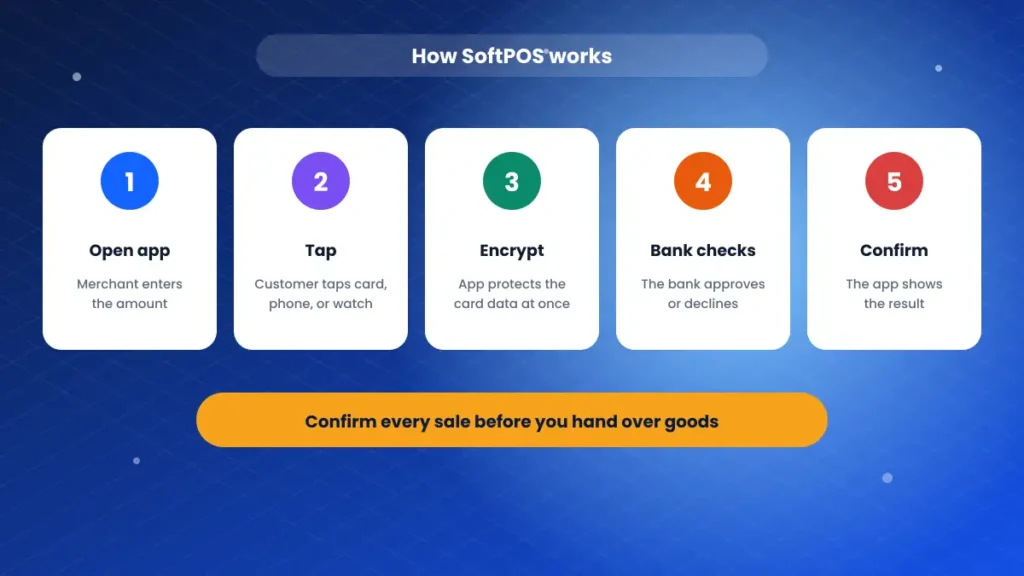
Importantly, the card data does not stay on the phone. Instead, the app protects it and passes it on for approval, much like a regular terminal. Our guide to what card authorisation is explains the approval step.
What you need to use SoftPOS
Before you start, check that you have these basics:
- A phone with NFC. Most of these apps in Nigeria run on Android phones with NFC switched on.
- A supported app. Usually, the app comes from your bank or payment provider.
- A business account. For example, ProvidusUnity Bank’s Soft POS needs a business account, which also receives your sales.
- A data connection. Also, the app needs the internet to send each payment for approval.
- Contactless customers. In addition, customers need a contactless card or a phone wallet such as Google Wallet.
Our guide to what contactless payment is explains how to check whether your card supports tap-to-pay.
SoftPOS vs a traditional POS terminal
Here is how SoftPOS compares with a regular POS terminal:
| Feature | Traditional POS terminal | SoftPOS |
|---|---|---|
| Hardware | A dedicated terminal | Your own NFC phone |
| Upfront cost | Buy or rent the terminal | Usually just an app download |
| Cards accepted | Chip, swipe, and contactless | Contactless only |
| PIN entry | On the terminal’s keypad | On screen, where supported |
| Printed slip | Usually yes | Usually a digital confirmation |
| Best for | Busy shops with many card users | Small sellers, deliveries, and events |
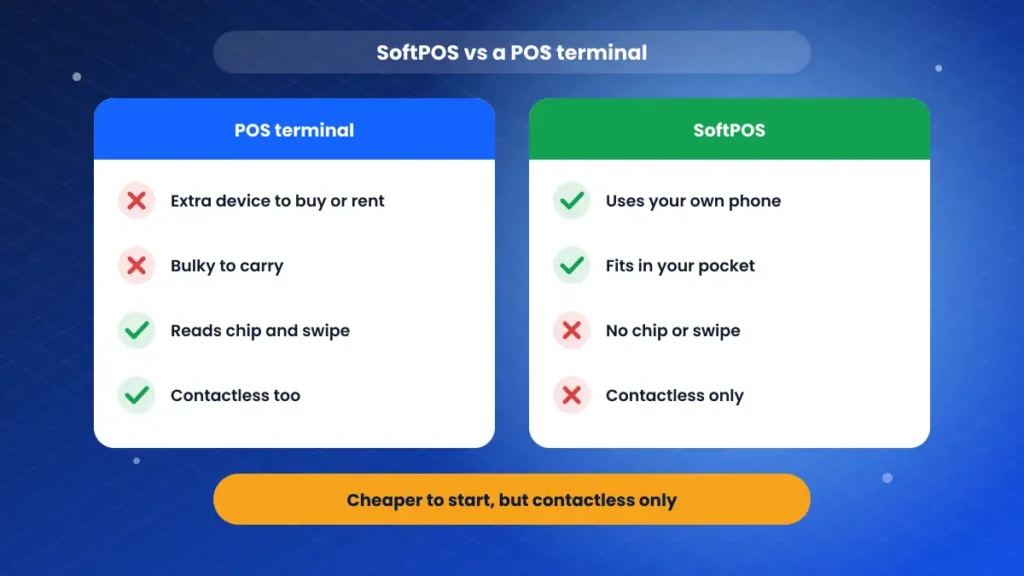
So, a phone terminal is cheaper and easier to carry. However, it cannot read chip cards that are inserted, which still matters in Nigeria. Our guide to what an EMV chip card is explains how chip payments differ.
Why SoftPOS is growing
Phone-based card acceptance is growing quickly around the world. For example, Visa reported in March 2025 that Tap to Phone use grew 200% year on year worldwide, and that nearly 30% of its Tap sellers were new small businesses.
Similarly, Juniper Research forecasts that SoftPOS transaction value will rise from $23.9 billion in 2025 to $540 billion in 2030, according to a Kiosk Industry summary. Meanwhile, Apple keeps adding countries to Tap to Pay on iPhone, including eight Latin American countries in September 2026.
Several reasons explain this growth. First, small sellers avoid the cost of a terminal. Second, delivery riders and market traders can take payments anywhere. Third, more customers now pay with phones and contactless cards.
SoftPOS in Nigeria
Nigeria has some SoftPOS options already. For instance, ProvidusBank launched a phone-based tap-to-pay service with Mastercard, Interswitch, and Thales in 2022, and Access Bank offers Visa’s Tap to Phone, Techpoint Africa reported.
However, contactless payments are still rare. According to the same report, contactless made up only about 0.1% of payments in Nigeria, and only about half of Android phones in the country have NFC. Google Wallet launched in Nigeria on 28 October 2026, but at first it supported only some cards from four banks.
As a result, phone terminals in Nigeria work best alongside transfers and QR payments for now. Moreover, the CBN’s 2025 rules require geo-tagging for payment terminals, but the TechAfrica News report does not say whether SoftPOS apps are covered. So, check with your provider.
Benefits and limits of SoftPOS
SoftPOS offers clear benefits for small businesses:
- Low start-up cost. In fact, you use a phone you already own.
- Easy to carry. Riders, traders, and event sellers can take payments anywhere.
- Fast set-up. Some providers activate a merchant profile within 48 hours.
- Modern payments. You can accept contactless cards, phones, and watches.
Still, it has limits:
- Contactless only. It cannot read inserted chip cards or swiped magnetic stripes.
- Few contactless cards yet. Many Nigerian customers still pay by transfer or by inserting a card.
- Battery and data. Also, a flat battery or weak network stops sales.
For other ways to get paid, see our guide to pay by bank and our guide on how to accept online payments.
How to use SoftPOS safely
SoftPOS apps must meet strict security standards. For example, the PCI Security Standards Council published the MPoC standard in 2022 for accepting contactless cards and PINs on everyday phones. Even so, follow these steps:
- Use a licensed provider. Download the app only from your bank or a licensed payment company through the official app store.
- Lock your phone. Use a PIN, fingerprint, or face unlock, and never leave the app open.
- Keep the phone updated. That is because updates fix security holes that criminals target.
- Check every approval. Confirm the sale in the app before you hand over goods.
- Watch for fake alerts. Never rely on a screenshot from the customer. Our guide on how to spot a fake bank alert shows you what to check.
- Avoid rooted or modified phones. Many of these apps refuse to run on them for security reasons.
Frequently asked questions
Can any phone work as a SoftPOS terminal?
No. First, the phone needs NFC, a supported operating system, and an approved app. In Nigeria, most options run on Android phones.
Can customers pay with their phones?
Yes, if their phone wallet holds a supported card. In fact, a phone tap works much like a contactless card tap.
Can I accept a card that is not contactless?
No. SoftPOS reads only contactless cards and devices. For other cards, you need a regular POS terminal or a transfer.
Is SoftPOS safe for my customers?
Yes, when you use an approved app. The app encrypts the card data, and the customer’s bank approves each payment.
Do I still need a POS terminal?
Overall, it depends on your customers. If most of them pay by transfer or chip card, a terminal or transfer option is still useful.
Key takeaways on SoftPOS
- SoftPOS turns an NFC phone into a card terminal through an app, with no extra hardware.
- Customers tap a contactless card, phone, or watch, and their bank approves the payment.
- It costs less to start than a POS terminal, but it accepts only contactless payments.
- Visa reported 200% growth in Tap to Phone use, but contactless is still rare in Nigeria.
- Use a licensed provider, lock your phone, and confirm every payment before you release goods.
Want to learn more about how payments are changing? Read our guides to network tokenisation and what a digital wallet is, or browse all our digital payments guides.