Every time you pay by card or send a transfer, a computer decides in a split second whether the payment looks like you. Increasingly, that computer uses artificial intelligence. This guide explains AI fraud detection: how it works, what it looks at, why it sometimes blocks genuine payments, what it cannot stop, and how to work with it.
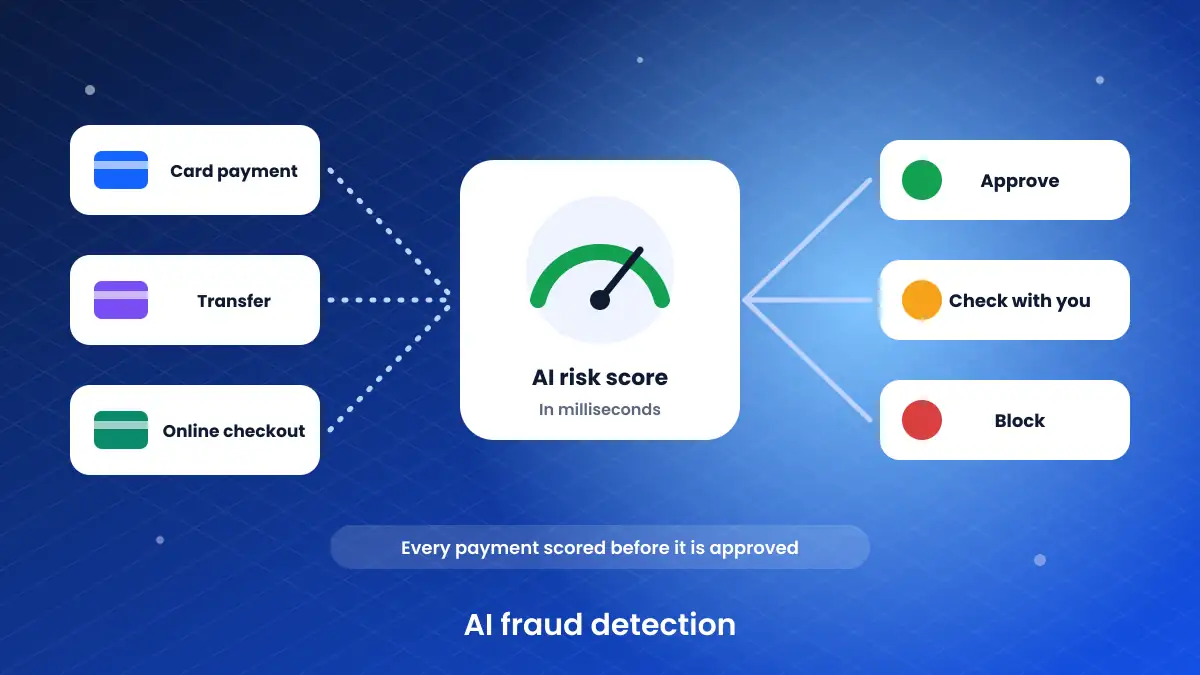
Quick answer: AI fraud detection uses machine learning to score each payment for risk in milliseconds. It compares the payment with your habits and with patterns from millions of known fraud cases. Then your bank approves it, asks you to confirm it, or blocks it. Visa says its system checks each card payment in about one millisecond, and most Nigerian fintechs now use AI for fraud checks.
In this guide
- What is AI fraud detection?
- How AI fraud detection works
- What the AI looks at
- Rules vs AI fraud detection
- AI fraud detection in practice
- Why a genuine payment may be blocked
- What AI fraud detection cannot stop
- How to work with your bank’s fraud checks
- Frequently asked questions
- Key takeaways on AI fraud detection
What is AI fraud detection?
AI fraud detection is the use of artificial intelligence, mainly machine learning, to spot fraudulent payments before the money moves. Instead of following a short list of fixed rules, the system learns from huge amounts of past data what normal and fraudulent payments look like.
For example, an older rule might say “block any card payment above a set amount from abroad”. By contrast, an AI model weighs hundreds of details at once. So, it can approve a large foreign payment that fits your travel plans, yet stop a small online purchase that looks wrong.
Banks, card networks such as Visa and Mastercard, payment switches, and fintech apps all use it. In fact, Visa says it first used neural networks to check transactions as far back as 1993.
How AI fraud detection works
Most systems follow the same five steps:
- You make a payment. First, you tap your card, pay online, or send a transfer.
- Data is collected. Next, the system gathers details such as the amount, the merchant, your device, and your location.
- The model scores the risk. Then, the AI compares the payment with your history and with known fraud patterns, and gives it a risk score.
- The bank decides. After that, your bank approves the payment, asks you to confirm it, or declines it.
- The system learns. Finally, confirmed fraud cases and genuine payments feed back into the model, so it keeps improving.
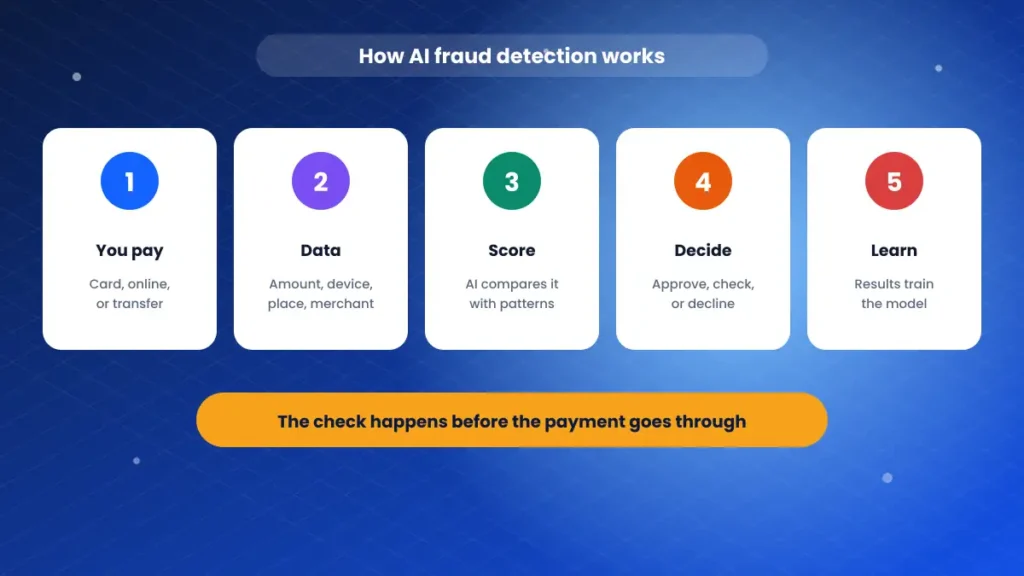
All of this happens while the payment is being authorised. Our guide to card authorisation explains that wider approval process.
What the AI looks at
A model can look at hundreds of signals. Visa, for instance, says its Advanced Authorization tool examines more than 500 risk attributes for each card payment, according to Visa. The most common signals include:
- Amount. Is it much larger than you usually spend?
- Location. Is the card being used in a city or country you have never visited?
- Device. Is the payment coming from your usual phone, or a new one?
- Merchant. Is the shop new to you, or linked to past fraud?
- Timing. Are there several payments in a few minutes, or one at an unusual hour?
- Behaviour. Does the way you type, swipe, or log in match your normal pattern?
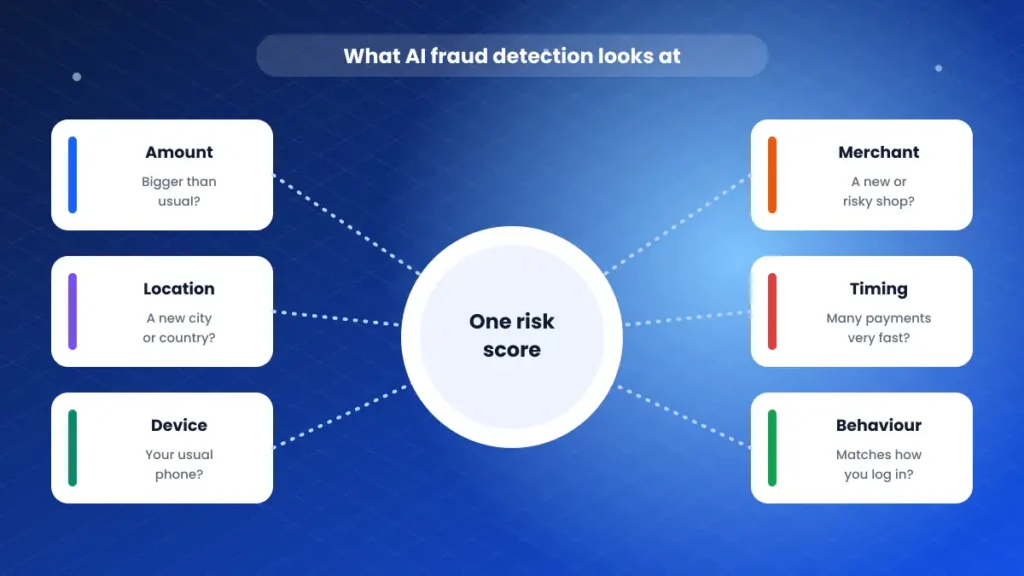
Here is a simple example. Customer 1 usually shops in Lagos during the day. One night, their card is used three times in ten minutes at an overseas electronics site, from a phone the bank has never seen. Each detail alone might pass. Together, however, they produce a high risk score, so the bank blocks the payment and sends an alert.
Rules vs AI fraud detection
Rule-based checks are still used, often alongside AI. Here is how the two compare:
| Feature | Fixed rules | AI fraud detection |
|---|---|---|
| How it decides | Follows set conditions | Weighs many signals together |
| New fraud tricks | Misses them until someone adds a rule | Can spot unusual patterns it has not seen before |
| Genuine payments blocked | Often, because rules are blunt | Fewer, because it knows your habits |
| Speed | Fast | Fast, often within milliseconds |
| Easy to explain | Yes | Harder, which is why regulators ask for transparency |
In short, rules are simple and clear, while AI is more accurate but harder to explain. As a result, many banks use both.
AI fraud detection in practice
Card networks and banks report large results, although most figures come from the companies themselves:
| Who | What they report |
|---|---|
| Visa | AI checks each card payment in about one millisecond; Visa says it helped block about $40 billion in fraud in 2023 |
| Mastercard | Decision Intelligence scores 143 billion payments a year; its generative AI upgrade raised fraud detection by 20% on average in early modelling |
| UK banks | Stopped about 70 pence of every pound of attempted unauthorised fraud in 2025 |
| Nigeria | 87.5% of fintechs surveyed by the CBN use AI for fraud detection |
Mastercard also said its upgrade cut genuine payments wrongly flagged as fraud by more than 85%, according to its February 2024 announcement. Similarly, in 2024, Visa added a tool that uses AI to score instant account-to-account payments, not only cards, Gulf News reported.
In Nigeria, the CBN’s Fintech Report 2025 found fraud detection was the main use of AI among fintechs, Ecofin Agency reported. However, the report also called fraud a major issue for the industry. Meanwhile, in the UK, banks prevented £1.68 billion of unauthorised fraud in 2025, according to a summary of the UK Finance report.
Why a genuine payment may be blocked
No system is perfect. Sometimes AI fraud detection flags a payment that is really yours. This is called a false positive, or a false decline. It often happens when you:
- travel to a new country or city;
- make a much larger purchase than usual;
- shop with a new online merchant;
- use a new phone or a new browser; or
- make several payments quickly.
If this happens, check your banking app or text messages for an alert. Usually, you can confirm the payment is yours and try again. Our guide to why card transactions get declined covers other reasons too.
What AI fraud detection cannot stop
AI is good at spotting payments that do not look like you. However, it struggles when the payment really is from you:
- Scams that trick you into paying. If a scammer persuades you to send money yourself, the payment comes from your phone and your account. Our guide to authorised push payment fraud explains these scams.
- Deepfake calls. Criminals now use AI too. Fake voices and videos can pressure you into acting fast, as our guide to deepfake scams shows.
- Stolen phones and codes. If a criminal has your unlocked phone and your PIN, the payment may look normal.
- Brand-new tricks. A model learns from the past, so a completely new scam may slip through at first.
That is why banks combine AI with other protections, such as device binding, network tokenisation, and passkeys for payments.
How to work with your bank’s fraud checks
A few habits help AI fraud detection protect you, without blocking your genuine payments:
- Keep your contact details up to date. Your bank needs to reach you quickly if it flags a payment.
- Turn on transaction alerts. Then, you will see every payment as it happens.
- Reply to fraud alerts only through official channels. Use your banking app or the number on your card, never a link in a text.
- Tell your bank before you travel. Some banks still use this to adjust their checks.
- Use one trusted phone for banking. A familiar device lowers your risk score.
- Report fraud at once. Your report also helps train the system to catch the next case.
Our guide on how to protect your bank account online lists more settings worth switching on.
Frequently asked questions
Does AI check every payment I make?
Most large banks and card networks score every card payment and many transfers. Visa, for example, says its AI analyses all transactions on its network.
Can AI fraud detection see my personal messages?
No. It uses payment data, such as the amount, merchant, device, and location. It does not read your chats or emails.
Why did my bank block a payment that was mine?
The payment probably looked unusual, for example, a large amount, a new merchant, or a new country. Confirm it through your banking app, then try again.
Will AI fraud detection refund money I lose?
No. AI tries to stop fraud before it happens. Refunds depend on your bank’s rules and the type of fraud, so report any loss to your bank at once.
Do Nigerian banks use AI fraud detection?
Many do. In a CBN survey, 87.5% of fintechs said they use AI for fraud detection, and card payments on Visa and Mastercard are also checked by the networks’ own AI.
Key takeaways on AI fraud detection
- AI fraud detection scores each payment for risk in milliseconds, using hundreds of signals.
- It compares a payment with your habits and with patterns from known fraud.
- Your bank then approves the payment, asks you to confirm it, or blocks it.
- It sometimes blocks genuine payments, so keep your contact details current and respond to alerts safely.
- It cannot stop scams that trick you into paying, so always check who you are sending money to.
Want to learn more about how payments are protected? Read our guides to what fintech is and how to spot a fake bank alert, or browse all our AI and productivity guides.