If you sell online, you will hear both terms within your first week: payment gateway and payment processor. Many people use them as if they mean the same thing, but they do two different jobs in the same payment. This guide puts payment gateway vs payment processor side by side, follows one ₦25,000 order through both, and helps you decide what your business actually needs to sign up for.
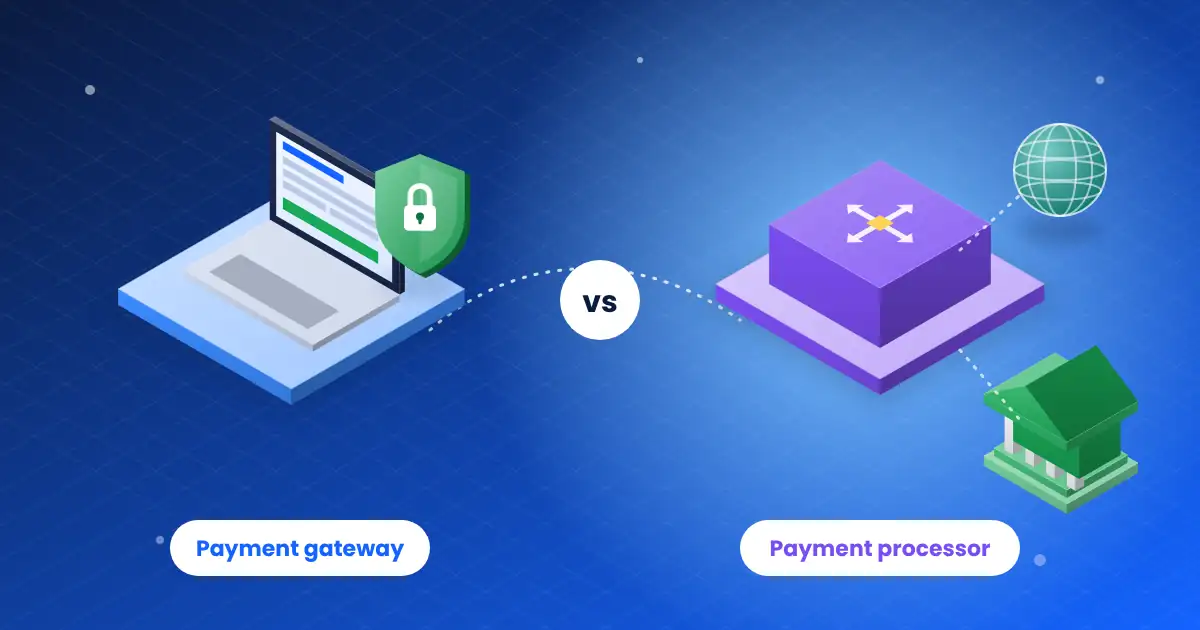
Quick answer: In the payment gateway vs payment processor question, the gateway is the front door and the processor is the engine room. The gateway collects and protects the customer’s card or bank details on your website or app and shows the result. The processor carries that request to the card network and the customer’s bank, brings back the approval, and later settles the money. In Nigeria, providers such as Paystack and Flutterwave give you both in one sign-up, so most small businesses only need one provider.
In this guide
- Payment gateway vs payment processor: the short answer
- What a payment gateway does
- What a payment processor does
- Following one ₦25,000 order through both
- Do you need a payment gateway, a payment processor, or both?
- Questions to ask a payment provider
- Security: who protects the card data?
- Frequently asked questions
- Key takeaways
Payment gateway vs payment processor: the short answer
Think of a restaurant. The waiter takes your order at the table and brings your food back. The kitchen, which you never see, actually prepares the meal. In this picture, the payment gateway is the waiter and the payment processor is the kitchen.
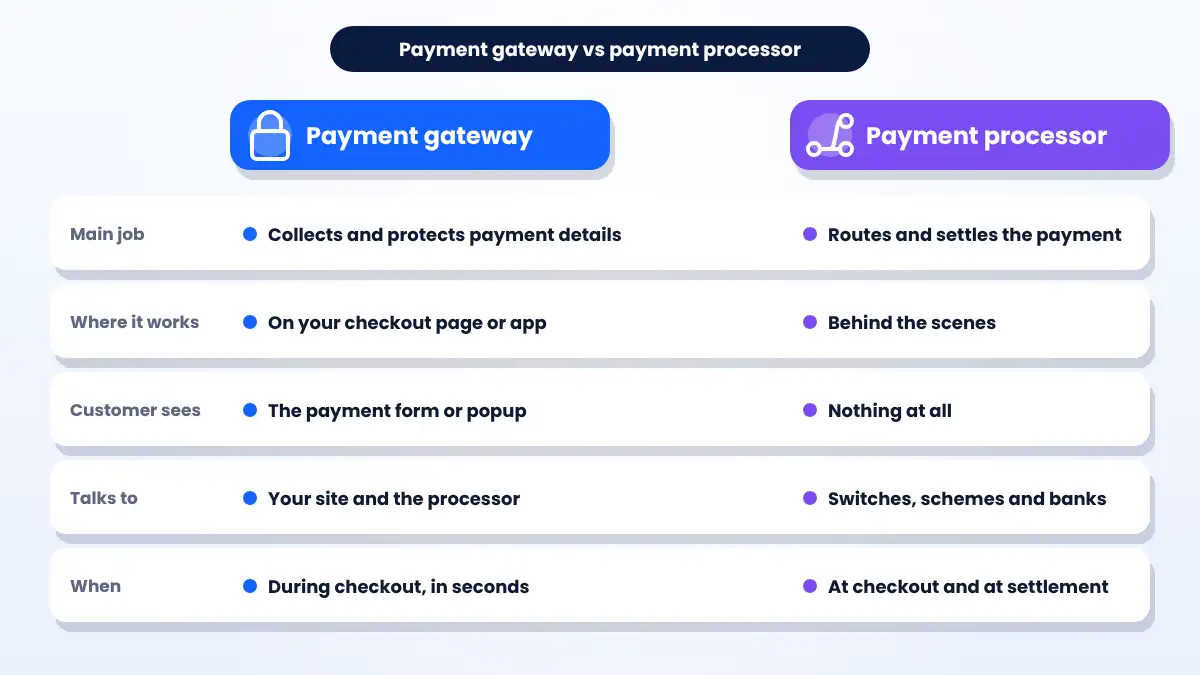
| Payment gateway | Payment processor | |
|---|---|---|
| Main job | Collects and protects payment details | Routes the payment and moves the money |
| Where it works | On your checkout page or app | Behind the scenes, between banks and card networks |
| What the customer sees | The payment form, popup or redirect page | Nothing at all |
| Handles card data | Captures it and turns it into a token | Receives it securely from the gateway |
| Talks to | Your website and the processor | Card schemes, switches, issuing and acquiring banks |
| When it works | During checkout, in seconds | During checkout and later, at settlement |
| Payment types | Online and in-app payments | Online, POS, ATM and other channels |
So a gateway is mainly an online tool. A processor, by contrast, sits behind almost every card payment, including the ones made at a POS terminal in a shop.
What a payment gateway does
A payment gateway is the part of the payment you can see. When a customer clicks “Pay”, the gateway:
- Shows the payment form. It can be a popup, an embedded form, or a redirect to the provider’s own page.
- Collects the details. The customer enters a card number, picks a bank, or chooses a transfer.
- Protects the data. It encrypts the details and often replaces the card number with a token, so your website never stores it. The gateway talks to your website through an API; our guide to what an API is explains how.
- Hands the request on. It passes the protected request to the processor.
- Shows the result. It tells the customer “Payment successful” or explains why the payment failed.
For a fuller explanation, read our guide to what a payment gateway is.
What a payment processor does
The payment processor does the heavy lifting that nobody sees. First, it formats the request into a message that banks and card schemes understand. Next, it sends that message through a payment switch and the card network to the customer’s bank. Then it returns the approval or decline to the gateway.
Its work does not end at checkout. Later, the processor also handles clearing and settlement, which is the process that moves the money from the customer’s bank to the merchant’s account. Our guide to what a payment processor is covers front-end and back-end processing in more detail.
Following one ₦25,000 order through both
Here is an illustrative example. Chidi orders shoes worth ₦25,000 from an online store that uses one Nigerian payment provider.
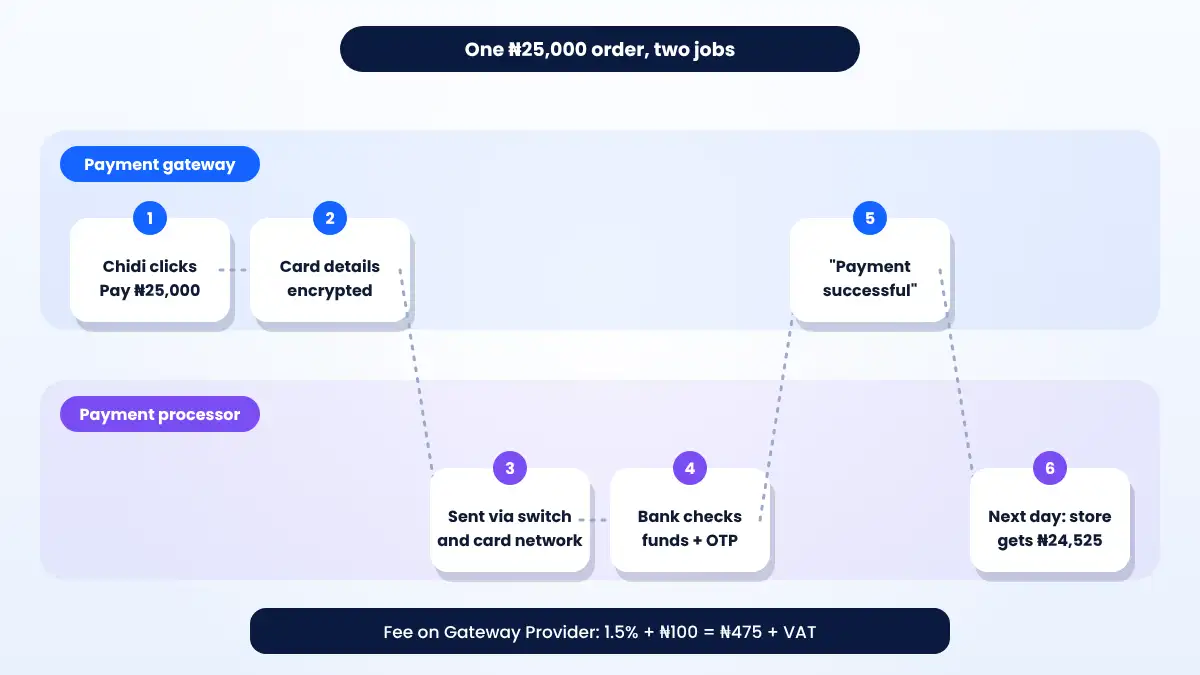
- Gateway: Chidi clicks “Pay ₦25,000”, and the payment popup opens on the store’s website.
- Gateway: He enters his card details and his PIN. The gateway encrypts them at once.
- Processor: The processor sends the request through the switch and card network to Chidi’s bank.
- Processor: His bank checks the balance and sends an OTP. After he enters it, the bank approves the payment.
- Gateway: The popup shows “Payment successful”, and the store receives a notification to confirm the order.
- Processor: Later, usually the next working day, the processor settles the money into the store’s account, minus the fee.
Fees vary by provider, so here is an illustration. Say the store’s provider charges 1.5% plus ₦100 per local payment, capped at ₦2,000. On this order, that comes to ₦475, so the store receives ₦24,525. The store pays one fee, even though two jobs were done. Always confirm your provider’s current rates, and check whether VAT is charged on top, because bank and provider fees in Nigeria usually attract 7.5% VAT.
Do you need a payment gateway, a payment processor, or both?
Every online card payment needs both jobs done. However, you rarely have to sign up for them separately.
| Your situation | What you usually need |
|---|---|
| Small online shop or new startup | One all-in-one provider, such as Paystack or Flutterwave, that offers both |
| Business that sells mainly in shops | A POS terminal from your bank or a provider; the processor sits behind it |
| Large business with high volumes | Sometimes a separate gateway and processor, to negotiate fees and add backup routes |
| Marketplace or app with many sellers | A provider that supports split payments and subaccounts |
In practice, Nigerian providers such as Paystack and Flutterwave act as both gateway and processor, and some now hold a CBN switching and processing licence too. So for most small businesses, the payment gateway vs payment processor choice is really a choice of one provider. Larger merchants that use several providers often add payment orchestration to route payments between them.
Questions to ask a payment provider
Before you sign up, ask these questions. They matter more than the name on the box.
- Which channels do you support? Check cards, bank transfers, USSD, and virtual accounts.
- What is the full fee? Ask for the percentage, the flat fee, any cap, and whether VAT is extra.
- How fast do you settle? Also ask what happens on weekends and public holidays.
- How do refunds and chargebacks work? Find out who pays the fee when a customer disputes a payment. Our chargeback ratio calculator helps you watch your dispute rate.
- Which checkout options do you offer? A popup or a redirect keeps card data off your servers.
- Is there a test mode? You should be able to test payments before you go live.
You can compare the real cost of each option with our payment processing fee calculator.
Security: who protects the card data?
Card data must be protected under the PCI DSS security standard. The good news is that a well-built gateway takes most of that burden off you. Our free PCI DSS readiness checklist helps you see what is left.
When you use a provider’s hosted page or redirect, the card number goes straight to the provider, and your website never sees it. As a result, many small merchants can use the shortest PCI self-assessment, called SAQ A. If you embed the provider’s payment form in an iframe instead, the PCI Security Standards Council says you must also make sure your page is protected from malicious scripts, according to its FAQ on SAQ A eligibility.
Either way, never store card numbers, CVVs, or PINs on your own system. Let the gateway handle them.
Frequently asked questions
Is Paystack a payment gateway or a payment processor?
Both. Paystack gives you a checkout gateway for your website or app, and it also processes and settles the payments. That is why most businesses only need one Paystack account.
Can I use a payment gateway without a payment processor?
No. A gateway on its own can only collect payment details. Something still has to carry the request to the bank and settle the money, so every gateway works with a processor, whether its own or a partner’s.
Is a payment processor the same as an acquirer?
Not quite. The acquirer is the bank that holds the merchant’s account and takes responsibility for the merchant. The processor does the technical work, often on the acquirer’s behalf. Our guide to what a card acquirer is explains the difference.
Which is cheaper, a gateway or a processor?
You usually pay one combined fee to your provider, not two. However, large businesses that connect to a processor directly can sometimes negotiate lower rates.
Do POS payments use a payment gateway?
Not in the usual sense. In a shop, the POS terminal does the gateway’s job of reading the card. The processor and switch still work behind it, as our guide to how POS transactions work shows.
Key takeaways
- In payment gateway vs payment processor, the gateway collects and protects payment details, while the processor routes the payment and settles the money.
- The gateway is what your customer sees; the processor works behind the scenes.
- Every online card payment needs both, but providers such as Paystack and Flutterwave offer both in one account.
- Compare providers on channels, the full fee including VAT, settlement speed, refunds, and checkout security.
- Use a hosted or redirect checkout so card data never touches your own servers.